How to Choose Exercises for Muscle Growth
How to choose exercises for muscle growth is one of the most important — and most misunderstood — aspects of hypertrophy training.
Many lifters spend countless hours searching for the “best” exercises, often assuming there is one perfect movement for every muscle group. In reality, muscle growth is rarely determined by a single exercise. Instead, it depends on whether an exercise allows you to apply sufficient tension, train hard, recover effectively, and progressively improve over time.
The goal of exercise selection is not to find magical exercises. The goal is to build a training program filled with movements that consistently deliver a strong stimulus while keeping fatigue manageable.
This article explains how to evaluate exercises for hypertrophy and how to make smarter exercise choices based on current evidence and practical experience. For a complete overview of evidence-based muscle-building principles, see our Hypertrophy Training Hub.
TL;DR
- Most exercises can build muscle if they are trained hard enough and progressed over time.
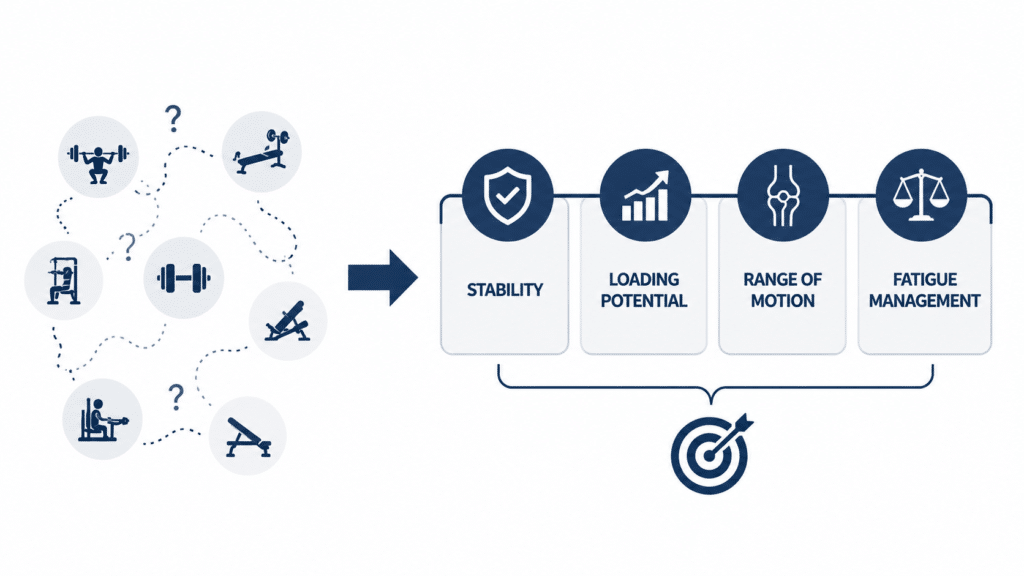
- The best exercises usually combine stability, sufficient range of motion, high loading potential, and manageable fatigue.
- Exercises should be selected based on how effectively they train the target muscle, not how impressive they look.
- Compound and isolation exercises both have valuable roles in hypertrophy programs.
- A slightly less effective exercise that you can perform consistently is often better than a theoretically perfect exercise that causes discomfort or excessive fatigue.
What Makes an Exercise Good for Muscle Growth?
When evaluating exercises, many lifters focus on factors that matter less than they think.
For example, an exercise is not automatically superior because it allows heavy loads, creates soreness, feels difficult, or is popular on social media.
Instead, effective hypertrophy exercises tend to share several characteristics:
- They create high levels of tension in the target muscle.
- They are stable enough to allow hard effort.
- They are easy to standardize and progress.
- They provide a useful range of motion.
- They generate an appropriate stimulus without excessive fatigue.
These characteristics make it easier to accumulate productive training volume and apply progressive overload over time.
Rather than asking “Is this exercise the best?”, a better question is:
“Does this exercise help me stimulate the target muscle effectively while supporting long-term progression?”
The Importance of Stimulus-to-Fatigue Ratio
One useful framework for exercise selection is the concept of stimulus-to-fatigue ratio.
In simple terms, this refers to how much hypertrophy stimulus an exercise provides relative to the fatigue it creates.
Two exercises may stimulate a muscle similarly, yet one may generate far more systemic fatigue, joint stress, or recovery demands.
For example, both Romanian deadlifts and conventional deadlifts train the posterior chain. However, many lifters find Romanian deadlifts provide a strong hamstring stimulus with less overall fatigue.
This does not automatically make Romanian deadlifts “better,” but it highlights an important principle:
The most productive exercises are not always the exercises that feel hardest.
As training volume increases, exercise selection becomes increasingly important because fatigue management directly affects recovery and future performance.
This is closely related to concepts such as Minimum Effective Volume (MEV), Maximum Recoverable Volume (MRV), and training volume for muscle growth.
Factor #1: Stability
Stable exercises generally allow greater focus on the target muscle because less effort is spent on balance and coordination.
This is one reason machine-based exercises can be highly effective for hypertrophy despite sometimes being viewed as less “functional.”
When stability increases, it often becomes easier to train closer to failure while maintaining technique.
For example:
- A chest-supported row is often easier to push hard than a bent-over row.
- A hack squat may allow more quad-focused effort than a free-weight squat for some lifters.
- A machine chest press may permit greater chest fatigue than a standing cable press.
More stability does not automatically mean more muscle growth. However, when two exercises target the same muscle similarly, the more stable option often allows higher quality effort and more consistent execution.
This becomes especially relevant when applying concepts such as training to failure and effective reps.
Factor #2: Loading Potential
A good hypertrophy exercise should allow clear and measurable progression.
If an exercise is difficult to standardize or impossible to overload consistently, it becomes harder to track whether meaningful progress is occurring.
Loading potential refers to how easily an exercise can be progressed over time through:
- Additional load
- Additional repetitions
- Improved technique
- Greater control
- Increased training volume
Exercises with high loading potential tend to remain useful for long periods because they provide clear opportunities for progression.
This does not mean every exercise must become dramatically heavier. The key is that performance improvements can be measured and repeated over time.
Factor #3: Range of Motion
Range of motion is one of the most frequently discussed variables in hypertrophy training.
In general, exercises that allow a muscle to work through a larger range of motion tend to provide more opportunities to generate tension across different muscle lengths.
However, more range of motion is not automatically better in every situation.
The most productive range of motion is one that can be performed safely, consistently, and under control while maintaining tension in the target muscle.
For example, a deep squat may provide an excellent stimulus for the quadriceps and glutes. However, if a lifter loses stability, experiences pain, or significantly alters technique at the bottom position, a slightly reduced range may be more productive.
The goal is not to maximize range of motion at all costs. The goal is to maximize productive tension throughout a repeatable range of motion.
This concept becomes especially important when evaluating exercises that appear similar but differ substantially in how much muscle length they expose the target muscle to.
Factor #4: Lengthened Tension
Recent hypertrophy research has increased interest in exercises that challenge muscles in a lengthened position, including methods such as lengthened partials.
Many muscles appear to respond particularly well when significant tension is present at longer muscle lengths.
Examples include:
- Romanian deadlifts for the hamstrings
- Incline dumbbell curls for the biceps
- Overhead triceps extensions for the long head of the triceps
- Deep squats and leg presses for the quadriceps
This does not mean that every exercise must emphasize the lengthened position.
Instead, lengthened tension should be viewed as one factor among many when selecting exercises.
An exercise that provides slightly less lengthened tension but allows better stability, progression, and recovery may still be the better overall choice.
Similarly, shortened-position exercises can remain valuable for accumulating volume, improving technique, and targeting muscles from different angles.
The key takeaway is that exercise selection should consider where an exercise is hardest, not just which muscles it trains.
Factor #5: Joint Comfort and Individual Differences
One of the biggest mistakes lifters make is assuming that a highly effective exercise for one person must also be the best exercise for everyone else.
Human anatomy varies.
Limb lengths, joint structures, mobility restrictions, injury history, and individual comfort all influence how exercises feel and perform.
A movement that feels excellent for one lifter may feel awkward or painful for another.
This is why intelligent exercise selection always includes an element of individualization.
If an exercise consistently causes joint discomfort, excessive irritation, or recurring pain, there is usually little reason to force it into a hypertrophy program.
In most cases, a comparable alternative exists.
For example:
- A machine press can replace a barbell press.
- A chest-supported row can replace a bent-over row.
- A hack squat can replace a back squat.
- A cable exercise can replace a dumbbell variation.
Muscles do not know which exercise you are performing.
They only respond to tension, effort, and recovery.
Compound vs Isolation Exercises
One of the most common exercise-selection questions is whether compound exercises are superior to isolation exercises for hypertrophy.
The reality is that both serve important roles.
Compound exercises allow multiple muscle groups to be trained simultaneously and are often efficient for accumulating training volume.
Examples include:
- Squats
- Leg presses
- Rows
- Pull-ups
- Bench presses
- Overhead presses
Isolation exercises focus more directly on a single muscle or movement pattern.
Examples include:
- Leg extensions
- Leg curls
- Biceps curls
- Triceps extensions
- Lateral raises
- Cable flyes
Most successful hypertrophy programs use both.
Compound exercises often form the foundation of a program, while isolation exercises help increase volume and target muscles that may not receive enough stimulus from compound lifts alone.
This is one reason why exercise selection should always be considered within the context of the entire program rather than evaluating exercises in isolation.
How Exercise Selection Fits Into Program Design
Exercise selection does not exist independently of the rest of your training variables.
Every exercise affects:
- Training volume
- Recovery demands
- Fatigue accumulation
- Exercise order
- Session length
- Progression opportunities
This is why exercise selection should always support the overall structure of your training program.
An exercise that looks great in theory may become problematic if it creates excessive fatigue relative to its benefit.
Likewise, a slightly less exciting exercise may become extremely valuable because it allows more productive weekly volume.
This idea connects directly to hypertrophy program design, volume versus intensity, and training frequency.
Good exercise selection is not about finding perfect exercises.
It is about finding exercises that fit the system.
Practical Guidelines for Exercise Selection
You do not need perfect exercises.
You need exercises that allow you to train hard, recover well, and make measurable progress over time.
Start with a problem you can actually observe. The examples below turn the selection criteria into a change you can test.
| What you notice | A change to try | What to compare next time |
|---|---|---|
| Your lower back ends a row before your intended back muscles | Try a chest-supported row; support addresses the observed limitation. | Use a repeatable setup and check whether you can finish the intended reps without the same lower-back limit. |
| Grip consistently ends pulling work first | Consider lifting straps for the target sets when back or hamstring training is the priority. | Check whether grip was actually the limiting factor. Keep exercise technique and effort comparable. |
| A machine path feels awkward despite adjusting the seat and handles | Try a different machine, cable or dumbbell variation that lets you use a comfortable, repeatable range. | Record the setup and range you can repeat. A heavier stack number is not evidence that the replacement is better. |
| The next weight increase causes a large drop in reps or control | Progress reps within your chosen range, or use smaller load increments where the equipment permits. | Keep range of motion and effort consistent so the progression is meaningful. |
| One movement leaves a gap in the muscle actions you train | Check the exercise guides for a complementary movement; for example, compare your hip-hinge work with a leg curl. | Choose the extra exercise for a clear role, and count its sets in the existing weekly total. |
These are practical selection examples, not a validated ranking or proof of superior growth. Change one main variable at a time, give an unfamiliar exercise time to become repeatable, and use several sessions of performance and recovery notes before judging it. Apply the following checks to whichever option you choose:
- Prioritize exercises that clearly target the intended muscle.
- Favor stable exercises when hypertrophy is the primary goal.
- Choose movements that allow consistent progression.
- Use a productive range of motion you can repeat reliably.
- Consider both stimulus and fatigue cost.
- Avoid exercises that consistently irritate joints or create unnecessary discomfort.
- Keep successful exercises in your program long enough to measure progress.
Many lifters make the mistake of changing exercises too frequently.
If an exercise is producing results, there is often little reason to replace it simply because a new variation appears online.
Consistency makes progression easier to track and helps determine whether an exercise is actually contributing to muscle growth.
Do You Need the “Best” Exercises?
Probably not.
Most lifters spend far too much time searching for perfect exercises and far too little time improving performance on the exercises they already use.
The difference between two reasonably effective exercises is often much smaller than the difference between consistent and inconsistent training.
A good exercise performed consistently for months will almost always outperform a theoretically perfect exercise that is changed every few weeks.
This is one reason why long-term progression remains more important than endlessly optimizing exercise selection.
Why It Matters
Exercise selection influences every major component of hypertrophy training.
It affects:
- The quality of your training stimulus
- Your ability to apply progressive overload
- Your recovery demands
- Your training volume tolerance
- Your long-term consistency
The best exercises are not necessarily the most popular exercises.
They are the exercises that allow you to train the target muscle effectively, recover successfully, and improve over time.
When exercise selection is viewed through that lens, training becomes far simpler.
Instead of chasing perfect exercises, you can focus on building a program that consistently produces results.
FAQ
What are the best exercises for muscle growth?
The best exercises for muscle growth are exercises that allow high levels of muscular tension, consistent progression, adequate stability, and manageable fatigue. There is no single best exercise for every lifter.
Are machines better than free weights for hypertrophy?
Not necessarily. Both machines and free weights can build muscle effectively. Machines often provide greater stability, while free weights may offer additional versatility. The best choice depends on the muscle being trained and the individual’s goals.
Do compound exercises build more muscle than isolation exercises?
Compound exercises are highly efficient because they train multiple muscle groups simultaneously. However, isolation exercises can be valuable for increasing volume and targeting muscles more directly. Most hypertrophy programs benefit from both.
How often should I change exercises?
Most exercises should be kept long enough to evaluate progression across multiple weeks. Frequent exercise changes make it harder to track performance improvements and determine what is driving results.
Does soreness mean an exercise is effective?
No. Soreness is not a reliable indicator of muscle growth. Effective exercises create sufficient tension and allow progression over time, regardless of how much soreness they produce.
References
- Schoenfeld BJ. The Mechanisms of Muscle Hypertrophy and Their Application to Resistance Training. Journal of Strength and Conditioning Research. 2010.
- Schoenfeld BJ, Ogborn D, Krieger JW. Dose-Response Relationship Between Weekly Resistance Training Volume and Increases in Muscle Mass. Journal of Sports Sciences. 2017.
- Schoenfeld BJ, Grgic J, Van Every DW, Plotkin DL. Loading Recommendations for Muscle Strength, Hypertrophy, and Local Endurance. Journal of Human Kinetics. 2021.
- Nunes JP, Ribeiro AS, Schoenfeld BJ, et al. Resistance Training Performed to Failure or Not to Failure Results in Similar Muscle Hypertrophy. Journal of Strength and Conditioning Research. 2022.