Optimal Training Volume for Hypertrophy: How to Find What Works for You
Optimal training volume for hypertrophy is one of the most important — and most misunderstood — variables in muscle growth.
Most lifters focus on how many sets they should perform. But volume alone does not determine hypertrophy.
What matters is how much effective volume you accumulate — volume that creates sufficient mechanical tension and is performed close enough to failure to stimulate growth.
This is why the real question is not:
“How many sets should I do?”
But rather:
How much volume can I perform that produces growth while still allowing me to recover?
That is what defines your optimal training volume.
TL;DR
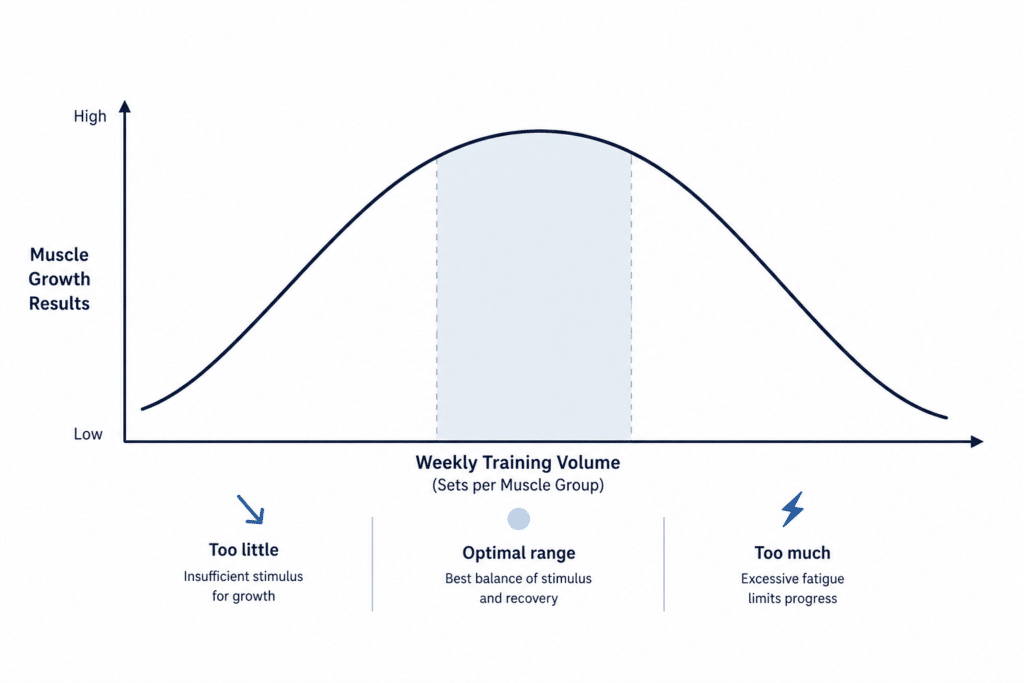
- Optimal training volume lies between MEV and MRV.
- Too little volume means insufficient stimulus for growth.
- Too much volume means fatigue can outweigh the stimulus.
- Research supports a broad dose-response relationship, but not one universal optimal number.
- Around 10 challenging sets per muscle group per week is a useful general reference — not a universal minimum or ceiling.
- Beginners may need less, while more experienced lifters may need more.
- Optimal volume is individual and changes over time.
- For practical tracking, count direct work fully and relevant indirect work as roughly half a set.
- Use progress and recovery to decide whether to add, maintain, or reduce volume.
Watch: How to Find Your Optimal Training Volume
Prefer to watch? This video walks you through five practical questions for finding your optimal training volume—without assuming that more sets automatically lead to more muscle growth.
Conceptual Foundation
Training volume is typically defined as the number of hard sets performed per muscle group per week.
However, volume alone does not determine hypertrophy. It interacts with:
- Training intensity (load and effort)
- Exercise selection
- Recovery capacity
For hypertrophy to occur, training volume must exceed a minimum threshold known as Minimum Effective Volume (MEV) — the lowest amount of training volume that produces measurable muscle growth.
As volume increases beyond MEV, hypertrophy stimulus generally increases.
However, this relationship is not linear indefinitely.
At some point, additional volume produces diminishing returns and increasing fatigue.
This upper limit is referred to as Maximum Recoverable Volume (MRV) — the highest amount of training volume you can recover from.
Between MEV and MRV lies your:
Optimal training volume range
Evidence Review
Current research supports a general dose-response relationship between training volume and hypertrophy.
Studies comparing low vs moderate volume consistently show that higher volume produces greater muscle growth — up to a point.
However, the relationship plateaus at higher volumes.
As training volume increases, recovery capacity becomes increasingly important for sustaining long-term progress.
When volume becomes excessive:
- Fatigue accumulates
- Systemic fatigue can increase
- Recovery capacity is exceeded
- Training performance declines
This means that more volume does not always lead to more hypertrophy.
The goal is not to maximize volume — but to optimize it within recoverable limits.
System-Level Implications
Optimal training volume is not a fixed number.
It is a dynamic range that varies based on the individual and context.
Research is often summarized as supporting a broad range of around 10–20 hard sets per muscle group per week. However, this should not be treated as a universal starting prescription or a guaranteed optimal range for every lifter.
For practical programming, a useful general reference is:
- Around 10 challenging sets per muscle group per week
This is not a universal minimum, ceiling, or guaranteed optimum. Beginners may grow with less, while experienced lifters may sometimes benefit from more. Use it as a reference that gives you room to monitor progress and recovery before making the smallest justified adjustment.
Because compound exercises also provide indirect work to other muscles, your total training stimulus may be higher than the number of direct sets alone suggests.
However, this range is highly dependent on:
- Training experience
- Proximity to failure
- Exercise selection
- Frequency
- Sleep and nutrition
The same volume can be optimal in one phase and excessive in another.
This is why volume must be adjusted over time rather than treated as a constant.
Volume should also be interpreted alongside volume vs intensity for hypertrophy, as both variables interact to determine total hypertrophy stimulus.
Practical Implementation
1. What actually counts as a set?
Not every set in your workout should count equally toward a muscle’s weekly volume.
A set is most useful to count when the target muscle is meaningfully loaded, the set is performed with stable technique, and it is taken close enough to failure to provide a meaningful hypertrophy stimulus.
- Direct sets train the target muscle as a primary mover — for example, a biceps curl for the biceps. Count these as one set.
- Indirect sets train the muscle as a secondary contributor — for example, a row for the biceps. As a practical estimate, count relevant indirect work as roughly half a set.
- Warm-up sets, very easy sets, and technique practice generally should not be counted as hard hypertrophy sets.
Do not automatically count every compound set as one full set for every muscle involved. The half-set rule is an estimate, not a biological law, but it is more useful than treating indirect work as either zero or a full direct set.
2. Where should you start?
If your current volume is producing progress and you are recovering well, keep it. If you need a starting point, use around 10 challenging sets per muscle group per week as a general reference — not a universal minimum or ceiling.
Keep the plan stable long enough to identify a meaningful trend. Do not add sets simply because one workout feels easy or because progress slows briefly.
Start lower when you are newer to training, your sets are taken very close to failure, your exercises create substantial fatigue, or your recovery is limited. A muscle that already receives substantial indirect work may also need fewer direct sets. More experienced lifters may sometimes need more. The goal is to establish a recoverable baseline that gives you room to adjust.
3. Are you still making progress?
Your optimal volume is best judged by what happens to your performance over time — not by how exhausted or sore one workout makes you feel.
- Are you adding repetitions with the same load?
- Are you adding load while maintaining your repetitions?
- Is your technique stable or improving?
- Are you achieving the same performance at a similar proximity to failure?
- Are your target muscles progressing across repeated sessions?
A single poor workout is not a plateau. Look for a consistent trend under comparable conditions. If progress has genuinely stalled for two or three weeks, move on to the recovery check before changing the program.
4. Are you recovering between workouts?
Performance tells you whether the plan is working. Recovery helps explain why it may not be working.
- Are you ready to train the muscle again by the next planned session?
- Is soreness manageable rather than persistent?
- Are joints and connective tissues tolerating the workload?
- Is performance stable across the week?
- Are sleep, motivation, and general fatigue reasonably stable?
No single recovery sign should make the decision. Look for local and systemic patterns over two or three weeks. If performance is declining while soreness, fatigue, joint discomfort, or readiness to train are also getting worse, adding more volume is likely the wrong move.
5. Should you add, maintain, or reduce volume?
Combine the answers from the previous questions before making a change:
- Progressing and recovering: maintain your current volume. More work is not automatically better.
- Not progressing, but recovering well: first review effort, technique, exercise selection, nutrition, and sleep. If those are in place, add one set to one exercise for that muscle during the week.
- Not progressing and not recovering: remove one or two of the lowest-quality sets, or take a deload if fatigue is more general.
Change one major variable at a time, keep everything else stable, and reassess after another two or three weeks. If performance improves and recovery stays good, the extra set may be worth keeping. The goal is to find the least volume required to keep progressing — not the most volume you can survive.
This decision process is more reliable than following a fixed weekly set target:
- Count the work that meaningfully trains the muscle.
- Start from a conservative, recoverable baseline.
- Track progress across repeated sessions.
- Interpret performance alongside recovery.
- Add, maintain, or reduce volume based on the combined evidence.
Why it matters:
If your training volume is too low, you will not provide enough stimulus to drive muscle growth.
If your volume is too high, fatigue will reduce training quality and limit long-term progress.
Finding your optimal training volume allows you to:
- Maximize hypertrophy
- Maintain consistent performance
- Avoid unnecessary fatigue accumulation
- Progress over longer timeframes
FAQ
How many sets per muscle per week for hypertrophy?
Around 10 challenging sets per muscle group per week is a useful general reference, not a universal minimum, ceiling, or guaranteed optimum. Beginners may need less and experienced lifters may sometimes need more. Adjust the amount using your performance and recovery trends.
Is more training volume always better for muscle growth?
No. While increasing volume can increase hypertrophy up to a point, excessive volume can increase fatigue and reduce training performance. The goal is to use enough volume to progress while remaining able to recover.
How do I know if my training volume is too high?
Do not rely on one sign alone. A consistent combination of declining performance, persistent soreness or fatigue, joint discomfort, and poor readiness for the next session over two or three weeks suggests that your current volume may exceed your recovery capacity.
Do compound exercises count as sets for every muscle involved?
Not equally. Count a direct set as one set for the target muscle and use roughly half a set as a practical estimate for relevant indirect work. This half-set rule is an estimate, not a biological law.
Can optimal training volume change over time?
Yes. Optimal training volume changes over time based on training experience, recovery capacity, calorie intake, stress levels, and exercise selection. The volume that is optimal during one phase may be excessive or insufficient during another.
References
- Pelland JC et al. (2026). The resistance training dose response: weekly volume, frequency, muscle hypertrophy, and strength gains.
- Schoenfeld BJ et al. (2017). Dose-response relationship between weekly resistance training volume and increases in muscle mass.
- Schoenfeld BJ et al. (2019). Resistance training volume enhances muscle hypertrophy but not strength in trained men.
- Robinson ZP et al. (2024). Proximity to failure, strength gain, and muscle hypertrophy: a series of meta-regressions.
- Schoenfeld BJ et al. (2019). Calculating set-volume for limb muscles with multi-joint exercises.
- Baz-Valle E et al. (2022). Training volume and muscle hypertrophy: a systematic review.