Minimum Effective Volume (MEV): How Many Sets Do You Need?
One of my clients called herself a “two-set girl.” When I suggested returning to three sets per exercise, she did not see the third set as extra opportunity. She saw it as something she had to save energy for.
With two sets, she trained harder, recovered better and found the sessions mentally easier. The third set did not merely add volume; it changed how she approached the first two. That is the practical value of minimum effective volume (MEV): finding the least training that reliably moves you forward before assuming that more sets must produce more growth.
What Is Minimum Effective Volume?
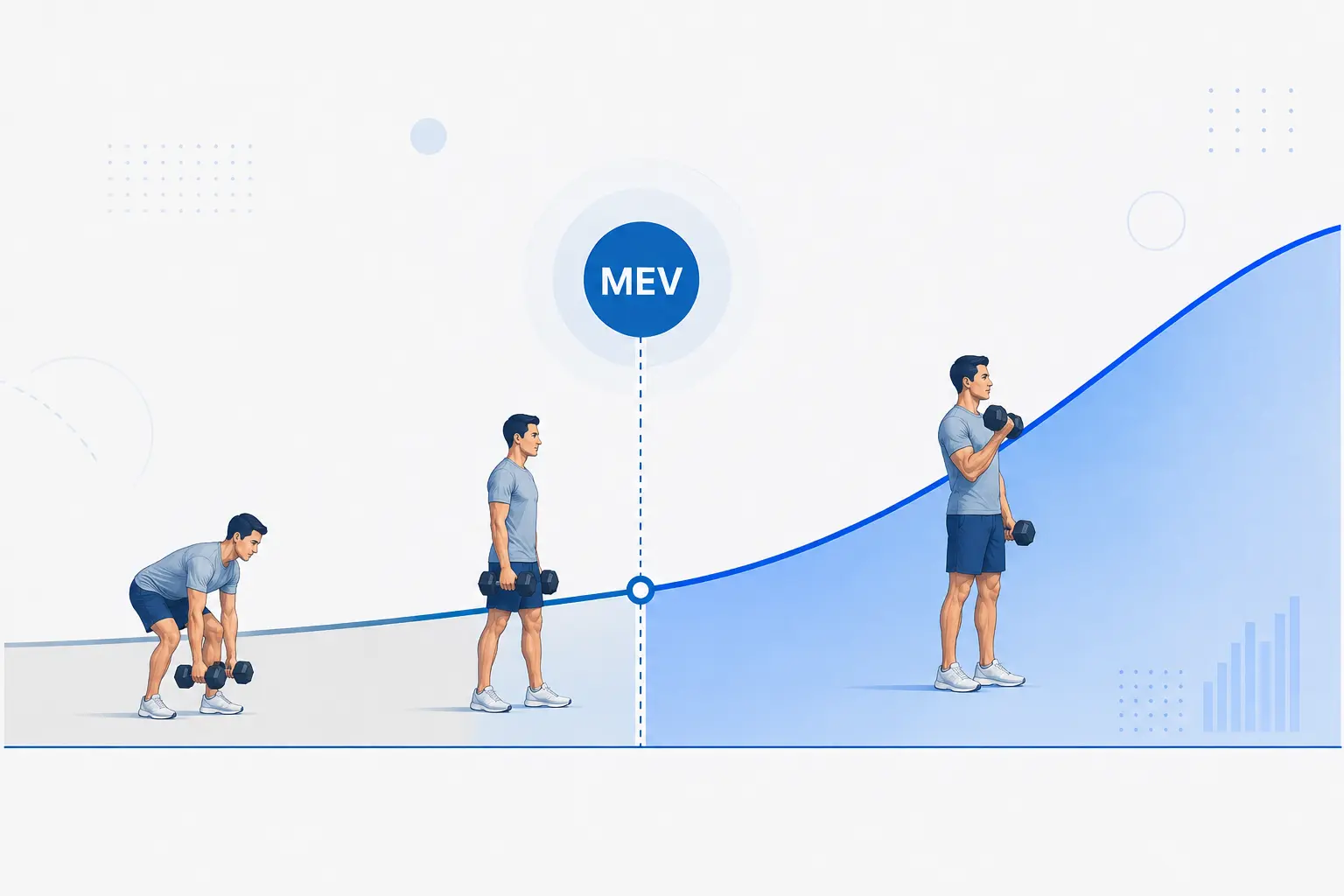
Minimum effective volume for hypertrophy describes the smallest number of hard sets per muscle group per week that leads to measurable increases in muscle size.
If you train below your MEV, you are likely maintaining muscle rather than building it. If you train at or slightly above it, hypertrophy becomes more likely over time.
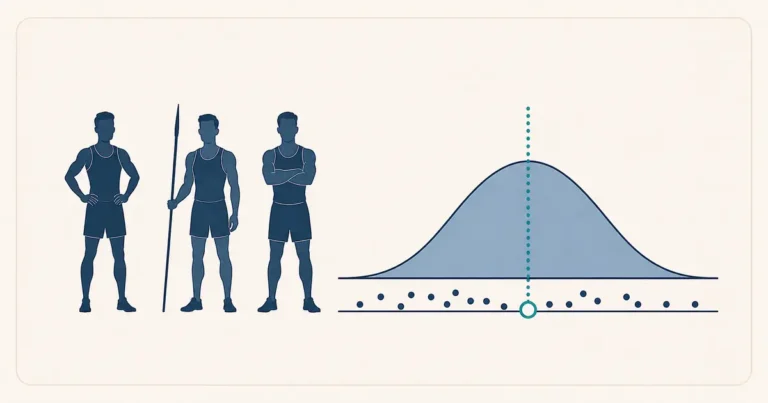
MEV is not a universal number. It depends on training age, muscle group, training intensity and proximity to failure, sleep, stress and energy availability. These factors also influence how much muscle you can realistically gain over time.
Beginners often grow from relatively little structured training. More advanced lifters may sometimes need more volume to create a new stimulus—but that is not automatic. A lifter who performs every set with high skill and close proximity to failure may get more from fewer sets than someone whose sets are less demanding.
Hypertrophy is primarily driven by mechanical tension, sufficient volume and proximity to failure. Volume is typically measured as hard sets per muscle group per week, but only sufficiently challenging sets make a meaningful contribution. Sets performed far from failure generally provide less hypertrophic stimulus per set, and rest periods between sets influence how much productive work you can sustain.
For a deeper breakdown of the interaction between volume, load and effort, see Volume vs Intensity for Hypertrophy.
MEV vs Productive Volume vs MRV
MEV is only one landmark on the volume spectrum. The useful target is not the highest volume you can survive; it is the amount that produces the best progress without fatigue eroding performance, recovery or motivation.
| Volume landmark | What it means | Typical signs | Primary decision |
|---|---|---|---|
| Below MEV | Too little effective stimulus to reliably produce growth. | No repeatable upward trend despite adequate time and measurement. | Improve set quality or cautiously increase stimulus. |
| At MEV | The lowest effective dose for measurable progress. | Slow, repeatable progress with low fatigue. | Keep the dose while it continues to work. |
| Productive range | More recoverable stimulus than the minimum. | Good progress with manageable fatigue and stable performance. | Use when faster progress justifies the added work. |
| Near or above MRV | Work approaches or exceeds what you can recover from. | Falling performance, persistent fatigue and worsening recovery. | Reduce volume and reassess recovery. |
Training at MEV is efficient, although a somewhat higher recoverable volume may produce faster gains for some lifters. At the other end is maximum recoverable volume (MRV): the highest amount of training volume you can perform while still recovering and making progress. Confusing these landmarks is one of the most common programming errors.
What Does Research Suggest?
Research does not explicitly define an individual MEV, but volume-response studies help establish the broader context.
| What the research suggests | What it does not establish |
|---|---|
| Relatively few hard weekly sets can stimulate growth, particularly in beginners. | One precise minimum number that applies to every person and muscle. |
| Higher weekly volume often produces more hypertrophy on average when it remains productive and recoverable. | That everyone needs at least 10 weekly sets to grow. |
| Set effort, exercise selection and recovery materially change the effective dose. | That training status alone can determine an individual’s MEV. |
A meta-analysis by Schoenfeld et al. (2017) found a graded dose-response, with the highest-volume category—10 or more weekly sets per muscle group—producing greater hypertrophy on average than lower-volume categories.
This does not mean 10 sets is the minimum effective volume. It shows that growth tended to increase as volume increased within the studied, recoverable ranges. MEV is the lowest point at which progress begins—not the point of maximal growth.
How Many Sets Can Be a Reasonable Starting Point?
There is no defensible universal MEV number. Around 4–10 direct hard sets per muscle per week is a reasonable conservative testing range for many lifters, but some will progress below it and others will need more. The only useful number is the lowest dose that produces a repeatable upward trend for you.
| Situation | Conservative starting decision |
|---|---|
| Direct work for a muscle | Roughly 4–8 hard weekly sets can be tested as a conservative starting range—not an MEV estimate. |
| Substantial overlap from compound exercises | Start toward the lower end and count the indirect contribution. |
| Sets performed very close to failure | Start lower because each set is more demanding. |
| Sets performed with lower effort | More total sets may be required, although improving effort may be the better first step. |
| Calorie deficit or limited recovery | Use the lowest dose that preserves or improves performance. |
Do not assign volume by muscle name alone. Pressing contributes to triceps and front-delt volume, while rows and pulldowns contribute to biceps volume. Your training split, exercise selection and set quality determine what those weekly totals actually mean.
Excessive work can eventually become counterproductive. Fatigue may accumulate locally or as broader systemic fatigue that affects overall performance. See how to recognize too much volume and why only sufficiently challenging reps contribute meaningfully to the stimulus.
How to Find Your Minimum Effective Volume
There is no calculator that can identify your individual MEV. It must be estimated from repeatable performance and recovery trends under reasonably consistent conditions.
Count direct and indirect weekly sets for each muscle.
Keep technique, exercise selection and roughly 0–3 RIR consistent.
Follow load, reps, execution and recovery across several weeks.
If the upward trend continues, the dose is already effective.
Before adding sets, review effort, sleep, calories, stress and exercise choice.
Test one small increase and keep it only if the outcome improves.
At conservative volumes, performance is less likely to be limited by central fatigue mechanisms. If performance improves consistently, you are likely at or above MEV. If it stalls for multiple weeks, volume may be too low—but it is only one possible explanation.
Watch: How to Find Your Optimal Training Volume
Prefer to watch? This video walks you through five practical questions for finding your optimal training volume—including where to start, what counts as a set, and when additional volume is actually justified.
Why Fewer Sets Can Sometimes Work Better
In my own training and with more advanced clients, I have often seen better strength progression at lower volumes when the lifter trains very hard and regularly approaches failure. Two demanding sets are not automatically inferior to three. If the third set makes the lifter pace the first two, lowers rep quality or creates recovery problems later in the week, the extra work may not be earning its place.
That was the lesson behind my “two-set girl” client. With three sets, she held something back because she knew another set was coming. With two, the task felt manageable and both sets counted. I notice the same tendency in myself: when I only have two work sets, I am more willing to make them genuinely productive.
This does not prove that two sets are universally superior. It shows why programme volume cannot be evaluated independently of human behaviour. The number on the spreadsheet can change effort, pacing, motivation and therefore the quality of the stimulus.
Add One Set, Not a New Programme
I used to make much larger jumps—for example, moving most exercises from three sets to four after six weeks, with even more sets for movements such as lateral raises. Neither my clients nor I recovered well from that approach. Performance and motivation sometimes declined, and some clients felt so run down that work and ordinary daily life became harder.
A more useful approach has been to begin with two sets per exercise and add volume gradually. On an upper-body day containing bench press, lat pulldown, shoulder press, seated row, lateral raises, curls and pressdowns, I might initially prescribe two sets for all seven exercises. Rather than taking every exercise to three sets at once, I might add only one set to the bench press on Upper 1 and one set to the seated row on Upper 2.
That adds only two work sets across the entire week. It is small enough that the programme does not suddenly feel different, yet large enough to test whether the additional volume improves progress. If recovery and performance remain good, another exercise can earn an extra set later. If nothing improves, the added set has not justified itself.
Recovery Decides Whether Volume Is Productive
Minimum effective volume is not static. It shifts with calorie intake, sleep quality, psychological stress, exercise selection and training frequency.
During a calorie deficit, the volume you can recover from often falls. That does not necessarily raise MEV; it narrows the space between enough training to stimulate growth and too much training to recover from. During a well-fed, low-stress phase, you may tolerate and benefit from more work—but additional volume still needs to improve the result.
This is why volume should respond to the lifter rather than follow a fixed escalation on a calendar. Because recovery determines how much work you can benefit from, fatigue management becomes central to long-term hypertrophy.
With clients, I looked for a trend rather than reacting to one bad workout. If performance declined for two or three weeks, recovery worsened and there was no obvious change in work stress, home life, food or sleep, training volume became a reasonable suspect. At times I also suspected that excessive training load contributed to restless sleep, but that connection is difficult to isolate and should be treated as a warning sign rather than proof.
Common MEV Mistakes
Your effective dose depends on the muscle, exercises, set quality and recovery context.
A distant-from-failure set and a technically consistent hard set do not provide the same stimulus.
Use a multi-week trend before deciding that the current dose has stopped working.
Compound exercises can meaningfully train muscles that are not listed as the primary target.
Soreness can reflect novelty and damage; it does not establish that volume is effective.
Technique, effort and exercise selection should earn attention before more volume is prescribed.
Practical Implementation
- Begin conservatively, often with around two hard sets per exercise.
- Keep the dose unchanged while load, repetitions or execution are improving.
- Add one set to one exercise only when progress has genuinely stalled and recovery remains good.
- Review the result over several weeks before adding more.
Minimum effective volume is not the lowest number of sets you can survive on. It is the lowest amount of training that reliably moves you forward. Every extra set should earn its place by improving that outcome.
Minimum effective volume is one part of a larger system. Explore the complete hypertrophy training guide or learn how volume fits into a structured hypertrophy training programme.
FAQ
How many sets per week is minimum effective volume for hypertrophy?
There is no universal minimum effective volume. Around 4–6 direct hard sets per muscle per week can be a conservative starting point for some lifters, but effective volume depends on set effort, exercise selection, training frequency and individual response.
Is minimum effective volume enough for optimal muscle growth?
Training at minimum effective volume can stimulate growth, but higher volumes within a recoverable range generally produce faster hypertrophy over time.
Does minimum effective volume increase as you gain experience?
Not necessarily. Advanced lifters may require a larger or more precise stimulus to keep progressing, but improved technique and the ability to train closer to failure can also make each set more productive. Training experience alone cannot determine MEV.
Can you build muscle training at MEV?
Yes. Training at minimum effective volume can build muscle, but progress is typically slower than training closer to your optimal volume. MEV represents the lowest volume threshold that reliably stimulates hypertrophy.
References
- Schoenfeld BJ, Ogborn D, Krieger JW. Dose-response relationship between weekly resistance training volume and increases in muscle mass. J Sports Sci. 2017. PubMed.
- Schoenfeld BJ, Grgic J, Ogborn D, Krieger JW. Strength and hypertrophy adaptations between low- vs high-load resistance training. J Strength Cond Res. 2017. PubMed.
- Baz-Valle E et al. A Systematic Review of the Effects of Different Resistance Training Volumes on Muscle Hypertrophy. Sports Med. 2022. PubMed.