Central vs Peripheral Fatigue in Strength Training
Your last few reps slow down, the next set feels heavier, or your usual load suddenly seems ambitious. What caused the drop? Central vs peripheral fatigue describes two places where the ability to produce force can be reduced: the nervous system driving the muscle and the muscle responding to that drive.
Central fatigue involves a reduced ability to activate muscle voluntarily through the central nervous system. Peripheral fatigue involves changes at or beyond the neuromuscular junction that reduce the muscle’s force-producing capacity. Both can contribute to the same task. Feeling drained, losing reps, or struggling to get motivated does not tell you their relative contribution. [1], [2]
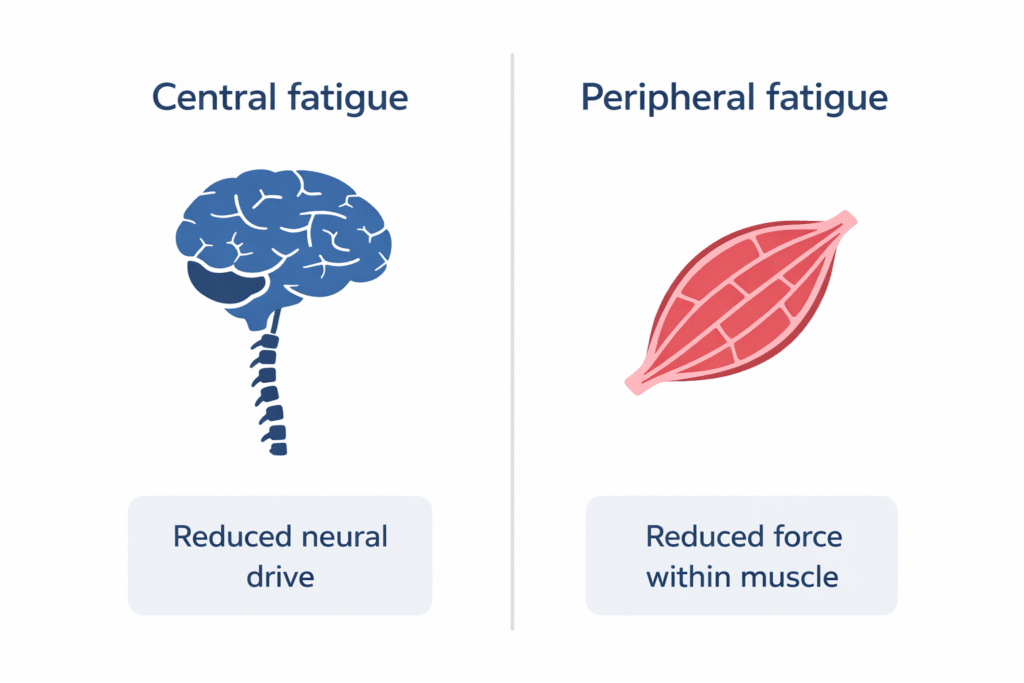
Central vs peripheral fatigue: what is the difference?
A voluntary contraction depends on signals travelling from the brain and spinal cord to the working muscles. The muscle fibers then have to turn that activation into force. Exercise can temporarily reduce performance at more than one point along this pathway.
| Question | Central fatigue | Peripheral fatigue |
|---|---|---|
| Where does it arise? | Within the central nervous system: the brain and spinal cord. | At or beyond the neuromuscular junction, including processes inside the muscle fibers. |
| What is reduced? | The ability to voluntarily activate the muscle. | The muscle’s ability to generate force in response to activation. |
| How is it commonly assessed? | Changes in voluntary activation, using stimulation during maximal voluntary contractions. | Changes in force evoked by stimulation, with additional measurements to investigate the mechanism. |
| Can you identify it from a workout feeling? | No. Low motivation or a heavy-feeling bar is not a specific test. | No. A burn, pump or loss of reps cannot quantify the peripheral contribution. |
These are physiological categories, rather than two distinct feelings you can reliably label during a workout. [1], [2]
What happens inside the muscle?
Peripheral mechanisms include changes in muscle membrane excitability, calcium handling and the contractile machinery. For example, a muscle fiber may release less calcium or produce less force for a given calcium signal. The contribution of these processes depends on the exercise conditions; “lactic acid buildup” alone is an inadequate explanation. [2]
How researchers distinguish central and peripheral fatigue
Researchers can stimulate a motor nerve while someone performs a maximal voluntary contraction. If stimulation adds force, it indicates that voluntary activation was incomplete. Comparing responses before and after exercise helps estimate a change in central activation. Tests of force evoked in a relaxed muscle help assess peripheral changes. [1]
This is more specific than recording a slower rep. A training log can show that performance changed, but it cannot divide the change into a percentage caused by the nervous system and a percentage caused by the muscle.
Feeling tired is not the same as measuring central fatigue
Fatigue research distinguishes an observable decline in performance from the experience of tiredness, effort or exhaustion. These influence one another, but they are not interchangeable. You can feel reluctant to train and still perform well after warming up; you can also feel motivated while your force-producing capacity is reduced. [3], [4]
Sleep, stress and how you feel are worth recording. They provide context for a training decision. They do not establish that your “CNS is fried,” or prove which mechanism explains a disappointing session.
Central vs peripheral concerns physiological mechanisms. Systemic vs local is commonly used in coaching to describe how broadly fatigue seems to affect training. A local exercise can involve both central and peripheral mechanisms. Read the separate guide to systemic vs local fatigue for that programming perspective.
Do heavy lifts cause central fatigue and machines cause peripheral fatigue?
That division is too simple. The load, duration of the effort, number of contractions, rest periods and muscle group all matter. A heavy compound lift is not automatically a “central” exercise, and a machine exercise is not exclusively “peripheral.” Resistance exercise can involve both mechanisms, with their relative contributions depending on the task. [5]
Choose exercises for the muscles and movements you want to train, then judge how well you can repeat useful work. Calling an exercise “CNS demanding” does not tell you how many sets you personally recover from.
Training to failure: more fatigue is not automatically more growth
In an eight-week study of 18 trained adults, Refalo and colleagues compared leg training to failure with stopping at a perceived two reps in reserve on the leg press and one on the leg extension. Average growth across the two measured quadriceps muscles was similar, while failure training produced greater losses of repetitions and lifting velocity. [7]
That study supports using proximity to failure to manage the fatigue cost of training. It did not separate that cost into central and peripheral mechanisms, and its results do not establish one optimal effort level for every exercise. Use reps in reserve as a practical way to prescribe effort.
How long does central or peripheral fatigue last?
There is no universal “CNS recovery time.” Carroll and colleagues describe rapid recovery of some central and peripheral components in the first few minutes after certain exercise tasks, alongside slower recovery of other components. Some muscle-level impairments can persist for hours, and the pattern differs after brief intense work versus prolonged exercise. [6]
Those findings do not create a rule that your nervous system always needs 48 or 72 hours, or that a few minutes restores everything. Rest between sets and readiness for the next workout are different decisions. Use repeatable performance as part of your assessment, with the wider habits covered in recovery and muscle growth.
What should you change when performance drops?
You can make a useful adjustment without locating the physiological cause. The suggestions below are practical coaching decisions, not tests for central or peripheral fatigue.
Check load, range of motion, exercise order, rest and estimated reps in reserve. Ten shorter reps are not directly comparable with ten controlled full-range reps.
Try more rest, a smaller load or one fewer hard set, depending on where performance breaks down. Record the change so you can assess whether it helped.
Compare several similar sessions. An isolated poor set is a weak basis for rebuilding your program; a repeated decline deserves a closer look.
A practical example: reps drop on the incline press
Imagine you usually perform 10 and then 9 reps at the same load and effort target. Today you get 10 and then 6. Before labelling it central fatigue, check whether you rested less or pushed the first set closer to failure. Try restoring your usual conditions and see how the next comparable session goes.
This is a hypothetical example, not a diagnostic threshold. If short rests are limiting your later sets, the guide to rest periods between sets is the relevant next step.
If the decline keeps happening
Review your recent workload and recovery conditions together. The guide to not recovering from training helps structure that review. If you have been adding sets, reconsider your recoverable training volume; if load and effort have also increased, examine the interaction between volume and intensity.
The useful outcome is a program you can progress and repeat. Feeling exhausted is information to consider, rather than a score for how much muscle a workout will build.
References
- Taylor JL, et al. (2016). Neural Contributions to Muscle Fatigue: From the Brain to the Muscle and Back Again. Medicine & Science in Sports & Exercise.
- Boyas S, Guével A. (2011). Neuromuscular fatigue in healthy muscle: underlying factors and adaptation mechanisms. Annals of Physical and Rehabilitation Medicine.
- Enoka RM, Duchateau J. (2016). Translating Fatigue to Human Performance. Medicine & Science in Sports & Exercise.
- Behrens M, et al. (2023). Fatigue and Human Performance: An Updated Framework. Sports Medicine.
- Zając A, et al. (2015). Central and Peripheral Fatigue During Resistance Exercise – A Critical Review. Journal of Human Kinetics.
- Carroll TJ, Taylor JL, Gandevia SC. (2017). Recovery of central and peripheral neuromuscular fatigue after exercise. Journal of Applied Physiology.
- Refalo MC, et al. (2024). Similar muscle hypertrophy following eight weeks of resistance training to momentary muscular failure or with repetitions-in-reserve in resistance-trained individuals. Journal of Sports Sciences.