Not Recovering From Training? Signs You’re Under-Recovered (and Fixes That Work)
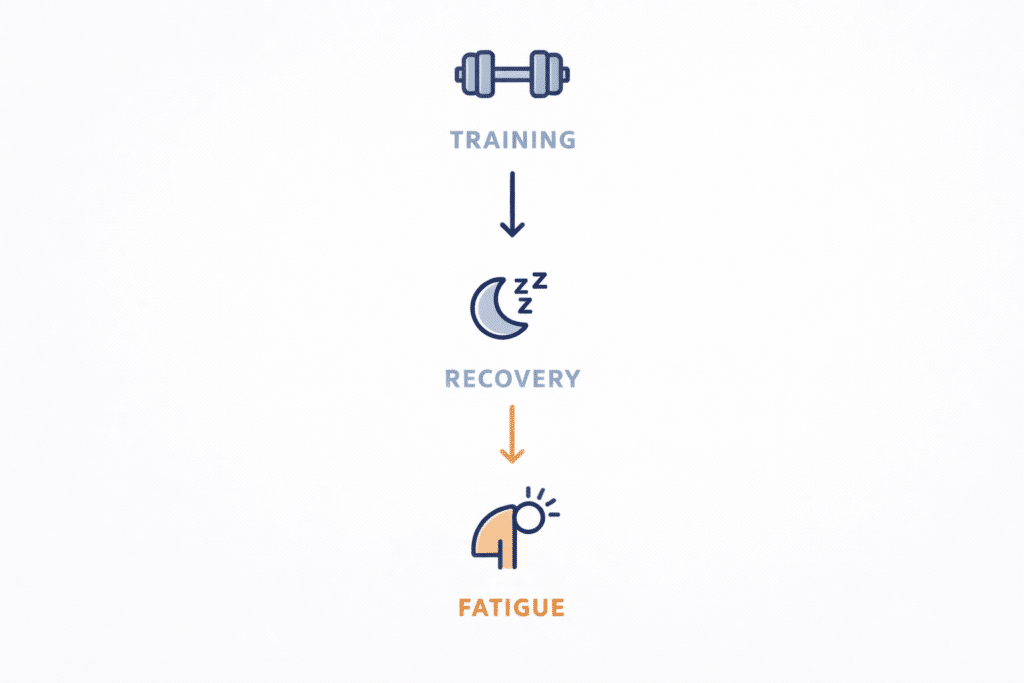
Not recovering between workouts? Learn the key signs of under-recovery and how to fix fatigue, stalled progress, and poor training recovery.
TL;DR
• If training stress exceeds recovery capacity, fatigue accumulates and progress stalls.
• Common signs include declining performance, persistent soreness, poor sleep, and reduced motivation to train.
• Under-recovery is usually caused by excessive training volume, insufficient sleep, or inadequate nutrition.
• Most recovery issues can be solved by adjusting training volume, improving sleep, and ensuring sufficient calorie intake.
Conceptual Foundation
Muscle growth does not occur during training itself. Instead, adaptation occurs during the recovery process between workouts, when the body repairs muscle tissue and becomes stronger.
Resistance training creates fatigue and muscle damage, which then triggers the body’s recovery processes. During recovery, the body repairs tissue and adapts so that the muscles become stronger and more resilient.
However, if training stress consistently exceeds your ability to recover, fatigue accumulates faster than adaptation can occur. This fatigue is not always limited to a single muscle, but can reflect a broader systemic fatigue state that affects overall performance.
This state is commonly referred to as under-recovery.
It is important to distinguish under-recovery from clinical overtraining syndrome. True overtraining is rare and typically occurs in endurance athletes exposed to extremely high training loads over long periods. Most lifters simply experience temporary fatigue accumulation from training that exceeds their current recovery capacity.
Recognizing the early signs of under-recovery allows you to adjust training before it begins to significantly interfere with progress.
In resistance training, insufficient recovery is often the result of training volume exceeding your maximum recoverable volume (MRV), where accumulated fatigue begins to outpace recovery.
Evidence Review
Training adaptations occur through the interaction of fitness and fatigue.
Resistance training produces both:
• positive adaptations (strength and muscle growth)
• temporary fatigue that reduces performance
When fatigue accumulates faster than it dissipates, performance may decline even if the training stimulus itself is sufficient.
Research on resistance training consistently shows that training volume and recovery capacity must remain balanced to sustain long-term hypertrophy progress.
Sleep also plays a critical role in recovery. Sleep restriction has been shown to impair muscle recovery, hormonal balance, and athletic performance.
Nutrition is another key factor. Adequate protein intake supports muscle repair, while sufficient calorie intake helps maintain recovery capacity during demanding training phases.
Together, these factors determine how much training stress an individual can tolerate before fatigue begins to accumulate excessively.
Understanding concepts like minimum effective volume (MEV) and MRV helps lifters manage fatigue and recovery more effectively.
System-Level Implications
Under-recovery rarely appears suddenly. Instead, it typically develops gradually as fatigue accumulates over multiple training sessions.
Several signs can indicate that recovery is insufficient.
Declining Training Performance
One of the clearest indicators of accumulated fatigue is a consistent decline in performance across sessions.
In some cases, reduced performance is not purely a muscular issue, but also reflects central fatigue mechanisms that reduce neural drive and overall output.
Occasional bad workouts are normal. However, if strength, reps, or work capacity steadily decrease across multiple workouts, fatigue may be exceeding recovery capacity.
Persistent Muscle Soreness
Muscle soreness after training is normal, especially when introducing new exercises or higher volumes.
However, muscle soreness (DOMS) that never fully resolves before the next session may indicate that recovery is lagging behind training stress.
Constant Fatigue
Under-recovery often manifests as general fatigue throughout the day, not just during workouts.
This can include:
• persistent tiredness
• reduced physical energy
• difficulty completing normal training loads
Poor Sleep Quality
Ironically, excessive fatigue can also impair sleep.
Many athletes experiencing accumulated fatigue report difficulty falling asleep, fragmented sleep, or waking up unrefreshed.
Reduced Motivation to Train
Psychological fatigue often accompanies physical fatigue.
When training consistently feels draining or unmotivating, it may be a sign that recovery resources are being exceeded.
Under-recovery is rarely caused by a single factor, but by how training volume, fatigue, and recovery are managed together over time.
This concept is part of a broader framework explained in our hypertrophy training guide.
Practical Implementation
If recovery is insufficient, the solution is usually small adjustments rather than drastic changes.
Adjust Training Volume
Training volume is the most common driver of fatigue accumulation.
Reducing weekly volume by 10–20% often allows fatigue to dissipate while maintaining an effective training stimulus.
In some cases, incorporating active recovery strategies such as low-intensity movement can help reduce fatigue without adding significant additional training stress.
Improve Sleep
Sleep is arguably the most powerful recovery tool available.
Most lifters perform best with 7–9 hours of sleep per night, particularly during phases of higher training volume.
In many cases, persistent fatigue is a sign that training volume has exceeded what your body can currently recover from.
Ensure Adequate Nutrition
Recovery requires sufficient energy availability.
Key nutritional factors include:
• adequate protein intake for muscle repair
• sufficient carbohydrates to support training performance
• enough total calories to sustain adaptation
Use Deloads Strategically
Periodic deload weeks allow fatigue to dissipate while maintaining training adaptations.
Typical deload strategies include:
• reducing training volume by 30–50%
• maintaining moderate intensity
• preserving normal exercise selection
Why it matters:
Hypertrophy training works best when training stimulus and recovery capacity remain balanced.
Too little training produces minimal adaptation.
Too much training without adequate recovery leads to fatigue accumulation, stalled progress, and reduced performance.
Effective programming therefore requires managing both training stress and recovery resources over time.
References
Schoenfeld BJ. The mechanisms of muscle hypertrophy and their application to resistance training.
https://pubmed.ncbi.nlm.nih.gov/20847704/
Fullagar HHK et al. Sleep and athletic performance: the effects of sleep loss on exercise performance and recovery.
https://pubmed.ncbi.nlm.nih.gov/24791913/
Kellmann M. Preventing overtraining in athletes in high-intensity sports and monitoring stress-recovery balance.
https://pubmed.ncbi.nlm.nih.gov/21609035/