Should You Train When Sore? What Science Says About DOMS
If you lift consistently, you will eventually ask the same question: should you train when sore, or is that a sign you need more recovery?
The short answer is that mild soreness is usually not a reason to skip training. But severe soreness, reduced force output, limited range of motion, or altered exercise technique are different. That is where DOMS stops being harmless background fatigue and starts becoming a recoverability issue. Research shows that DOMS is most common after novel or unaccustomed training, especially eccentric work, and that it can temporarily reduce force production and performance. At the same time, soreness itself is not a reliable marker of hypertrophy.
It is also important to distinguish between local muscle soreness and broader systemic fatigue, as performance limitations are not always driven by the muscle itself.
For hypertrophy, the better question is not just “am I sore?” but:
What does this soreness tell me about my current training volume, recovery capacity, and position between MEV and MRV?
TL;DR
- DOMS usually appears after novel or hard training, especially with a strong eccentric component, and often peaks around 24–72 hours post-workout.
- Mild soreness usually does not require a rest day.
- Severe soreness can reduce force production, ROM, movement quality, and training performance.
- DOMS is not a reliable sign that a workout was better for muscle growth.
- Repeated exposure to the same exercises usually reduces soreness over time via the repeated bout effect.
- The best use of DOMS is as a recoverability and programming signal, not as a goal.
Conceptual Foundation: What Is DOMS?
DOMS stands for delayed onset muscle soreness. It is the tenderness, stiffness, and movement-related discomfort that tends to show up the day after training and often peaks in the following 1–3 days. It is especially common when you do something your body is not well adapted to yet: a new exercise, more volume than usual, harder eccentrics, or a return to training after time off.
Mechanistically, DOMS is linked to exercise-induced muscle damage, local inflammation, swelling, altered calcium handling, and changes in force transmission. Importantly, that does not mean soreness directly measures how much muscle you will build. Muscle damage can contribute to disruption and remodeling, but the literature does not support the idea that more soreness reliably predicts more hypertrophy.
In some cases, reduced performance may also reflect central fatigue mechanisms rather than purely local muscle limitations.
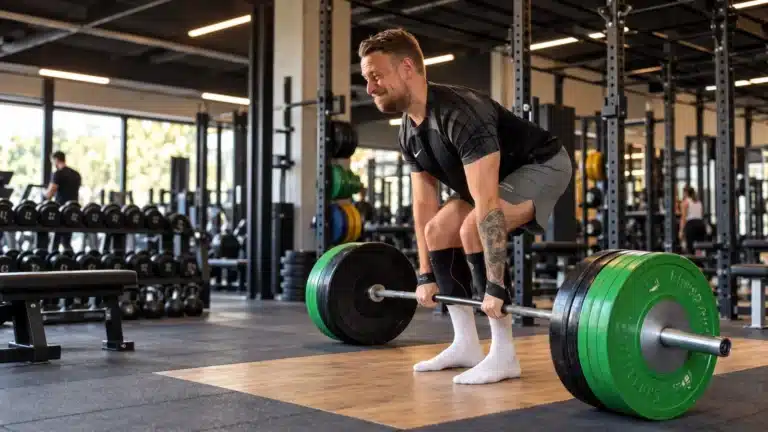
You may also notice that some exercises cause more soreness than others. For example, movements like Romanian deadlifts (RDLs) often lead to more prolonged soreness because they load the muscle in a lengthened position under tension. This type of stimulus tends to create more disruption, especially if you are not adapted to it.
This is also why introducing new exercises or emphasizing long muscle lengths often results in more soreness initially.
Muscle soreness is only one piece of the larger recovery picture in hypertrophy training.
This concept is part of a broader framework explained in our hypertrophy training guide.
Evidence Review: Should You Train When Sore?
1) Mild soreness usually does not mean “do not train”
Most practical, evidence-aligned guidance agrees that low-grade soreness is usually fine to train through, especially if movement quality is normal and the soreness improves as you warm up. This is why many lifters can still perform productive sessions with mild DOMS.
2) Severe soreness is different
When soreness is high, the issue is not pain alone. Exercise-induced muscle damage can reduce force-generating capacity, power output, ROM, proprioception, and movement efficiency. That matters because you may still “complete” the workout while producing worse reps, lower output, and more compensatory mechanics.
3) Soreness is not a hypertrophy score
This is where many fitness articles go soft. You do not need to chase soreness to grow. Reviews on exercise-induced muscle damage and hypertrophy note that muscle growth can occur with little meaningful damage, and that early post-workout increases in protein synthesis may be directed toward repair/remodeling rather than true hypertrophy when damage is high. In fact, once repeated training attenuates damage, hypertrophy can continue just fine.
4) The repeated bout effect matters
One of the most important DOMS concepts is the repeated bout effect: after your body is exposed to a given exercise stressor, later bouts typically cause less soreness, lower CK response, and less performance disruption. In other words, less soreness over time often means you are adapting — not that the program stopped working.
System-Level Implications: DOMS in the Context of MEV and MRV
This is where the article becomes more useful than most top-ranking pages.
DOMS is best understood as a recoverability signal relative to training volume.
At MEV, soreness may be low or even absent. That does not automatically mean the workout was ineffective. It may simply mean stimulus was sufficient without creating much disruption.
Between MEV and MRV, mild or moderate soreness can happen, but it should still be recoverable between sessions. This is usually the productive zone: enough overload to drive adaptation, but not so much fatigue that performance keeps falling.
At or above MRV, soreness becomes more concerning when it is:
- persistent across sessions,
- accumulating week to week,
- limiting force production,
- changing exercise execution,
- or repeatedly forcing unplanned exercise substitutions.
In that context, DOMS is no longer just “proof you trained hard.” It is a sign that disruption cost may be too high relative to what you can currently recover from. That framing is much more useful than the generic “listen to your body” advice most articles stop at.
Practical Implementation: How to Train When Sore
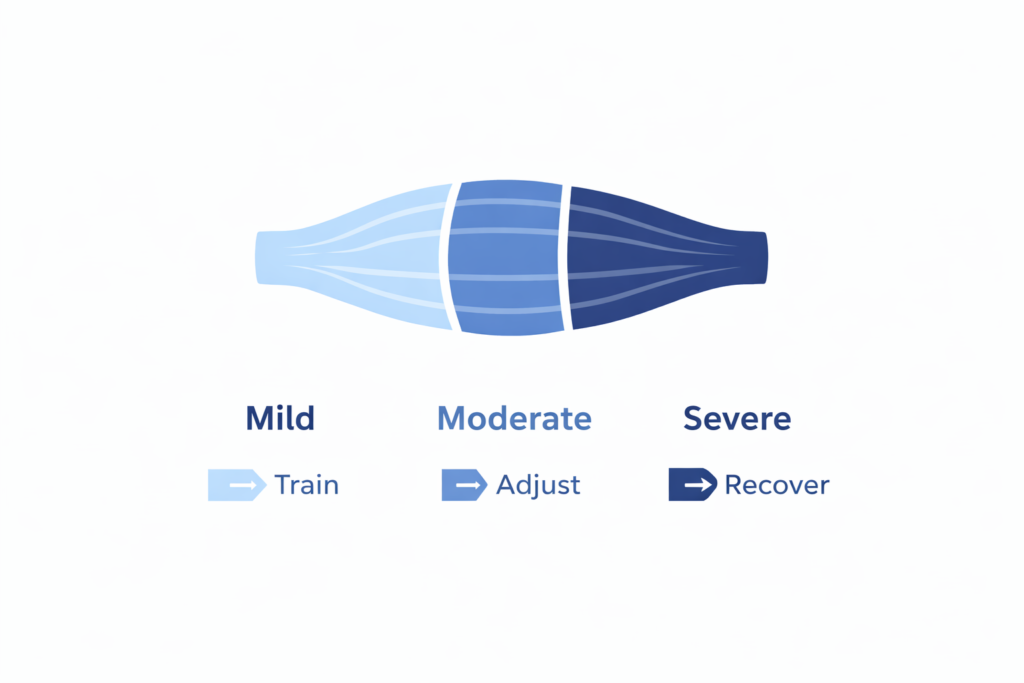
Mild soreness
Train as planned.
If your soreness is noticeable but does not change technique, ROM, or force output in a meaningful way, you usually do not need to modify the session. A proper warm-up is often enough. This is the most common scenario for experienced lifters.
Moderate soreness
Train, but adjust the stimulus.
This is where intelligent programming beats binary thinking. Options include:
- reducing load slightly,
- trimming 1–2 sets,
- using a more stable exercise variation,
- avoiding long-length high-tension eccentrics for that session,
- or training another muscle group first.
The goal is not to baby the session. It is to keep quality high while preventing fatigue from compounding unnecessarily.
In some cases, incorporating low-intensity movement between sessions may help improve perceived recovery and reduce stiffness.
Severe soreness
Do not force a normal workout.
If soreness is severe enough that daily movement feels restricted, your warm-up does not improve things, or technique is clearly altered, treat that as a recovery problem. Switch muscle groups, use very light recovery-oriented work, or take the extra recovery. Literature on exercise-induced muscle damage consistently notes temporary but meaningful reductions in function and performance after severe damage.
DOMS as a Programming Feedback Tool
A useful rule of thumb:
- No soreness ever: not automatically bad, but if progress is also stalled, you may be underdosing stimulus.
- Mild soreness that resolves on time: usually compatible with productive training.
- Severe or persistent soreness: often a sign that volume, novelty, or eccentric stress is too high for your current recovery capacity.
So when asking should you train when sore, the real answer is:
Train through soreness when it is recoverable.
Adjust when soreness becomes performance-limiting.
Why it matters:
Most lifters misread DOMS in one of two directions.
They either treat soreness as proof that a workout was great, or they panic and assume any soreness means they should stop training. Both are oversimplified.
The better interpretation is that DOMS reflects how disruptive a training exposure was relative to your current level of adaptation and recovery. Used this way, soreness can help you stay in productive volume territory, avoid chronic under-recovery, and stop confusing “feeling wrecked” with effective hypertrophy training.
References
Cheung K, Hume P, Maxwell L. Delayed onset muscle soreness: treatment strategies and performance factors. Sports Med. 2003. https://pubmed.ncbi.nlm.nih.gov/12617692/
Damas F, Libardi CA, Ugrinowitsch C. The development of skeletal muscle hypertrophy through resistance training: the role of muscle damage and muscle protein synthesis. Eur J Appl Physiol. 2018. https://pubmed.ncbi.nlm.nih.gov/29282529/
Doma K, Matoso BRP, da Silva WM, et al. The Repeated Bout Effect of Multiarticular Exercises on Muscle Damage Markers and Physical Performance: A Systematic Review and Meta-Analysis. J Strength Cond Res. 2023. https://pubmed.ncbi.nlm.nih.gov/38015738/
Byrne C, Twist C, Eston R. Neuromuscular function after exercise-induced muscle damage: theoretical and applied implications. Sports Med. 2004. https://pubmed.ncbi.nlm.nih.gov/14715039/
FAQ
Can you workout when sore?
Yes, usually — if soreness is mild and does not noticeably reduce performance or alter movement quality.
Should you train sore muscles two days later?
Often yes. DOMS commonly peaks around 24–72 hours, so being sore two days later is normal. The key is whether function is preserved.
Does soreness mean muscle growth?
Not reliably. Soreness can happen without meaningful long-term hypertrophy, and hypertrophy can occur with minimal soreness.
When should you not train when sore?
When soreness is severe, sharp, associated with swelling/bruising, causes compensatory movement, or feels more like injury than training soreness.