Recovery and Muscle Growth: What Actually Matters?
TL;DR
Recovery and muscle growth are often misunderstood. This article explains what recovery actually means, which factors matter most, and why most recovery problems are really training problems in disguise.
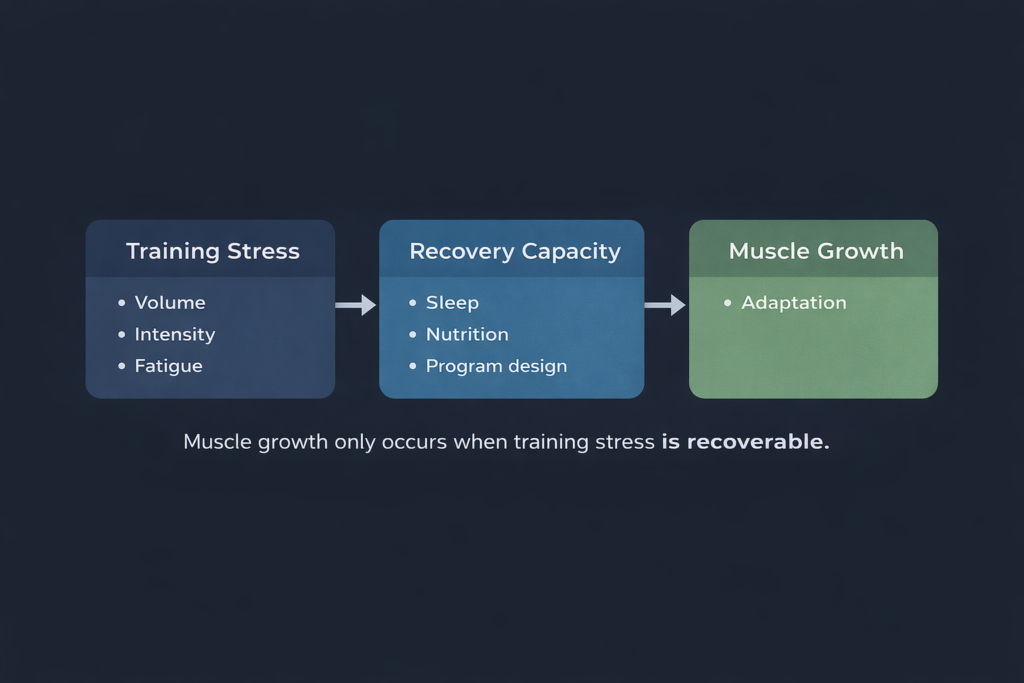
- Muscle growth doesn’t happen because you “recover well” — it happens when training stress is recoverable
- Recovery isn’t something you optimize directly; it’s the result of matching training to real life
- Sleep and nutrition matter, but program design matters most
- You don’t need rest days to grow muscle — you need training you can adapt to consistently
- Recovery is a constraint, not a goal — training drives growth
Recovery is one of the core drivers of muscle growth, but it does not exist in isolation.
It is part of a broader system involving training volume, fatigue management, and progression over time — all of which are explained in our hypertrophy training guide.
What Do We Actually Mean by “Recovery”?
In physiology, recovery refers to the process by which fatigue dissipates and the body returns to—or surpasses—its previous capacity.
In real life, that definition becomes blurry.
Some people think recovery means soreness disappearing.
Others think it means feeling fresh every session.
Some equate recovery with rest days, massage, or supplements.
None of those are reliable indicators.
Muscle soreness is not a direct measure of muscle damage.
Feeling tired does not mean you are failing to recover.
Feeling good does not guarantee you are adapting.
This is also why muscle soreness — commonly known as DOMS — does not reliably indicate effective training or recovery status.
Recovery is not a sensation.
It is an outcome.
If training performance is stable or improving over time, recovery is happening — even if you never feel perfectly rested.
Recovery capacity ultimately determines how much volume can be productively performed at a given intensity.
Muscle Growth Happens When Stress Is Recoverable
Training provides the stimulus for muscle growth. Recovery determines whether that stimulus can be adapted to — which is central to understanding what causes muscle growth.
This is where many people get it backward.
They assume muscle growth is driven by recovery, and training simply triggers it. In reality, training stress is the driver. Recovery only sets the upper limit for how much stress you can tolerate.
Volume, intensity, exercise selection, and proximity to failure all contribute to fatigue. The more demanding your training is, the more recovery capacity it requires.
But recovery capacity is not infinite.
It depends on sleep, nutrition, stress levels, training history, and genetics. Two people can run the same program and have completely different outcomes — not because one recovers “better,” but because their total life stress differs.
Recovery ultimately determines how much training volume you can tolerate, which is why pushing beyond your maximum recoverable volume (MRV) often leads to excessive fatigue and stalled progress.
What works on paper does not always work in practice.
When people talk about recovery and muscle growth, they often focus on rest instead of whether training stress can actually be adapted to.
Training volume is one of the primary drivers of fatigue, and managing volume is often the most effective way to improve recovery.
Understanding your Minimum Effective Volume helps determine whether your current workload is sufficient to stimulate growth without exceeding recovery capacity.
What This Looks Like in the Real World
This is where theory meets reality.
Imagine two lifters following the same program.
One sleeps seven hours most nights, eats consistently, and keeps most sets one or two reps shy of failure. Progress is steady.
The other trains just as hard, but turns every set into a grind, sleeps five to six hours, and adds extra volume “just in case.” Progress stalls within weeks.
The difference is not recovery tools.
It is recoverability.
Recovery problems often show up quietly. Performance slowly declines. Motivation drops. Joints feel achy. Nothing feels dramatically wrong — but nothing improves either.
When that happens, the solution is rarely to add more recovery strategies. It is to reduce the mismatch between training demands and real-world capacity.
Low-intensity movement can also support recovery by increasing blood flow and reducing stiffness — a concept often referred to as active recovery.
The Big Three That Actually Matter
Sleep
Sleep supports recovery by improving performance capacity, hormonal regulation, and fatigue resistance.
But sleep does not “repair muscles” in isolation.
It allows you to train productively and tolerate training stress over time. Even modest improvements in sleep consistency can increase how much training volume you can handle.
Perfection is not required.
Consistency is.
Energy and Protein Intake
Adequate energy intake increases recovery capacity by supporting adaptation and reducing systemic fatigue.
Protein supports muscle repair, but more protein does not automatically mean faster recovery. Once basic needs are met, training structure matters more than nutrition tweaks.
Under-eating is one of the most common — and most overlooked — recovery constraints, especially during fat-loss phases.
If you’re unsure whether you’re eating enough to support recovery and muscle growth, use our free Macro Calculator to estimate your daily calorie, protein, carbohydrate, and fat targets based on your body weight, activity level, and goal.
Program Design
This is the most underestimated factor.
Training volume that looks reasonable on paper can become unrecoverable when paired with high intensity, poor exercise selection, or excessive failure training.
Frequency, exercise choice, and set quality all influence fatigue. Smart programs distribute stress in ways that are sustainable, not heroic.
Good recovery is usually a sign of good programming.
Training closer to failure increases fatigue disproportionately, even when the number of effective reps remains similar.
Do You Need Rest Days to Grow Muscle?
Rest days are tools, not requirements.
Some people thrive on high-frequency training with few full rest days. Others perform better with more separation between sessions.
What matters is not the presence of rest days, but whether total training stress stays within recoverable limits.
Deloads, reduced-volume weeks, or lower-intensity phases often accomplish more than simply skipping workouts. Growth does not require constant freshness — it requires consistent progress.
Higher training frequency doesn’t necessarily impair recovery, as long as total training stress remains recoverable.
What Matters Less Than People Think
Muscle soreness is not a reliable indicator of recovery or growth.
Cold exposure may reduce soreness, but frequent use can interfere with long-term hypertrophy.
Massage tools may improve comfort, but they do not compensate for excessive training stress.
Supplements rarely solve recovery problems caused by poor program design or under-recovery from life stress.
These tools can support recovery at the margins. They cannot replace intelligent training.
Recovery Is a Constraint, Not a Goal
You do not grow muscle by optimizing recovery in isolation.
You grow muscle by applying training stress that your body can adapt to repeatedly.
Recovery sets the boundaries. Training operates within them.
When life becomes more demanding, training often needs to become simpler — not more aggressive. Reducing volume, managing intensity, or improving exercise selection restores progress faster than chasing recovery hacks.
Over time, recovery capacity improves. What once felt demanding becomes manageable. Not because you recover better — but because your body becomes more resilient to training stress.
Understanding recovery and muscle growth means focusing less on recovery tools and more on whether training stress is actually recoverable over time.
Practical Takeaways
- If progress stalls, adjust training before adding recovery tools
- When life stress increases, training stress should often decrease
- You don’t need to feel fully recovered to make progress
- You need training you can recover from consistently
- Recovery supports training — training drives growth
References
Schoenfeld, B. J., Ogborn, D., & Krieger, J. W. (2016).
Dose-response relationship between weekly resistance training volume and increases in muscle mass. Journal of Sports Sciences.
https://pubmed.ncbi.nlm.nih.gov/27433992/
Bishop, D., Jones, E., & Woods, D. (2008).
Recovery from training: a brief review. Journal of Sports Sciences.
https://pubmed.ncbi.nlm.nih.gov/18438210/
Halson, S. L. (2014).
Sleep in elite athletes and nutritional interventions to enhance sleep. Sports Medicine.
https://pubmed.ncbi.nlm.nih.gov/24791913/