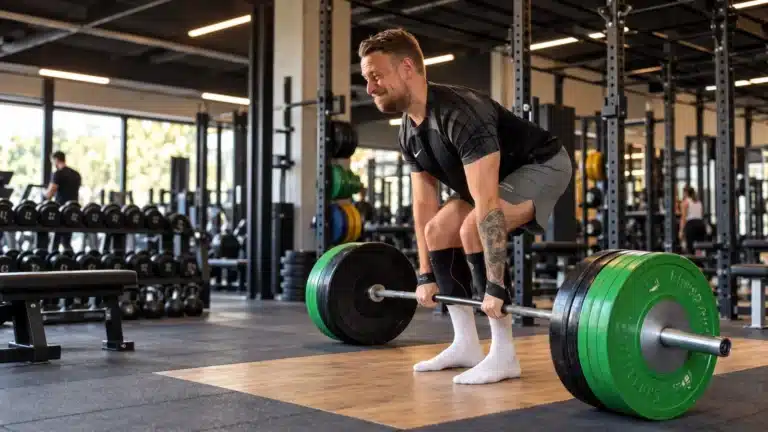
Training to Failure: Is It Necessary for Muscle Growth?
TL;DR
- Training to failure for muscle growth is not strictly necessary.
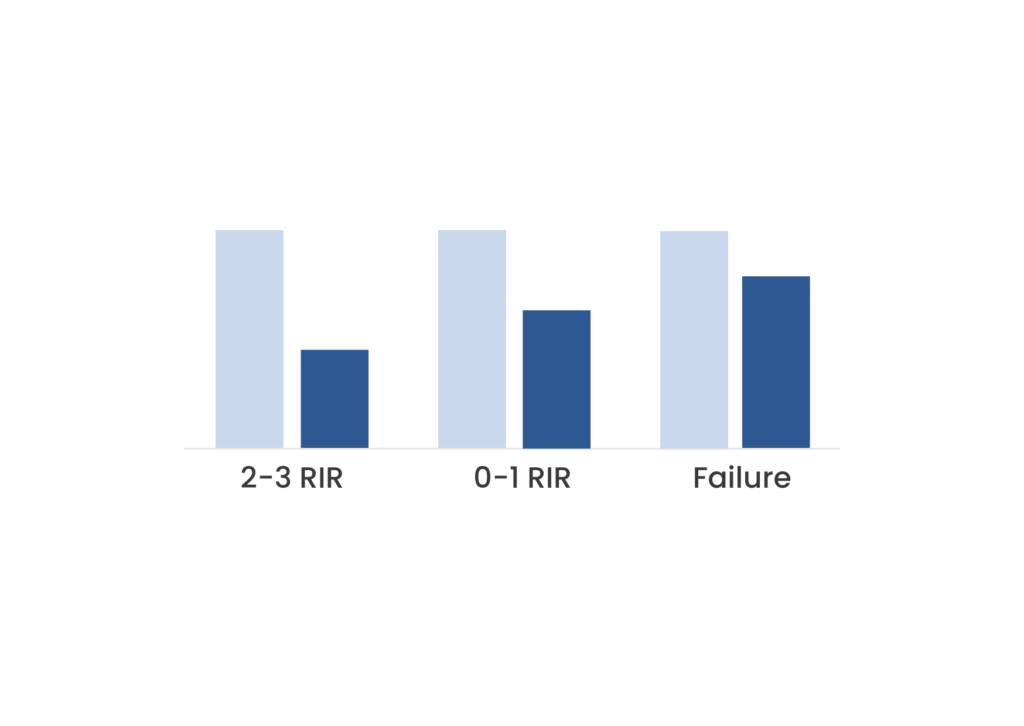
- Sets performed close to failure (0–3 reps in reserve) stimulate similar hypertrophy.
- Absolute failure increases fatigue more than it increases stimulus.
- Strategic use can be helpful, especially for isolation work.
- Long-term muscle growth depends more on recoverable volume than maximal exhaustion.
Training to failure for muscle growth is often misunderstood: effort matters, but absolute failure is rarely necessary for maximizing hypertrophy.
Beginner Explanation: Training to Failure in Simple Terms
Muscle growth responds to effort — but not necessarily to exhaustion.
When you lift a weight, your body recruits muscle fibers based on how demanding the task is. As the set becomes harder, more fibers are recruited. By the time you are only one or two repetitions away from failure, most available motor units are already active.
Failure simply means you have reached the point where you cannot complete another repetition with proper technique.
The common belief is that reaching that final, impossible rep is what triggers muscle growth. In reality, much of the growth stimulus likely occurs in the final few challenging repetitions before failure.
This means that stopping slightly short — while still training hard — may produce nearly the same muscle-building signal with less fatigue.
Failure is not a different stimulus. It is the extreme end of the same effort spectrum, which is central to understanding training intensity for hypertrophy.
The question is not whether effort matters. The question is whether pushing every set to the absolute limit adds enough benefit to justify the additional fatigue.
The Science Review
Failure vs Non-Failure (Volume Matched)
When researchers compare training to failure versus stopping short — while matching total volume — hypertrophy outcomes are generally similar.
A 2021 meta-analysis by Grgic et al. found no significant advantage of failure training over non-failure training for muscle growth when total volume was equated.
Other controlled trials support this conclusion: proximity to failure appears sufficient to maximize hypertrophy.
This is closely related to the mind-muscle connection, which can influence how effectively you recruit and fatigue the target muscle.
In practice, if you perform enough hard sets close to failure, taking every set to absolute failure does not appear to produce additional muscle growth.
The Fatigue Cost
Training to failure increases:
- Peripheral fatigue
- Central nervous system fatigue
- Performance drop in subsequent sets
- Recovery demands
Rest periods between sets also play a key role in managing fatigue and maintaining performance across sets.
Research on velocity loss shows that excessive fatigue accumulation does not enhance hypertrophy and may impair strength development if pushed too aggressively.
Because muscle growth is a chronic adaptation, the ability to repeat high-quality training week after week is more important than maximizing effort in a single set — which is central to understanding what causes muscle growth over time.
Because muscle growth is a chronic adaptation, the ability to repeat high-quality training week after week is more important than maximizing effort in a single set. This is closely tied to overall recovery capacity and how fatigue is managed across a training cycle.
Why it matters:
If training to failure for muscle growth does not meaningfully increase hypertrophy but significantly increases fatigue, then overusing failure can:
- Reduce weekly recoverable volume
- Limit progressive overload
- Decrease movement quality
- Increase injury risk
Over time, sustainable training produces more muscle than repeated maximal exhaustion.
Real-World Applications
Understanding training to failure for muscle growth changes how you structure sessions.
1. Compound Lifts
On movements like squats, bench press, or deadlifts, consistently stopping 1–3 reps short of failure allows you to:
- Maintain technique
- Preserve performance across sets
- Recover better between sessions
This typically leads to higher total productive volume.
2. Isolation Exercises
On exercises with lower systemic fatigue — such as lateral raises or leg extensions — occasional failure sets can be useful.
The fatigue cost is lower, and the risk profile is reduced.
3. Hypertrophy-Focused Phases
During moderate-volume hypertrophy blocks, keeping most sets at 1–2 RIR often maximizes stimulus-to-fatigue ratio.
Failure can be reserved for:
- Final sets
- Short specialization blocks
- Advanced trainees with strong autoregulation
4. Managing Fatigue Over a Mesocycle
If performance begins to decline across sessions, frequent failure training may be contributing.
During high-volume phases or periods of accumulated fatigue, reducing exposure to failure may be necessary to maintain performance and progression.
Practical Takeaways
Instead of asking whether training to failure for muscle growth is necessary, ask:
How much fatigue am I accumulating relative to stimulus?
A sustainable model:
- Most sets: 1–3 RIR
- Occasional sets: 0 RIR
- Rare true failure on compound lifts
- Strategic use on isolation movements
Muscle growth is built through repeatable, recoverable training that allows consistent progressive overload — not constant maximal strain.
References
- Grgic J, et al. Effects of resistance training performed to repetition failure on muscular strength and hypertrophy: A meta-analysis. J Sport Health Sci. 2021.
https://pubmed.ncbi.nlm.nih.gov/33497853/ - Sampson JA, Groeller H. Is repetition failure critical for the development of muscle hypertrophy? Scand J Med Sci Sports. 2016.
https://pubmed.ncbi.nlm.nih.gov/26666744/ - Pareja-Blanco F, et al. Effects of velocity loss during resistance training on performance and hypertrophy. Med Sci Sports Exerc. 2017.
https://pubmed.ncbi.nlm.nih.gov/27684481/