Sleep and Muscle Growth: How Important Is Sleep for Hypertrophy?
TL;DR
Sleep and muscle growth are tightly connected, as sleep directly influences recovery, hormone regulation, and the body’s ability to build muscle after training.
- Sleep is not optional for hypertrophy—it directly affects recovery, hormones, and training performance
- Short sleep reduces muscle protein synthesis and increases muscle breakdown
- Consistently poor sleep can blunt gains even with optimal training and nutrition
- Most lifters need 7–9 hours per night to maximize muscle growth
- Sleep quality matters as much as sleep duration
Why Sleep Matters for Muscle Growth
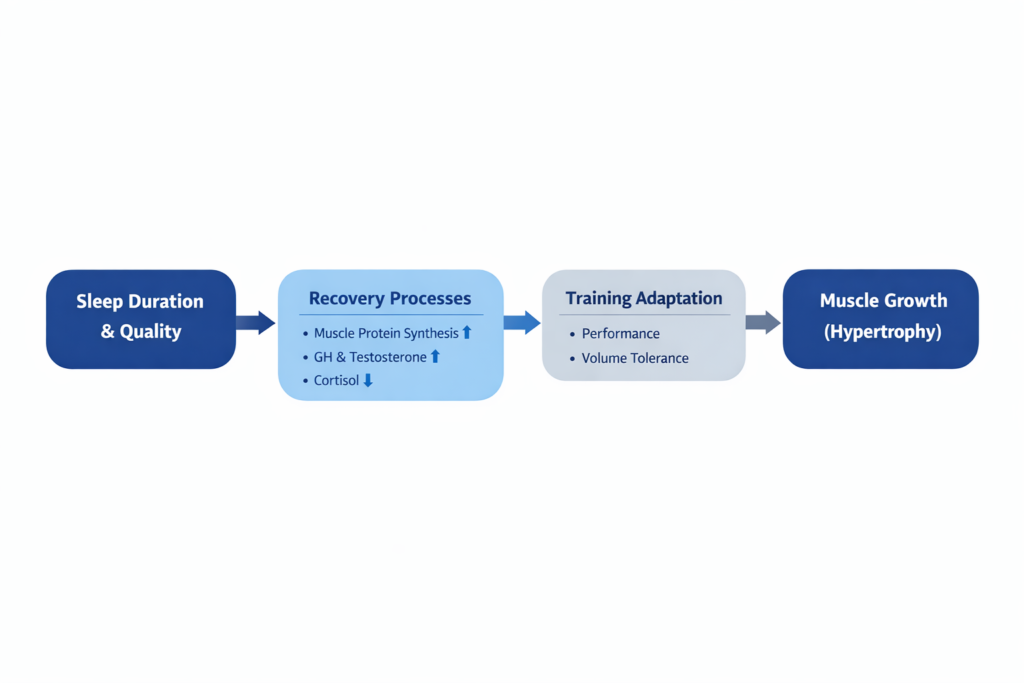
Sleep is the primary window where your body shifts from training stress to adaptation. Resistance training provides the stimulus, but sleep provides the biological environment that allows muscle repair, remodeling, and growth to occur.
During sleep:
- Muscle protein synthesis (MPS) increases
- Growth hormone secretion peaks
- Nervous system fatigue is reduced
- Glycogen is replenished
- Inflammation is regulated
Without sufficient sleep, these processes are impaired—regardless of how good your program looks on paper.
Sleep is one of the core drivers of recovery and muscle growth, alongside training stimulus and adequate nutrition.
How Sleep Affects Hypertrophy Physiology
Muscle Protein Synthesis
Several studies show that sleep restriction reduces post-exercise muscle protein synthesis, even when protein intake is adequate. Less sleep = weaker anabolic response.
This means:
- You build less muscle from the same training session
- Recovery between sessions is slower
- Net muscle balance shifts toward maintenance or loss
Hormonal Environment
Sleep strongly influences key hormones related to hypertrophy:
- Growth hormone: Released primarily during deep sleep
- Testosterone: Short sleep reduces morning testosterone levels
- Cortisol: Sleep deprivation elevates cortisol, increasing catabolism
The combination of lower anabolic hormones and higher stress hormones creates a poor environment for muscle growth.
Sleep Deprivation and Muscle Loss
Sleep loss doesn’t just slow gains—it can actively promote muscle loss.
Research suggests that even short-term sleep restriction can:
- Reduce lean mass retention during calorie deficits
- Increase muscle protein breakdown
- Shift weight loss toward muscle rather than fat
This is especially relevant during cutting phases, where sleep becomes a critical muscle-sparing factor.
Sleep, Training Performance, and Volume Tolerance
Hypertrophy is tightly linked to training quality and volume tolerance—both of which depend on sleep.
Poor sleep is associated with:
- Reduced strength output
- Lower repetition performance
- Impaired motor coordination
- Increased perceived effort (RPE)
Over time, this leads to:
- Lower effective training volume
- Reduced progressive overload
- Higher injury risk
Even if motivation is high, the nervous system simply can’t perform optimally without sufficient sleep.
When sleep is consistently poor, implementing deloads or reducing training load can help manage fatigue and preserve performance.
How Much Sleep Do You Need for Hypertrophy?
For most lifters:
- Minimum: ~7 hours per night
- Optimal: 7–9 hours consistently
Some individuals may require slightly more, especially:
- During high-volume training blocks
- While dieting
- Under high life stress
Importantly, consistency matters more than occasional long nights. Chronic short sleep cannot be “caught up” with weekend oversleeping.
Sleep Quality vs Sleep Quantity
Eight hours of fragmented, poor-quality sleep is not equivalent to eight hours of consolidated, deep sleep.
Key sleep quality factors:
- Regular sleep schedule
- Dark, cool sleeping environment
- Limited caffeine late in the day
- Reduced screen exposure before bed
Improving sleep quality can significantly enhance recovery—even without increasing total sleep time.
Why It Matters:
Sleep is not a passive recovery tool—it is an active driver of hypertrophy. Without sufficient, high-quality sleep, muscle growth is biologically constrained. Training harder or adding volume cannot compensate for chronic sleep deprivation.
If hypertrophy is the goal, sleep should be treated with the same priority as progressive overload and adequate protein intake.
Practical Takeaways
- Aim for 7–9 hours of sleep every night
- Prioritize sleep consistency over perfection
- Avoid aggressive training blocks during periods of poor sleep
- During fat loss, sleep becomes even more critical for muscle retention
- Treat sleep as part of your training plan—not an afterthought
References
1) Saner NJ, Lee MJC, Pitchford NW, et al. The effect of sleep restriction, with or without high-intensity interval exercise, on myofibrillar protein synthesis in healthy young men. J Physiol. 2020.
PMID: 32078168
https://pubmed.ncbi.nlm.nih.gov/32078168/
2) Lamon S, Morabito A, Arentson-Lantz E, et al. The effect of acute sleep deprivation on skeletal muscle protein synthesis and the hormonal environment in young men and women. Physiological Reports. 2021.
https://pmc.ncbi.nlm.nih.gov/articles/PMC7785053/
3) Nedeltcheva AV, Kilkus JM, Imperial J, Kasza K, Schoeller DA, Penev PD. Insufficient sleep undermines dietary efforts to reduce adiposity. Ann Intern Med. 2010.
PMID: 20921542
https://pubmed.ncbi.nlm.nih.gov/20921542/
4) Leproult R, Van Cauter E. Effect of 1 week of sleep restriction on testosterone levels in young healthy men. JAMA. 2011.
PMID: 21632481
https://pubmed.ncbi.nlm.nih.gov/21632481/
5) Leproult R, Copinschi G, Buxton O, Van Cauter E. Sleep loss results in an elevation of cortisol levels the next evening. Sleep. 1997.
PMID: 9415946
https://pubmed.ncbi.nlm.nih.gov/9415946/