
Protein for Muscle Growth: How Much You Need, Best Sources & Timing Explained
TL;DR
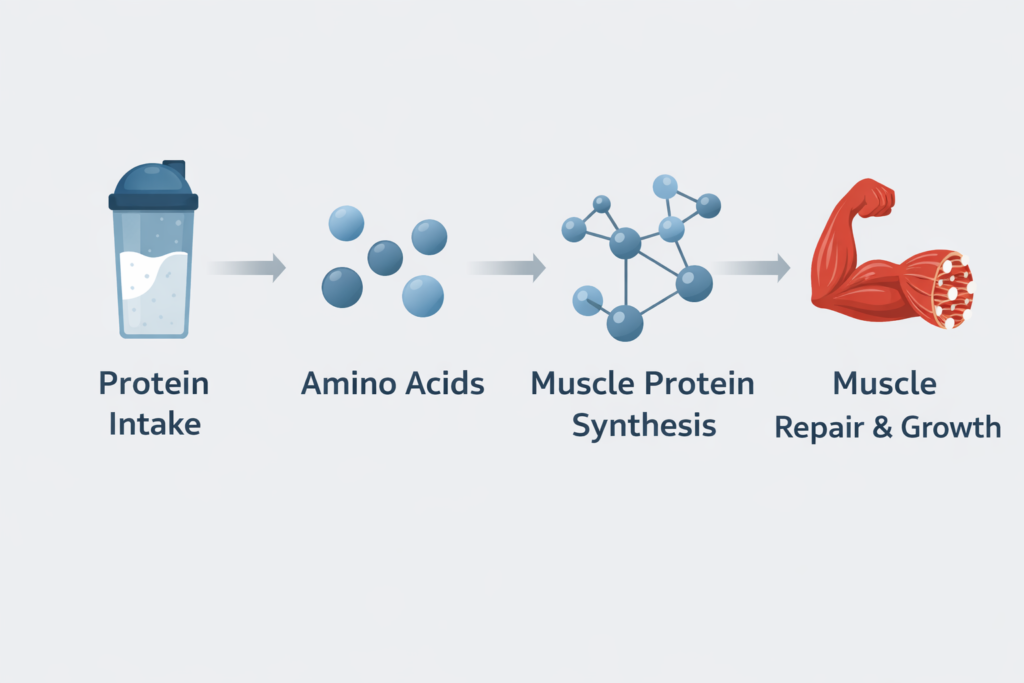
Protein is essential for muscle growth because it provides the amino acids required to repair and build muscle tissue after training.
- Most strength-trained individuals benefit from 1.6–2.2 g of protein per kg body weight per day
- Total daily protein intake matters more than precise timing
- Protein quality and amino acid composition influence muscle protein synthesis
- Both animal- and plant-based proteins can support hypertrophy when intake is sufficient
- Protein supplements are useful for convenience, not a requirement for results
This guide explains how protein for muscle growth works, how much you actually need, and how to apply the science in practice.
While protein intake is fundamental for muscle growth, it is often discussed alongside other evidence-based muscle-building supplements.
What Is Protein and Why It Matters for Muscle Growth
Protein is one of the three macronutrients, alongside carbohydrates and fats. Unlike carbs and fats, protein plays a structural role in the body. Muscles, tendons, enzymes, hormones, and parts of the immune system are all built from protein.
At the most basic level, protein is made up of amino acids. These amino acids act as building blocks that the body uses to repair tissue, create new cells, and adapt to physical stress. When you perform resistance training, you create microscopic damage to muscle fibers. Protein provides the raw material needed to repair that damage and make the muscle slightly larger and stronger than before — a process known as muscle hypertrophy.
Muscle Protein Synthesis Explained Simply
Muscle growth is regulated by the balance between:
- Muscle Protein Synthesis (MPS) – building new muscle proteins
- Muscle Protein Breakdown (MPB) – breaking down existing muscle proteins
When MPS exceeds MPB over time, muscle mass increases. Resistance training strongly stimulates MPS, but without sufficient dietary protein, this response is blunted. Protein intake does not “build muscle” on its own — it enables the adaptation created by training.
Together, these processes explain why protein for muscle growth plays a central role in resistance training adaptations.
How Much Protein Do You Need Per Day?
Protein requirements depend on several factors, including body weight, training status, energy intake, and goals. Over the last two decades, a large body of research has converged on a fairly narrow optimal range for people who lift weights.
Evidence-Based Protein Intake Range
For most resistance-trained individuals, the optimal intake for maximizing muscle growth is:
1.6–2.2 g of protein per kilogram of body weight per day
Protein needs can differ depending on whether the primary goal is fat loss or muscle gain. For a deeper comparison, see:
Protein for Fat Loss vs Muscle Gain
This range consistently maximizes muscle protein synthesis in both men and women.
Why More Isn’t Always Better
Consuming protein above this range does not appear to further increase muscle growth for most people. Once MPS is maximally stimulated, additional protein is either oxidized for energy or excreted.
Higher intakes may still be useful in specific situations:
- During calorie deficits
- For very lean individuals
- When appetite control is a priority
However, from a muscle-building standpoint, extremely high protein intakes are unnecessary.
Beginners vs Advanced Lifters
- Beginners can often grow muscle with slightly lower protein intake due to heightened training sensitivity.
- Advanced lifters benefit more consistently from intakes toward the upper end of the range, as gains are slower and adaptations more subtle.
For a detailed breakdown, calculations, and examples, see the mini-article:
How Much Protein Should You Eat Per Day?
Knowing your protein target is only part of the equation. To support muscle growth effectively, you also need appropriate calorie and macronutrient intake. Use our free Macro Calculator to estimate your daily calorie, protein, carbohydrate, and fat targets based on your body weight, activity level, and goal.
Best Protein Sources: Food First
Protein can come from a wide variety of foods. From a practical standpoint, whole food protein sources should form the foundation of any diet.
High-Quality Animal Protein Sources
Animal-based proteins are typically:
- Complete (contain all essential amino acids)
- Highly digestible
- Rich in leucine
Examples include:
- Meat (beef, poultry, pork)
- Fish and seafood
- Eggs
- Dairy products (milk, yogurt, cheese)
These foods are efficient at stimulating muscle protein synthesis and require minimal planning to meet amino acid needs.
Plant-Based Protein Sources
Plant proteins can absolutely support muscle growth, but they require more attention to:
- Total intake
- Variety
- Digestibility
Common plant protein sources include:
- Legumes (lentils, beans, chickpeas)
- Soy products (tofu, tempeh)
- Whole grains
- Nuts and seeds
By combining multiple sources and consuming sufficient total protein, plant-based diets can fully support hypertrophy.
For a focused discussion of which protein sources are most effective for muscle growth, see:
Best Protein Sources for Muscle Growth
Protein Quality and Amino Acids
Not all protein sources stimulate muscle protein synthesis equally. This difference is largely explained by amino acid composition and digestibility.
Essential Amino Acids (EAAs)
Of the 20 amino acids, nine are considered essential — meaning they must come from the diet. These are particularly important for muscle growth, as they directly stimulate MPS.
Leucine: The Key Trigger
Leucine plays a unique role by activating the mTOR pathway, which initiates muscle protein synthesis. Most research suggests that approximately 2–3 grams of leucine per meal is sufficient to maximally stimulate MPS.
Animal proteins generally reach this threshold more easily, while plant proteins may require larger servings or strategic combinations.
Protein Quality Scores
Protein quality is often evaluated using:
- PDCAAS (Protein Digestibility-Corrected Amino Acid Score)
- DIAAS (Digestible Indispensable Amino Acid Score)
While these scores are useful scientifically, they are less important in practice than total protein intake and food variety.
Animal vs Plant Protein for Muscle Growth
The debate between animal and plant protein is often framed as a competition, but physiologically, muscle responds to amino acids — not ideology.
What the Research Shows
When total protein intake is matched:
- Muscle growth is similar between animal- and plant-based diets
- Differences largely disappear when protein intake is sufficient
The key distinction is efficiency:
- Animal proteins require less volume to meet amino acid needs
- Plant proteins require more planning and often higher total intake
For a deeper comparison, see the mini-article:
Animal vs Plant Protein for Muscle Growth
Protein Timing and Distribution
Protein timing has historically been overstated. While timing does matter to some extent, it is secondary to total daily intake.
The “Anabolic Window” Myth
Muscle protein synthesis remains elevated for many hours after training. As long as protein is consumed within a reasonable timeframe before and after training, precise timing is not critical.
For an in-depth discussion of protein timing and whether timing actually matters for hypertrophy, see:
Does Protein Timing Matter for Muscle Growth?
Practical Protein Distribution
Most research supports distributing protein intake evenly across the day:
- 20–40 g of protein per meal
- 3–5 meals per day
This approach helps maintain repeated stimulation of muscle protein synthesis.
Protein distribution per meal and optimal dosing are explored further in:
How Much Protein Per Meal?
Protein Supplements: An Overview
Protein supplements are simply convenient food sources, not special muscle-building agents.
Common Protein Supplements
- Whey protein
- Casein protein
- Soy protein
- Pea and blended plant proteins
When Supplements Make Sense
- When total protein intake is difficult to reach through food
- When convenience is important
- Around training when appetite is low
When They’re Not Necessary
If you already meet protein needs through whole foods, supplements offer no additional muscle-building benefit.
Safety and Common Myths
Does High Protein Damage the Kidneys?
In healthy individuals, high protein intake has not been shown to impair kidney function. This myth likely originates from clinical populations with pre-existing kidney disease, where protein restriction is sometimes necessary.
Is There a “Maximum Safe Intake”?
Protein intakes well above typical recommendations have been studied without adverse effects in healthy adults. However, excessively high intakes provide no clear advantage for muscle growth.
Protein and Bone Health
Contrary to older claims, higher protein intake is associated with better bone health, particularly when combined with resistance training.
Practical Takeaways
- Aim for 1.6–2.2 g/kg/day of protein
- Prioritize whole food sources
- Distribute protein evenly across meals
- Use supplements for convenience, not necessity
- Focus on consistency over perfection
FAQ
How much protein do you need per day to build muscle?
Most evidence suggests that 1.6–2.2 grams of protein per kilogram of bodyweight per day maximizes hypertrophy for most individuals.
Is 2 grams of protein per kilogram necessary?
Not necessarily. Intakes above approximately 1.6 g/kg show diminishing returns for most people, though slightly higher intakes may provide a margin of safety during calorie deficits.
How much protein per meal is optimal?
Approximately 0.3–0.5 g/kg per meal appears sufficient to maximally stimulate muscle protein synthesis in most individuals.
Is plant protein as effective as animal protein?
Plant protein can effectively support muscle growth when total intake is adequate and essential amino acid intake is sufficient, though protein quality and leucine content may differ between sources.
References
Morton RW et al. A systematic review, meta-analysis and meta-regression of the effect of protein supplementation on resistance training–induced gains in muscle mass and strength. Br J Sports Med.
https://pubmed.ncbi.nlm.nih.gov/28698222/
Phillips SM, Van Loon LJC. Dietary protein for athletes: from requirements to optimum adaptation. J Sports Sci.
https://pubmed.ncbi.nlm.nih.gov/22150425/
Schoenfeld BJ, Aragon AA. How much protein can the body use in a single meal for muscle-building? J Int Soc Sports Nutr.
https://pubmed.ncbi.nlm.nih.gov/29497353/


