Progressive Overload Explained: How to Keep Building Muscle
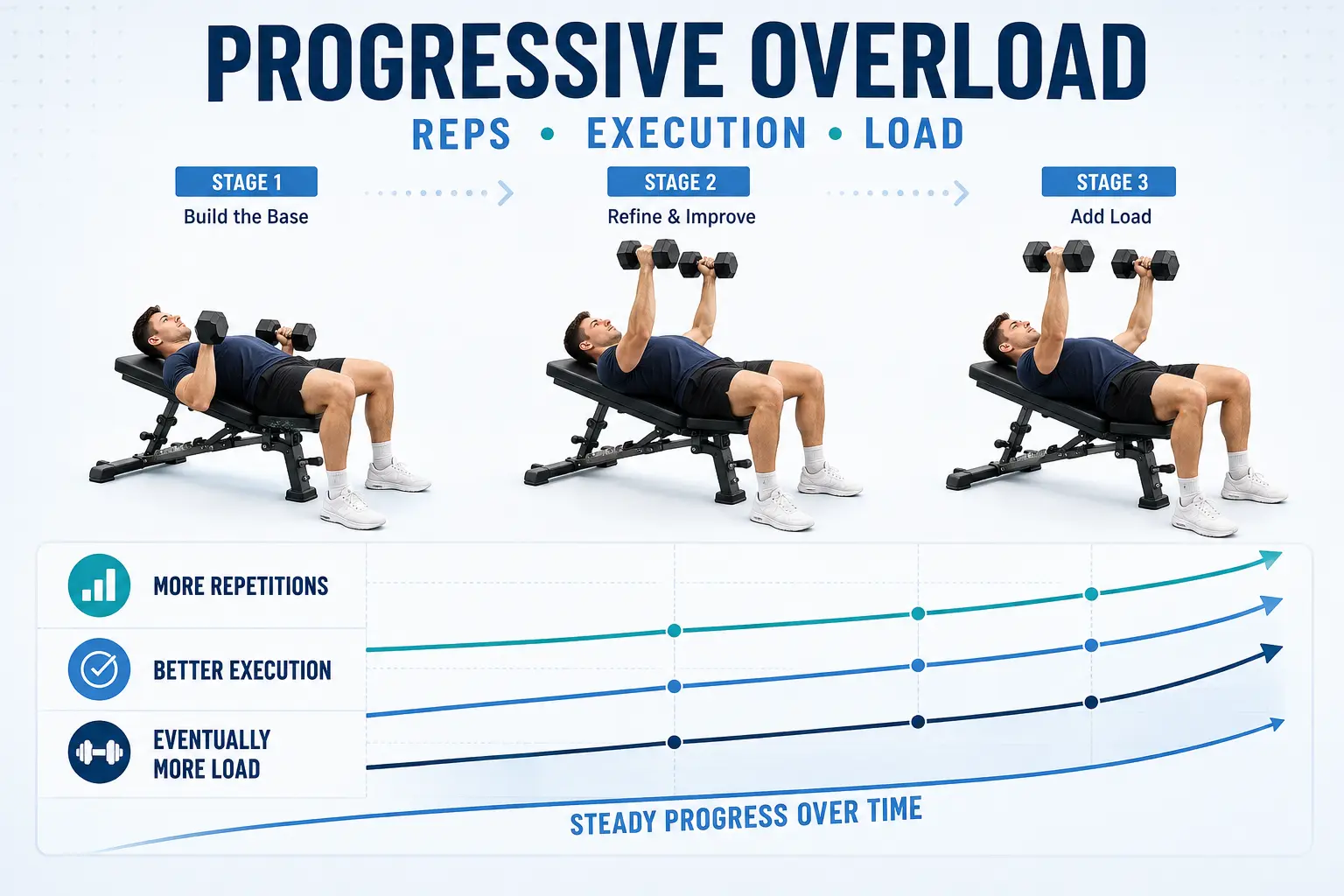
Progressive overload is often reduced to “add weight every workout.” That is useful when it happens naturally, but it is not the full principle. Long-term hypertrophy requires training demands to remain challenging as your capacity improves—not forcing a heavier number onto the bar regardless of execution.
What Is Progressive Overload?
Progressive overload is the planned increase in training demands needed to keep a programme appropriately challenging as you become more capable. If the same workout becomes easier, repeating it forever provides less relative stress than it once did.
However, overload and progress are not exactly the same thing. Adding 2.5 kg is an input. Completing more repetitions with stable technique is an outcome. Both can be useful, but blindly increasing the input does not guarantee a better hypertrophy stimulus.
Why Progressive Overload Matters for Muscle Growth
Resistance training exposes muscle fibres to mechanical tension. Over time, repeated bouts of sufficiently challenging training can contribute to hypertrophy. As strength, skill and work capacity improve, the programme must evolve enough to keep producing an effective stimulus.
Progressive overload is therefore not a separate biological “muscle-growth mechanism.” It is a programming principle that helps maintain the conditions required for adaptation. Read more about mechanical tension and hypertrophy.
Progress also does not need to appear every session. Short-term performance changes with sleep, food, stress, exercise order and normal measurement noise. The signal becomes clearer across multiple exposures.
Methods of Progressive Overload
| Method | Example | What must stay stable | Main caution |
|---|---|---|---|
| More repetitions | 8 reps becomes 10 with the same load | Technique, range of motion and proximity to failure | Do not shorten the movement to manufacture reps. |
| More load | 80 kg becomes 82.5 kg | Target muscle contribution and execution | A heavier lift is not better if technique changes materially. |
| Better execution | More controlled reps with less unwanted momentum | Load and rep target | Harder execution can temporarily lower recorded performance. |
| Greater range of motion | Progressing from a shortened to a consistent full ROM | Control and relevant joint tolerance | Compare like with like in the training log. |
| More productive volume | Adding one weekly set to a stalled muscle | Set effort and recovery | More sets create fatigue and should not be added automatically. |
| Harder variation | Moving to a more demanding exercise progression | Target and purpose of the exercise | A new movement resets the comparison. |
Reducing rest periods can make a workout harder, but it often reduces load or repetition performance. For hypertrophy, shorter rest is not automatically a productive form of overload. Use enough rest between sets to preserve the work you are trying to progress.
A Simple Double-Progression Method
Double progression is one of the most reliable ways to turn the principle into a repeatable decision.
For example, 8–12 repetitions with a consistent execution standard.
Keep the load while performance gradually moves through the range.
When all prescribed sets reach the top with the intended RIR, increase weight and rebuild.
Example: You prescribe three sets of 8–12 repetitions at approximately 1–2 reps in reserve. Once all three sets reach 12 repetitions without a meaningful technique change, add the smallest practical load. Repetitions may return to eight or nine, which begins the next progression cycle.
How Fast Should Progressive Overload Happen?
There is no universal schedule. Beginners often progress rapidly because skill and strength improve at the same time. Intermediate and advanced lifters usually need smaller increases across longer periods.
Early training
Repetitions or load may improve most weeks, although part of that improvement reflects learning the movement.
Intermediate training
Progress is less linear and is better evaluated across several weeks.
Advanced training
Small improvements in a rep, execution or a specific lift can be meaningful across a training block.
During a calorie deficit
Maintaining performance can represent a successful outcome while bodyweight decreases.
Do not confuse fast loading progression with fast muscle gain. Neural adaptation, technique and confidence can increase performance before substantial hypertrophy occurs.
What Should You Do When Progression Stalls?
A plateau is a prompt to diagnose—not an automatic instruction to add sets. First determine whether the comparison is valid and the stall is persistent.
Compare the same exercise, order, range of motion and effort target.
Review sleep, calories, stress, soreness and performance across other lifts.
Adjust load, reps, volume or exercise choice—then observe the result.
If several lifts decline and fatigue is rising, adding overload may worsen the problem. Review recovery and muscle growth or whether a deload is appropriate. If one muscle stalls while recovery remains strong, a small increase in training volume may be worth testing.
Common Progressive Overload Mistakes
Adding weight regardless of form
The number rises while range of motion or target-muscle contribution falls.
Changing exercises too often
Constant novelty prevents reliable comparisons and skill development.
Adding sets on a calendar
Volume rises without evidence that the previous dose stopped working.
Taking every set to failure
Effort becomes maximal while fatigue makes subsequent performance harder to interpret.
Ignoring bodyweight changes
Maintaining repetitions during a cut—or a bodyweight exercise at a higher body mass—can hide progress.
Reacting to one workout
One poor session is normal variation. Use a trend before rewriting the programme.
Frequently Asked Questions
Does progressive overload mean adding weight every workout?
No. More repetitions, better execution, greater range of motion and carefully added productive volume can also progress training. Load should rise when performance supports it.
Can you build muscle without getting stronger?
Short-term strength and hypertrophy do not move perfectly together, but a long-term inability to improve any relevant performance measure may indicate that training or recovery should be reassessed.
How often should you progressively overload?
There is no fixed interval. Progress when repetitions, technique and effort show that the current prescription has become more manageable.
Is adding sets progressive overload?
It can increase training demand, but it also increases fatigue. Add volume only when the existing work is high quality, progress has stalled and recovery remains adequate.
References
- Currier BS et al. American College of Sports Medicine Position Stand: Resistance Training Prescription for Muscle Function, Hypertrophy, and Physical Performance in Healthy Adults. Med Sci Sports Exerc. 2026. PubMed.
- American College of Sports Medicine. Progression models in resistance training for healthy adults. Med Sci Sports Exerc. 2009. PubMed.
- Schoenfeld BJ. The mechanisms of muscle hypertrophy and their application to resistance training. J Strength Cond Res. 2010. PubMed.