Deload Training Explained: When and How to Deload
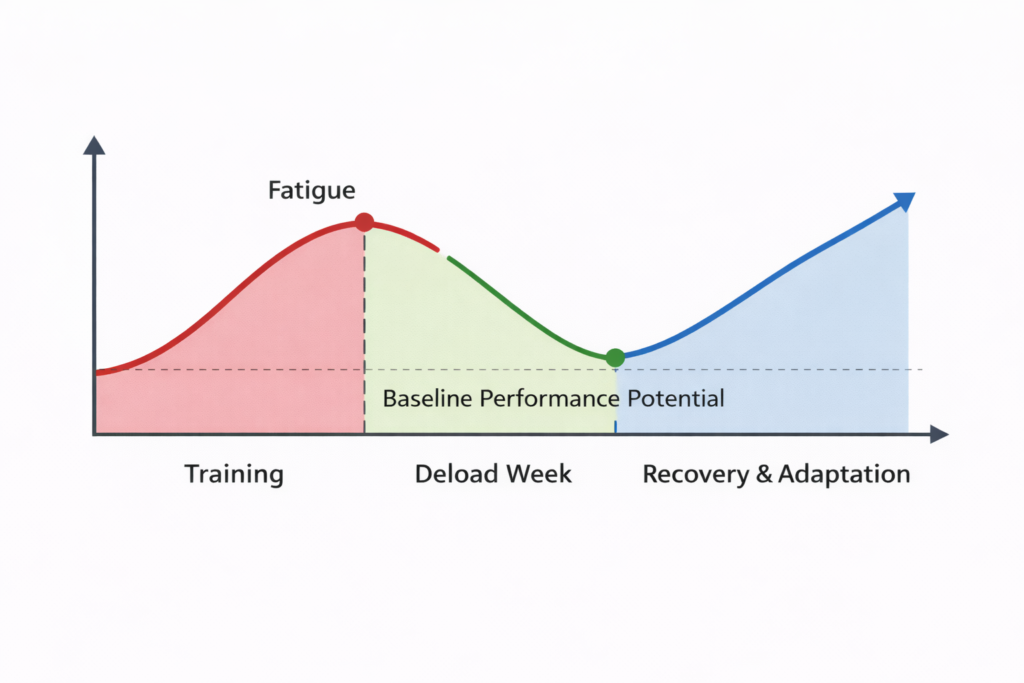
A deload is useful when it solves a recovery problem. It is not a mandatory ritual that every lifter must perform every fourth week, and current research does not establish one optimal schedule or protocol.
What Is a Deload?
A deload is a defined period of reduced training stress intended to reduce physiological or psychological fatigue and improve readiness for the next phase of training. In strength and physique sport, it commonly lasts around 5–7 days, although the appropriate duration depends on the problem being addressed.
Training stress can be reduced by changing one or more variables:
- Performing fewer hard sets
- Stopping further from failure
- Using lighter loads
- Training fewer days
- Removing unusually fatiguing exercises
- Taking several complete rest days
A deload is different from a competition taper. A taper is designed to maximize performance for a specific event; a deload is a broader fatigue-management tool within ongoing training.
How Do You Know Whether You Need a Deload?
One poor session is not enough. Look for a cluster of changes that persists despite normal sleep, nutrition and life stress.
| Signal | What it may mean | Check before deloading |
|---|---|---|
| Performance declines across several sessions | Accumulated fatigue may be masking fitness | Exercise order, technique, nutrition and acute illness |
| Usual loads feel unusually difficult | Readiness may be reduced | Sleep, calorie intake and recent stress |
| Persistent joint or connective-tissue irritation | Repeated loading may need modification | Pain severity, technique and whether clinical assessment is appropriate |
| Motivation falls alongside poor performance | Psychological and physical fatigue may overlap | Whether boredom or programme design is the primary issue |
| Only one exercise stalls | Often a local programming issue | Load jump, exercise fit and target-muscle execution |
How Should You Structure a Deload?
Reducing volume is often the cleanest starting point because it lowers total work while allowing you to practise familiar movements. There is no universally validated percentage, so the size of the reduction should reflect how fatigued you are.
| Method | Example | When it fits | Trade-off |
|---|---|---|---|
| Reduce sets | Perform roughly half of the usual work sets | General accumulated fatigue | Retains movement practice with much less work |
| Increase RIR | Stop 3–5 reps from failure | High effort has accumulated | Load can remain familiar while sets become easier |
| Reduce load | Use approximately 10–20% less weight | Heavy loading or joint stress is the concern | May feel less specific for strength practice |
| Reduce frequency | Complete two sessions instead of four | Time, sleep or whole-body fatigue is limited | Less practice but more complete recovery days |
| Complete rest | Take most or all of the week off | Travel, illness recovery or strong psychological fatigue | Simple, but some lifters feel less practised on return |
A practical general-purpose week might retain the same exercises, cut work sets by approximately 40–60% and keep every set several repetitions from failure. That is a coaching template—not a biologically precise formula.
Example: Turning a Normal Week Into a Deload
| Variable | Normal week | Example deload |
|---|---|---|
| Weekly sessions | 4 | 3–4 |
| Sets per exercise | 3–4 | 1–2 |
| Proximity to failure | 0–3 RIR | 3–5 RIR |
| Load | Normal working load | Same or modestly reduced |
| Exercise selection | Full programme | Keep key lifts; remove optional fatigue |
Planned vs Reactive Deloads
Planned deload
Scheduled before fatigue becomes disruptive. Useful after predictably demanding blocks, before testing or when life already creates a natural lighter week.
Reactive deload
Introduced when performance and recovery trends show that fatigue is already interfering. Useful when training stress and life stress are less predictable.
Neither approach is universally superior. A rigid four-week calendar can cause unnecessary deloads, while waiting until performance collapses can keep an athlete in an unproductive state too long. The more stable and demanding the programme, the easier fatigue may be to anticipate.
What Does Research Say About Deloads?
Direct deload research remains limited. A 2023 expert consensus described deloading as reduced training stress intended to mitigate fatigue and improve preparedness, but consensus about practice is not the same as proof that one protocol maximizes hypertrophy.
A 2024 study in resistance-trained people compared continuous training with a one-week midpoint break involving complete training cessation. Hypertrophy, power and muscular endurance were similar, but continuous training produced somewhat better lower-body strength outcomes. The deload did not produce the proposed “re-sensitization” advantage.
A 2026 study in 19 untrained men used reduced set volume and frequency during two weeks of an eight-week programme. The deload and continuous conditions produced similar muscle-thickness and strength-endurance changes, despite the deload condition completing less total volume. These findings suggest that short reductions do not necessarily erase progress; they do not establish that everyone benefits from scheduled deloads.
Will You Lose Muscle During a Deload?
A normal one-week deload is unlikely to cause meaningful muscle loss. Muscle size measurements can change slightly with glycogen, water and training-induced swelling, so looking or feeling “flatter” is not proof that contractile tissue has disappeared.
Even substantially reduced training can preserve adaptations for longer than a typical deload. This is one reason you do not need to turn a recovery week into another demanding stimulus.
How Should You Return After a Deload?
Avoid introducing several novel movements immediately after reducing fatigue.
Return to the previous productive dose unless it caused the fatigue problem.
Improved readiness should show through training quality—not only enthusiasm on day one.
If the same fatigue returns immediately, the underlying programme may exceed your recovery capacity. Review fatigue management, excessive training volume and the broader recovery guide.
Frequently Asked Questions
How often should you deload?
There is no universal interval. Use performance, recovery and the demands of the current training block. Some lifters schedule deloads; others use them only when persistent fatigue appears.
How long should a deload last?
About 5–7 days is common, but the appropriate duration depends on fatigue, training design and practical circumstances.
Should you stop training completely during a deload?
Not necessarily. Most deloads can retain familiar exercises while reducing sets and effort. Complete rest is an option, not a requirement.
Should you reduce weight or sets during a deload?
Reducing sets is a simple starting method. Load can remain familiar if sets stop well before failure, or it can be reduced when heavy loading and joint stress are part of the problem.
Will a deload make you weaker?
A brief deload may temporarily change how practised a lift feels, but it is unlikely to erase meaningful strength or muscle. Complete cessation may be less useful when maximizing immediate strength performance is the priority.
References
- Bell L et al. Integrating Deloading into Strength and Physique Sports Training Programmes: An International Delphi Consensus Approach. 2023. Full text.
- Coleman M et al. Gaining more from doing less? The effects of a one-week deload period during supervised resistance training on muscular adaptations. 2024. Full text.
- Pancar Z et al. Effects of deload periods in resistance training on muscle hypertrophy and strength endurance in untrained young men using a randomized within-subject design. Sci Rep. 2026. Full text.
- Bickel CS, Cross JM, Bamman MM. Exercise dosing to retain resistance training adaptations in young and older adults. Med Sci Sports Exerc. 2011. PubMed.