Training Frequency for Hypertrophy: How Often Should You Train Each Muscle?
TL;DR
- Training frequency matters because it distributes weekly volume, not because more sessions magically stimulate more growth.
- 2× per muscle per week is a strong default for hypertrophy.
- Higher frequencies can help manage fatigue and improve quality, not necessarily increase total growth.
- Weekly volume, proximity to failure, and recovery matter more than frequency alone.
This article explains training frequency for hypertrophy and how often each muscle should be trained based on current evidence.
Beginner explanation: what is training frequency?
Training frequency refers to how many times per week you train a specific muscle group, not how often you go to the gym.
Examples:
- Chest trained Monday only → 1×/week
- Chest trained Monday + Thursday → 2×/week
- Chest trained Monday, Wednesday, Friday → 3×/week
For hypertrophy, frequency is best understood as a tool to organize volume and recovery, not a growth driver on its own.
What does the science say about frequency and muscle growth?
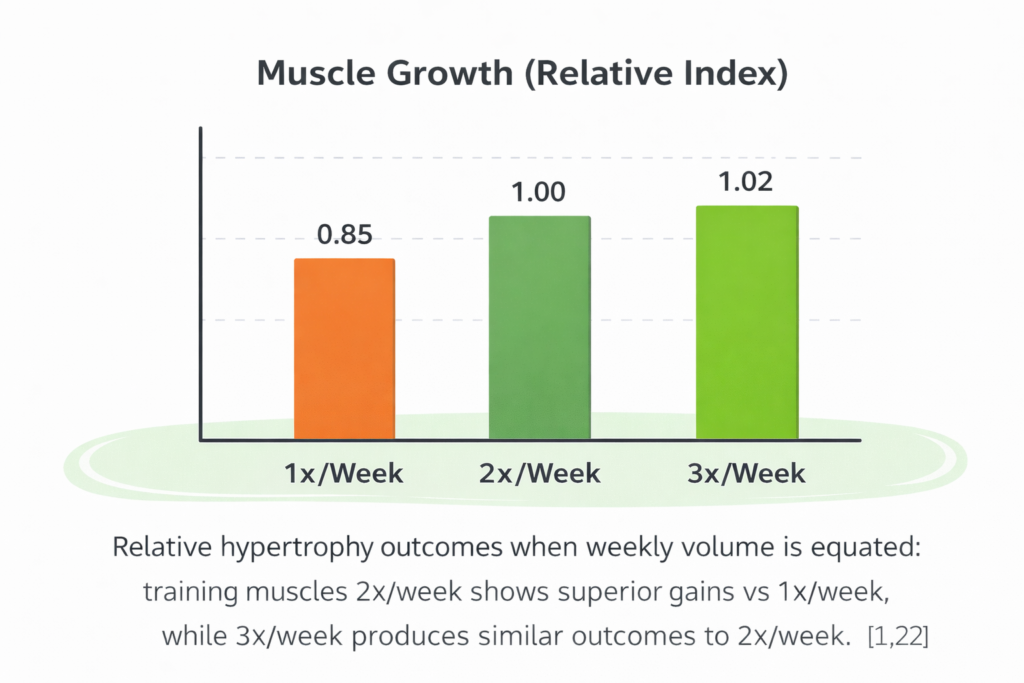
When weekly volume is matched, training frequency has little to no independent effect on hypertrophy.
Research consistently shows:
- 1× vs 2× vs 3× per week → similar muscle growth, if total weekly sets are equal
- Higher frequency mainly helps by:
- Reducing per-session fatigue
- Allowing higher quality sets
- Improving technique consistency
In other words:
Muscles grow from total effective volume over time — frequency just decides how you split it.
Why 2× per week is often the sweet spot
Training each muscle twice per week offers several practical advantages:
1. Better volume distribution
Instead of cramming 12–16 sets into one brutal session, you might do:
- 6–8 sets on Day A
- 6–8 sets on Day B
This typically leads to:
- Better performance per set
- Less joint and connective tissue stress
2. Improved recovery management
Muscle protein synthesis peaks for ~24–48 hours after training.
Training a muscle again once recovery is complete ensures regular stimulation without excessive overlap.
3. Sustainable long-term progression
2× frequency works well for:
- Beginners
- Intermediates
- Most advanced lifters outside specialization phases
When higher frequency (3–4×/week) can make sense
Higher frequencies are situational, not mandatory.
They may be useful when:
- A muscle is a lagging body part
- Weekly volume is high (15–25+ sets)
- You want shorter, higher-quality sessions
- Technique-heavy lifts benefit from frequent practice
Example:
- Side delts or calves trained 3–4×/week with low per-session volume
- Large muscles (quads, chest, back) usually cap out around 2–3×/week
Is 1× per week ever optimal?
Yes — but mostly in specific contexts:
- Very high per-session volume (advanced bodybuilders)
- Limited weekly training days
- Short-term specialization blocks
However, for most lifters, 1×/week is harder to recover from and easier to under-stimulate if volume quality drops.
Practical recommendations (evidence-based)
Most people (default)
- 2× per muscle per week
- 10–20 weekly sets per muscle
- 1–3 reps in reserve on most sets
Beginners
- Full-body or upper/lower splits
- 2–3× per muscle per week
- Lower per-session volume
Advanced lifters
- Base muscles: 2×/week
- Lagging muscles: 3–4×/week
- Frequency adjusted to manage fatigue, not chase novelty
Key takeaway
Training frequency does not drive hypertrophy by itself.
Instead, it:
- Helps distribute volume
- Improves set quality
- Manages fatigue and recovery
If you’re unsure what to choose, train each muscle twice per week, progress your loads and reps over time, and adjust only when recovery or volume becomes a bottleneck.
Training frequency should always be adjusted in the context of total volume, recovery capacity, and long-term progression — not viewed as an isolated driver of muscle growth.
References
Schoenfeld BJ, Ogborn D, Krieger JW. How many times per week should a muscle be trained to maximize muscle hypertrophy? A systematic review and meta-analysis of studies examining the effects of resistance training frequency. J Sports Sci. 2018.
— Volume-equated studies show no meaningful hypertrophy difference when frequency varies, and individuals can choose frequency based on preference.
Link: https://pubmed.ncbi.nlm.nih.gov/30558493/
Schoenfeld BJ, Ogborn D, Krieger JW. Effects of resistance training frequency on measures of muscle hypertrophy: a systematic review and meta-analysis. Sports Med. 2016.
— Data indicate that when volume is equated, twice weekly frequency tends to outperform once weekly for hypertrophy and supports 2×/week as an evidence-based default.
Link: https://pubmed.ncbi.nlm.nih.gov/27102172/
Grgic J, et al. Resistance training frequency and adaptations in skeletal muscle: current evidence and practical considerations. J Sci Med Sport. (abstract/summary available).
— Review confirms that higher frequencies may not independently drive hypertrophy beyond volume, and equating volume across frequencies produces similar muscle growth outcomes.
Link: https://pubmed.ncbi.nlm.nih.gov/?term=Resistance+training+frequency+hypertrophy