
Does Protein Timing Matter for Muscle Growth?
TL;DR
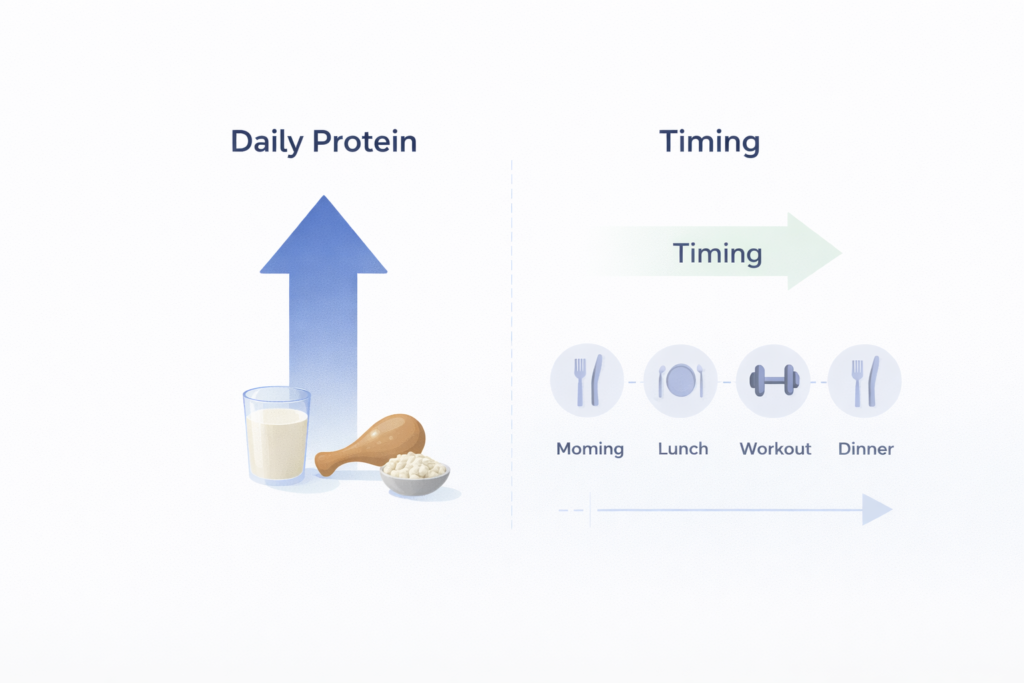
- Total daily protein intake is far more important than precise timing.
- Protein timing has only a small effect once daily intake is sufficient.
- Spreading protein across meals may support muscle protein synthesis.
- There is no narrow “anabolic window” that requires immediate post-workout protein.
Protein timing is just one part of a larger picture, which is explained in the complete protein for muscle growth guide.
Beginner Explanation: What Is Protein Timing?
Protein timing refers to when you consume protein during the day—most commonly around workouts or evenly spaced across meals.
For years, fitness culture promoted the idea of a narrow “anabolic window,” suggesting that protein had to be consumed immediately after training to stimulate muscle growth. Modern research has largely debunked this oversimplified view.
Instead, muscle growth depends primarily on total protein intake over the day, with timing playing a secondary, supportive role.
The Science: Does Timing Affect Muscle Protein Synthesis?
Muscle protein synthesis (MPS) increases after resistance training and remains elevated for at least 24–48 hours. This means your muscles are responsive to protein for far longer than a short post-workout window.
Studies consistently show that when total daily protein intake is matched, precise timing around workouts has little impact on overall hypertrophy outcomes.
However, protein distribution does matter to a degree. Consuming sufficient protein doses across multiple meals can stimulate MPS multiple times per day, which may be beneficial compared to skewing most protein into a single meal.
Protein Timing vs Total Daily Intake
If you had to prioritize only one variable, it should always be total daily protein intake. Without enough protein across the day, timing becomes irrelevant.
Once daily intake is adequate, timing can be used to optimize habits rather than drive dramatic gains. Think of protein timing as a refinement tool—not a requirement.
Is Post-Workout Protein Really More Important?
Post-workout protein intake is often framed as uniquely important, but this typical framing can be misleading. Resistance training increases muscle protein synthesis for many hours, meaning the muscle remains responsive to protein well beyond the immediate post-exercise period.
Consuming protein after training is still practical and sensible, especially if it helps ensure your adequate daily intake. However, studies comparing different timing strategies consistently show that total protein intake and overall distribution across the day explain most differences in muscle growth outcomes.
In practice, post-workout protein should be viewed as a convenient opportunity rather than a strict requirement.
Who Might Benefit Most From Protein Timing?
While timing is less critical for beginners, it may be slightly more relevant for:
- Advanced lifters with high training volumes
- Individuals training multiple times per day
- People with very low meal frequency
Even in these cases, the effect size remains modest compared to total intake.
Common Misconceptions About Protein Timing
One of the most persistent myths in fitness nutrition is the idea of a narrow anabolic window that closes shortly after training. This belief has led many lifters to prioritize immediate post-workout protein intake while neglecting overall daily intake.
In reality, muscle protein synthesis remains elevated for many hours after resistance training. As long as total protein intake is sufficient and reasonably distributed across meals, precise timing plays a minor role for most individuals.
Practical Takeaways: How to Time Protein in Real Life
- Aim for adequate total protein per day before worrying about timing.
- Distribute protein across 3–5 meals to stimulate MPS multiple times.
- Consuming protein within a few hours before or after training is sufficient.
- No need to rush a protein shake immediately after workouts.
References
- Schoenfeld BJ, Aragon AA. Nutrient timing revisited: is there a post-exercise anabolic window?
- Moore DR et al. Protein ingestion to stimulate myofibrillar protein synthesis
- Morton RW et al. Protein intake and resistance training adaptations


