
How Much Protein Per Meal?
TL;DR
- Total daily protein intake is the most important factor for muscle growth and body composition
- Protein per meal influences the timing of muscle protein synthesis (MPS), not how much protein your body can absorb
- MPS is maximized at roughly 0.25–0.4 g protein per kg body weight per meal for most people
- This usually equals 20–40 g protein per meal, depending on body size and protein quality
- Protein per meal is a secondary optimization variable, not a requirement for building muscle
Per-meal protein intake is discussed here in detail, but it sits within the broader framework outlined in the protein for muscle growth guide.
Beginner Explanation: Why Protein Per Meal Is Discussed
When you eat protein, it is digested into amino acids that stimulate muscle protein synthesis (MPS). This process allows the body to build and repair muscle tissue in response to resistance training.
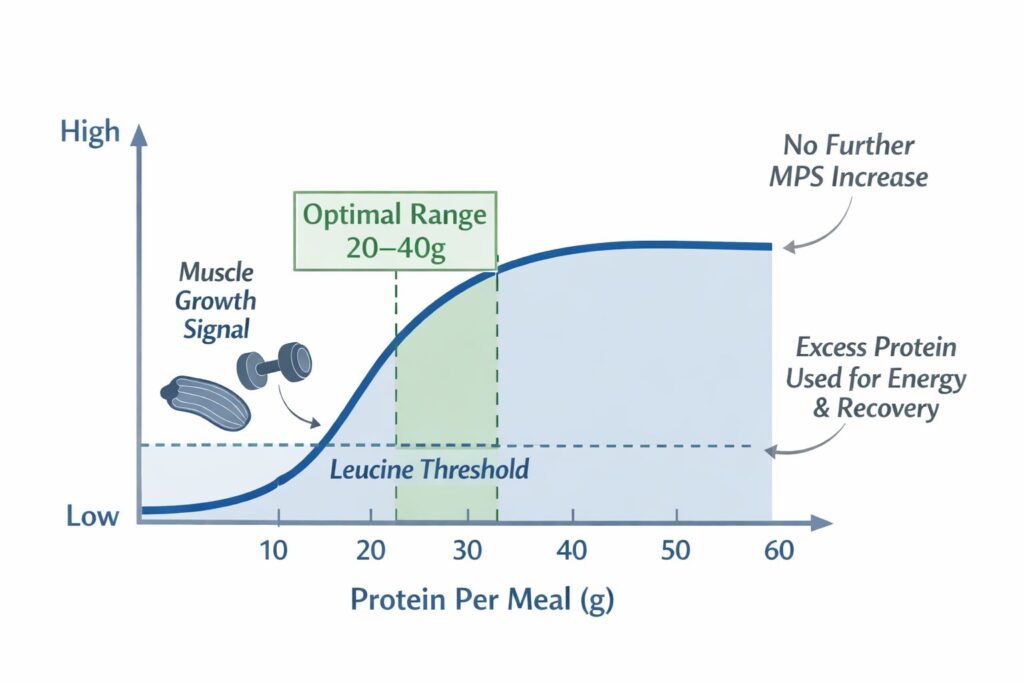
However, MPS does not increase indefinitely as more protein is consumed in a single meal. Instead, it reaches a plateau once a sufficient protein dose is reached. Consuming more protein beyond that point does not further increase the muscle-building signal.
This is why protein distribution across the day is often discussed. By spreading protein intake over multiple meals, MPS can be stimulated several times rather than only once or twice.
Why Total Daily Protein Matters More Than Protein Per Meal
While protein per meal influences how often muscle protein synthesis is stimulated, it is far less important than total daily protein intake.
From a physiological standpoint, the body can digest, absorb, and utilize large protein doses — even 60–80 grams in a single meal. The limiting factor is not absorption, but the muscle-building signal itself. Once muscle protein synthesis is maximally stimulated, additional protein does not further increase the response.
This means that protein per meal affects the timing of muscle protein synthesis peaks, not how much protein your body can ultimately use. For most people, consistently hitting an adequate daily protein target is significantly more important than perfectly distributing protein across meals.
Protein per meal should therefore be viewed as a secondary optimization variable, not a strict rule for muscle growth.
The Science: How Much Protein Maximizes MPS Per Meal?
Controlled trials examining protein dose and muscle protein synthesis show a clear dose–response relationship.
Across multiple studies:
- Maximal MPS is generally achieved at approximately 0.25–0.4 g of protein per kilogram of body weight per meal
- Consuming protein beyond this range does not meaningfully increase MPS in young, healthy adults
- Larger individuals tend to require doses toward the upper end of the range
- Older adults may require slightly higher per-meal doses due to anabolic resistance
In practical terms, this explains the commonly cited guideline of 20–40 grams of protein per meal. This range reflects the amount needed to saturate muscle protein synthesis under typical conditions.
Leucine Threshold and Protein Quality
Protein quality plays an important role in determining how much protein is required per meal.
Leucine, an essential amino acid, acts as a trigger for muscle protein synthesis. Proteins rich in leucine stimulate MPS more efficiently than proteins with lower leucine content.
As a result:
- High-quality proteins such as whey, dairy, eggs, meat, and fish can reach maximal MPS at lower total protein doses
- Many plant-based proteins require larger portions or strategic combinations to achieve the same effect
This is why both protein quantity and protein source matter when planning meals.
Is Eating More Than 40 g of Protein Per Meal a Waste?
No. Protein consumed beyond the MPS ceiling is not wasted.
Protein eaten in larger doses still contributes to:
- Total daily protein intake
- Satiety and appetite control
- Recovery and tissue repair
- Energy needs
However, from a muscle-building efficiency perspective, spreading protein intake across meals is generally more effective than consuming very large amounts in a single sitting.
Practical Takeaways: How to Structure Protein Intake
For most strength-training individuals:
- Prioritize meeting your daily protein target first
- Aim for 3–5 protein-containing meals per day when practical
- Target roughly 0.25–0.4 g protein per kg body weight per meal
- Focus on high-quality protein sources when possible
This approach balances scientific accuracy with practicality and avoids unnecessary rigidity.
Once you have a practical meal structure, the next step is setting your full daily intake. Use our free Macro Calculator to estimate your calorie, protein, carbohydrate, and fat targets based on your body weight, activity level, and goal.
References
- Moore DR et al.
Protein ingestion to stimulate myofibrillar protein synthesis requires greater relative protein intakes in healthy older versus younger men.
American Journal of Clinical Nutrition.
https://pubmed.ncbi.nlm.nih.gov/20357034/ - Schoenfeld BJ, Aragon AA.
How much protein can the body use in a single meal for muscle-building? Implications for daily protein distribution.
Journal of the International Society of Sports Nutrition.
https://pubmed.ncbi.nlm.nih.gov/29497353/ - Morton RW et al.
A systematic review, meta-analysis and meta-regression of protein supplementation and resistance training.
British Journal of Sports Medicine.
https://pubmed.ncbi.nlm.nih.gov/28698222/


