Creatine Upset Stomach: Why It Happens and How to Fix It
TL;DR
If you’re experiencing creatine upset stomach symptoms like bloating, nausea, or diarrhea, you’re not alone. While creatine is one of the safest supplements in sports nutrition, digestive discomfort can occur — especially at higher doses.
- Creatine can cause stomach discomfort if taken in large single doses
- Most issues are related to osmotic effects in the intestine
- Splitting doses (3–5 g/day) solves the problem for most people
- Taking creatine with food often reduces nausea
- Creatine monohydrate is generally well tolerated when dosed correctly
How to Prevent Creatine Upset Stomach
If creatine gives you stomach pain, bloating, or diarrhea, the supplement itself is rarely “toxic.”
The issue is usually dose and concentration.
Creatine monohydrate is one of the most researched supplements in sports nutrition. If you want a complete overview of benefits and safety.
See our full guide:
Creatine: Benefits, Dosage, Safety, and What the Research Says
1. Osmotic effect in the gut
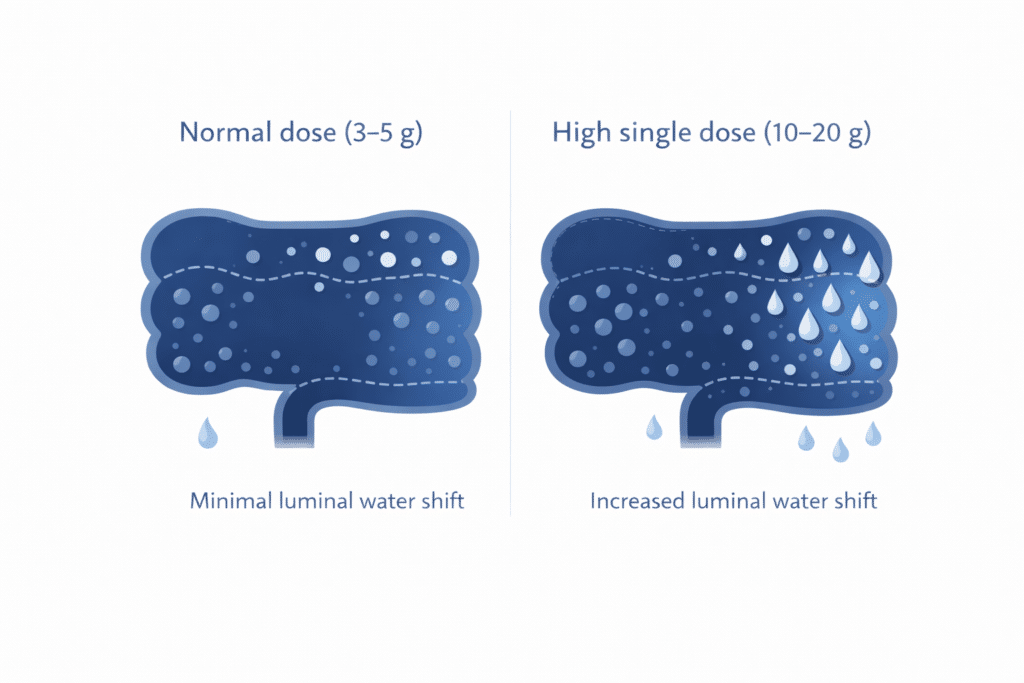
Creatine is an osmotically active compound.
When you ingest a large dose (e.g., 10–20 g at once), unabsorbed creatine can pull water into the intestine. This increases luminal fluid and may lead to:
- Loose stools
- Bloating
- Cramping
- Urgency
This is the same mechanism seen with other poorly absorbed compounds.
2. Loading phase intolerance
The classic loading protocol is:
20 g per day (split into 4 doses) for 5–7 days
While effective for rapid saturation, this protocol increases the risk of gastrointestinal distress — especially if:
- Doses are not split
- Taken on an empty stomach
- Not dissolved properly
For most people, loading is unnecessary.
3. Poor dissolution or low-quality product
Undissolved creatine particles may irritate the stomach lining.
Mixing in warm water improves solubility.
Micronized creatine monohydrate typically dissolves better.
What the Research Says
Creatine monohydrate has been extensively studied and is generally well tolerated.
Large safety reviews consistently report:
- No clinically relevant gastrointestinal harm
- Mild GI symptoms in a minority of users
- Symptoms are dose-dependent
The most common side effects reported:
- Diarrhea
- Stomach discomfort
- Nausea (rare)
Importantly, these effects are temporary and reversible.
How to Fix Creatine Stomach Problems
1. Reduce your dose
Instead of:
- 10 g at once
Use:
- 3–5 g once daily
This alone fixes most cases.
For a full breakdown of evidence-based dosing, read:
How Much Creatine Should You Take Per Day?
2. Skip the loading phase
Muscle saturation happens within ~3–4 weeks at 3–5 g/day.
There is no long-term advantage to loading for most recreational lifters.
The traditional loading phase is often unnecessary for most lifters. We explain this in detail in:
Creatine Loading Phase: Is It Necessary?
3. Split doses if needed
If 5 g causes discomfort:
- Try 2.5 g in the morning
- 2.5 g later in the day
4. Take it with food
Taking creatine with a meal reduces gastric irritation and may improve tolerance.
5. Dissolve properly
Mix creatine thoroughly in:
- Warm water
- Juice
- Protein shake
Undissolved sediment increases discomfort risk.
Does Creatine Cause Bloating?
Some users report bloating. Two mechanisms exist:
- Temporary GI water retention (gut-related)
- Intramuscular water retention (normal and expected)
The second is often confused with stomach bloating.
Creatine increases intracellular water in muscle, not abdominal fat.
If you’re interested in this mechanism, see:
Creatine Water Retention Explained
When to Be Concerned
Stop supplementation and consult a healthcare professional if you experience:
- Persistent abdominal pain
- Severe diarrhea
- Blood in stool
- Symptoms lasting more than 1–2 weeks
These are not typical creatine reactions.
Practical Dosing Strategy (Most Evidence-Based Approach)
For 95% of lifters:
- 3–5 g creatine monohydrate daily
- No loading
- Take with a meal
- Stay hydrated
This maximizes muscle saturation while minimizing GI distress.
Who Is More Likely to Experience GI Issues?
- Individuals sensitive to osmotic shifts
- Those with IBS or digestive disorders
- People taking very high doses (>10 g at once)
For these individuals, conservative dosing is essential.
Bottom Line
Creatine upset stomach issues are almost always dose-related — not dangerous.
With proper dosing and administration, creatine monohydrate is one of the safest and most studied supplements in sports nutrition.
References
1. Kreider RB et al. (2017)
International Society of Sports Nutrition position stand: safety and efficacy of creatine supplementation in exercise, sport, and medicine.
Journal of the International Society of Sports Nutrition.
https://pubmed.ncbi.nlm.nih.gov/28615996/
2. Persky AM & Brazeau GA. (2001)
Clinical pharmacology of the dietary supplement creatine monohydrate.
Pharmacological Reviews.
https://pubmed.ncbi.nlm.nih.gov/11564682/
3. Greenwood M et al. (2003)
Creatine supplementation during college football training does not increase the incidence of cramping or injury.
Journal of Athletic Training.
https://pubmed.ncbi.nlm.nih.gov/12937471/
4. Poortmans JR & Francaux M. (1999)
Long-term oral creatine supplementation does not impair renal function in healthy athletes.
Medicine & Science in Sports & Exercise.
https://pubmed.ncbi.nlm.nih.gov/10449011/