How Much Creatine Should You Take Per Day?
Creatine dosing is simpler than supplement marketing often makes it sound. You do not need a rotating protocol, an exact pre-workout window or a different dose on rest days. The practical goal is to raise and then maintain muscle creatine stores.
How Much Creatine Should You Take Per Day?
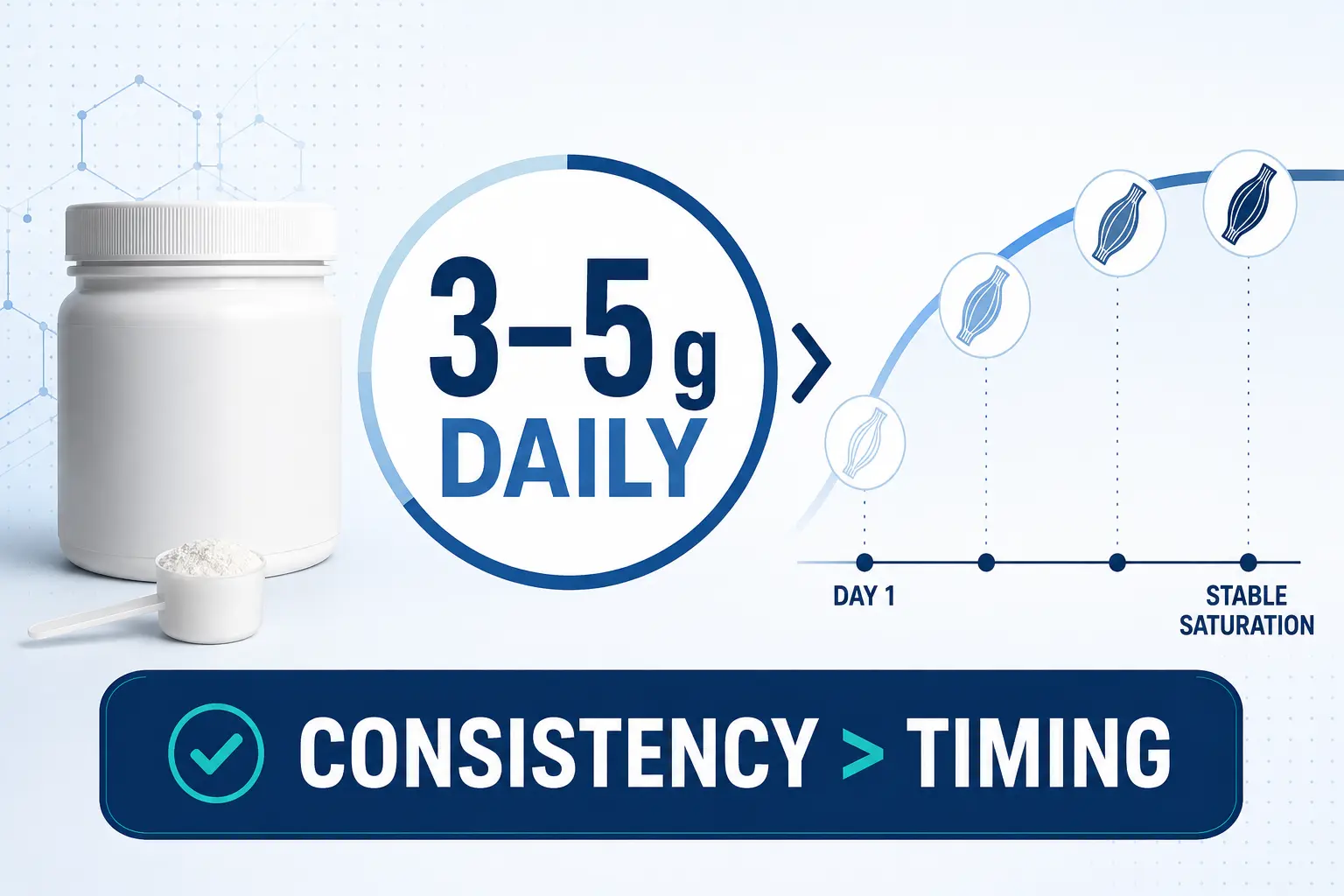
The standard evidence-based maintenance dose is 3–5 g of creatine monohydrate per day. This gradually increases intramuscular creatine and phosphocreatine stores, supporting repeated high-intensity efforts and the training adaptations that can follow.
Creatine is not primarily an acute stimulant. One serving does not need to produce a sensation or immediate performance change. Its main effect depends on accumulating and maintaining higher tissue stores over time. That is why a repeatable daily routine matters more than the clock.
| Approach | Dose | Approximate timeline | Best suited to |
|---|---|---|---|
| Simple maintenance | 3–5 g daily | Stores rise gradually over roughly 3–4 weeks | Most people |
| Loading phase | About 20 g daily, split into four doses, for 5–7 days; then 3–5 g daily | Faster saturation, often within about one week | Someone who wants saturation sooner |
| Relative loading | About 0.3 g/kg/day for 5–7 days; then maintenance | Individualized version of loading | Research or weight-adjusted protocols |
Does Bodyweight Change the Creatine Dose?
Body size can influence total creatine storage, but it rarely requires a complicated everyday formula. Three grams may be sufficient for a smaller person, while larger or highly muscular athletes often choose the upper end of the standard range.
| Situation | Practical starting dose | Reasoning |
|---|---|---|
| Smaller adult or sensitive stomach | 3 g daily | Often sufficient when taken consistently; easier to tolerate. |
| Most strength-trained adults | 5 g daily | Simple, well-established and requires no bodyweight calculation. |
| Very large athlete | 5 g daily initially | Higher maintenance intakes are sometimes used, but more is not automatically better. |
A dose should not be increased simply because the scale is not moving. Creatine can increase bodyweight through additional water stored with muscle creatine, but the size and timing of that change vary. Read the separate guide to creatine and water retention.
Do You Need a Creatine Loading Phase?
No. Loading changes how quickly stores rise, not the eventual long-term level achieved with consistent supplementation. It can be useful before a time-sensitive training or competition period, but it also means taking several doses per day and may increase gastrointestinal discomfort.
Choose loading if…
You want to reach elevated muscle creatine stores sooner and can comfortably divide the daily intake into smaller servings.
Skip loading if…
You prefer the simplest routine, have a sensitive stomach or do not care whether saturation takes several weeks.
See the complete decision guide to the creatine loading phase for protocols, trade-offs and practical examples.
When Should You Take Creatine?
Take it at the time you are most likely to remember. Current evidence does not establish a practically important advantage for taking creatine immediately before rather than after training. Once muscle stores are elevated, a single dose is primarily maintaining saturation.
You should also take creatine on rest days. Pairing it with breakfast, another daily supplement or a regular meal is often more useful than chasing a narrow timing window. For the complete evidence review, see creatine timing before or after training.
What If You Miss a Creatine Dose?
Resume your normal dose the next day. Do not double it. Muscle creatine stores decline gradually, so missing one day—or even several days—does not instantly return them to baseline. The dedicated guide explains what happens when you miss creatine for a few days.
Can the Daily Dose Upset Your Stomach?
Some people experience cramping, nausea or loose stools when taking a large amount at once, particularly during loading. The simplest responses are to use a smaller serving, dissolve it thoroughly, take it with a meal and avoid consuming the full loading dose in one sitting.
For troubleshooting, read why creatine can upset your stomach. Healthy adults generally tolerate recommended creatine doses well, but someone with kidney disease, pregnancy, relevant medication use or another clinical concern should discuss supplementation with a qualified healthcare professional.
Which Type of Creatine Should You Choose?
Creatine monohydrate is the default. It is the form used in most of the evidence, and more expensive forms have not consistently demonstrated superior muscle uptake or results.
Look for creatine monohydrate rather than a proprietary blend.
Confirm that a measured serving provides a practical 3–5 g dose.
Prefer transparent labeling and quality information you can verify.
If you want a concrete product example, see our creatine monohydrate product assessment. It applies the checklist above and states what we have—and have not—verified.
Frequently Asked Questions
Should you take creatine every day?
Yes. Daily use is the simplest approach because it gradually raises and then maintains muscle creatine stores. Take the same maintenance dose on training and rest days.
Is 10 g of creatine per day too much?
Ten grams per day is more than most people need for maintenance. It is not automatically dangerous for a healthy adult, but it may increase the chance of gastrointestinal discomfort without producing better long-term results than a standard 3–5 g dose.
How much creatine should a beginner take?
A beginner can use the same evidence-based dose as an experienced lifter: 3–5 g of creatine monohydrate daily. Training quality, nutrition and consistency remain more important than supplement timing.
Do you need to cycle creatine?
No. There is no established requirement to cycle on and off creatine when a healthy adult uses a normal maintenance dose.
How much water should you drink with creatine?
There is no special universal water target caused by creatine. Maintain normal hydration according to thirst, training conditions, climate and sweat loss.
Bottom Line
For most adults who strength train, 3–5 g of creatine monohydrate per day is enough. Take it consistently, including on rest days. Loading can raise muscle stores faster, but it is optional. Product type, timing and elaborate dosing formulas matter less than using a straightforward monohydrate product regularly.
References
- Hultman E, Söderlund K, Timmons JA, Cederblad G, Greenhaff PL. Muscle creatine loading in men. Journal of Applied Physiology. 1996;81(1):232–237. PubMed.
- Kreider RB, Kalman DS, Antonio J, et al. International Society of Sports Nutrition position stand: safety and efficacy of creatine supplementation in exercise, sport, and medicine. Journal of the International Society of Sports Nutrition. 2017;14:18. PubMed.
- Antonio J, Candow DG, Forbes SC, et al. Common questions and misconceptions about creatine supplementation: what does the scientific evidence really show? Journal of the International Society of Sports Nutrition. 2021;18:13. Full text.