Does Creatine Cause Water Retention, Bloating or Fat Gain?
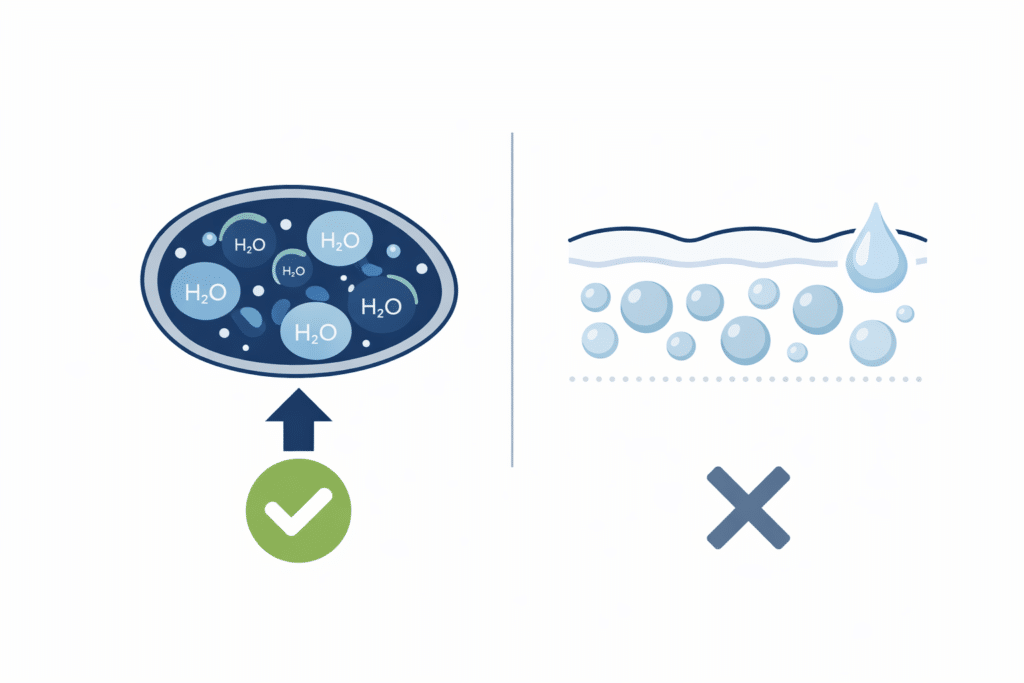
Does creatine cause water retention? Yes, creatine can increase body water and scale weight, especially during a loading phase, but it does not increase body fat. Some of the early water is associated with muscle creatine storage and intracellular fluid. However, studies do not all show the same change in total, intracellular, and extracellular water, so “all creatine water stays inside the muscle” is too absolute.
Quick interpretation: an early scale increase after starting creatine is more likely to reflect water and gut contents than fat. It is not automatically new contractile muscle either.
Water weight, bloating, fat, or muscle?
| What changed? | What it means | Can creatine contribute? |
|---|---|---|
| Intracellular water | Fluid inside cells, including muscle cells | Yes. Creatine is osmotically active, and some studies report increased intracellular water |
| Total scale weight | Everything measured by the scale: tissue, water, food, and waste | Yes. Weight can rise quickly, particularly with loading |
| GI bloating | Abdominal fullness, gas, discomfort, or diarrhea | Possible, especially with large single servings; this is not the same as body-fluid retention |
| Body fat | Stored energy in adipose tissue | No direct fat-gain effect is supported by controlled research |
| Muscle tissue | Longer-term structural adaptation to training | Creatine may support training adaptations, but a rapid first-week “lean mass” increase can include water |
The useful question is not simply “does creatine retain water?” It is which measurement changed, over what time frame, and under which dosing protocol?
What the research actually shows
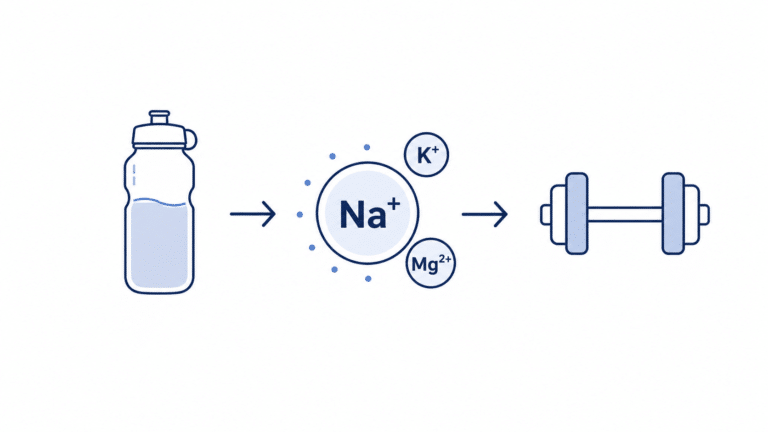
Creatine is transported into muscle and is osmotically active, which provides a plausible mechanism for water to accompany increased muscle creatine. Short loading studies have reported increases in body water during the first several days.
But fluid-compartment results are mixed:
- Powers and colleagues found that creatine increased muscle creatine, body mass, and total body water, but did not change the distribution between intracellular and extracellular water.1
- An eight-week trial in resistance-trained men found larger increases in total and intracellular water with creatine, while extracellular-water changes were similar between groups. The ratio of skeletal muscle mass to intracellular water remained similar.2
- A broad 2021 evidence review concluded that short-term water retention can occur, often attributed to intracellular volume, while several longer studies show no disproportionate change in body-water compartments relative to muscle mass.3
Therefore, the most defensible conclusion is: creatine can increase water and body mass, especially early, but neither the size nor the exact fluid distribution is identical in everyone.
How much water weight can creatine add?
There is no universal number. The 2021 review reports that a standard loading phase—around 20 g/day for 5–7 days—typically produces roughly 1–3 kg of body-mass gain, mostly attributed to net water retention.3 That range should not be treated as a forecast for every user.
| Dosing approach | Likely scale pattern | Important caveat |
|---|---|---|
| Loading: 20–25 g/day for 5–7 days | A faster, more noticeable increase is more likely | Some people gain less or do not notice a clear change; food, sodium, glycogen, and measurement noise also affect weight |
| Maintenance only: 3–5 g/day | Any change is generally slower and may be harder to distinguish from normal fluctuation | There is not one reliable “expected” kilogram value for this route |
If a rapid scale change concerns you, skip loading and use a normal daily dose. Read the full guide to weight gain after starting creatine for a tracking-focused explanation.
Does creatine make you look puffy?
Not predictably. The claim that creatine always pushes water under the skin and makes everyone look soft is not supported. But the opposite claim—every gram of retained water is guaranteed to sit inside muscle—is also stronger than the evidence.
Appearance is subjective and affected by many variables: carbohydrate intake and glycogen, sodium, hydration, recent training, inflammation, menstrual-cycle phase, lighting, and how full the digestive tract is. Controlled fluid-compartment measurements are more informative than a mirror impression, and even those studies have produced different findings.
Does creatine cause bloating?
“Bloating” can describe two different experiences:
- Digestive bloating: abdominal fullness, cramps, loose stool, or nausea after a large dose.
- Visible fluid retention: a perceived softer or puffier appearance.
Digestive symptoms are the clearer dose-related issue. The evidence review reports that servings above 10 g may increase gastrointestinal distress.3 If this happens, stop taking a large single serving, use 3–5 g/day, take it with a meal if that feels better, and make sure the powder is mixed thoroughly. The guide to creatine and stomach upset covers this in detail.
Visible puffiness is less predictable. If you feel your appearance changed, compare photos and average morning body weight under similar conditions for 2–3 weeks instead of deciding from one day.
Does creatine make you gain fat?
No direct fat-gain effect has been demonstrated. Creatine itself is not a meaningful calorie source, and randomized studies reviewed in 2021 do not show creatine increasing fat mass across the populations studied.3
That does not mean someone taking creatine can never gain fat. A calorie surplus can increase fat whether or not creatine is present. The point is that a quick scale increase immediately after starting creatine is not evidence that creatine created body fat.
Is the extra weight muscle?
Not necessarily. Body-composition methods often report “lean mass” or “fat-free mass,” which includes water and is not identical to newly built contractile muscle. If lean mass rises within days—before enough training time has passed for substantial hypertrophy—fluid is a plausible contributor.
This distinction remains scientifically active. A 2024 meta-analysis found about 1.14 kg more lean body mass when creatine was combined with resistance training than with training alone.4 A 2025 randomized trial that included a one-week creatine-only phase observed an early lean-mass increase before training, then no additional between-group lean-mass advantage during the following 12 weeks.5 One trial does not overturn an entire literature, but it reinforces why lean mass, water, and muscle tissue should not be treated as synonyms.
Does creatine water retention go away?
The early scale jump usually stabilizes once muscle creatine stores and the surrounding conditions stabilize; weight should not keep climbing indefinitely from the same dose alone. If you stop supplementing, elevated muscle creatine declines gradually. Classic group data found muscle total creatine was no longer different from baseline about 30 days after stopping.6 In a one-person case study, muscle phosphocreatine remained above baseline after a 30-day washout, showing that washout can take longer in some individuals.7
Any corresponding scale decrease is individual. It cannot be predicted exactly from the dose because daily weight also reflects glycogen, sodium, food, hydration, and body tissue.
My practical rule for tracking body weight
This is an author interpretation rule, not a method for measuring fluid compartments: when someone starts or loads creatine, I treat the following 2–4 weeks as a transition to a new scale baseline. I use a 7-day average, waist measurement, and consistent photos rather than labeling a sudden increase as fat. Fat gain requires support from the longer trend and energy intake—not just one higher weigh-in.
How to reduce an unwanted scale jump or stomach discomfort
- Skip the creatine loading phase and take 3–5 g/day.
- If you load, divide the daily total into several small servings rather than one large dose.
- Keep weigh-ins consistent: morning, after using the bathroom, before eating or drinking.
- Do not simultaneously make large changes to sodium and carbohydrate intake if you want an interpretable scale trend.
- If abdominal symptoms persist at 3–5 g/day, stop and reassess the product and the assumption that creatine is the cause.
For the broader benefit-and-safety context, see the evidence-based creatine guide and the detailed page on creatine side effects and safety.
Frequently Asked Questions
Does creatine cause water retention?
Creatine can increase body water and scale weight, especially during a loading phase. Some evidence supports increased intracellular water, but fluid-distribution findings differ between studies, so it is too absolute to claim that all retained water is exclusively inside muscle cells.
How much water weight can you gain from creatine?
A loading phase can produce roughly 1–3 kg of body-mass gain in some people, mostly attributed to water, but individual responses vary. With 3–5 g per day and no loading, any increase is usually slower and may be difficult to separate from normal weight fluctuation.
Does creatine cause bloating or a puffy face?
Creatine does not predictably make everyone look puffy. Digestive bloating is a separate issue and is more likely after large single servings. Sudden or marked facial swelling should not be assumed to be normal creatine water retention.
Does creatine water retention go away?
The early scale increase usually stabilizes after creatine stores and body water reach a new baseline. If supplementation stops, elevated muscle creatine and any associated weight generally decline gradually over several weeks.
Should I stop taking creatine while cutting?
Not merely because the scale is higher. Water weight is not body fat and does not prevent fat loss. Skipping loading and using 3–5 g per day can make the transition in scale weight less abrupt.
Bottom line
Creatine can increase water and scale weight, especially during loading. The early change is not fat, but it should not automatically be called new muscle either. Intracellular water is part of the explanation, while exact fluid distribution and magnitude vary across studies and individuals. If you want a less abrupt change, skip loading and take 3–5 g/day.
References
- Powers ME, et al. Creatine supplementation increases total body water without altering fluid distribution. Journal of Athletic Training. 2003.
- Ribeiro AS, et al. Creatine supplementation does not influence the ratio between intracellular water and skeletal muscle mass in resistance-trained men. 2020.
- Antonio J, et al. Common questions and misconceptions about creatine supplementation: what does the scientific evidence really show? Journal of the International Society of Sports Nutrition. 2021.
- Desai I, et al. The effect of creatine supplementation on resistance training-based changes to body composition: a systematic review and meta-analysis. 2024.
- Desai I, et al. The effect of creatine supplementation on lean body mass with and without resistance training. 2025.
- Hultman E, et al. Muscle creatine loading in men. Journal of Applied Physiology. 1996.
- Rawson ES, et al. Effects of repeated creatine supplementation on muscle, plasma, and urine creatine levels. Journal of Strength and Conditioning Research. 2004.