DEXA vs InBody: Which Is More Accurate for Body Composition?
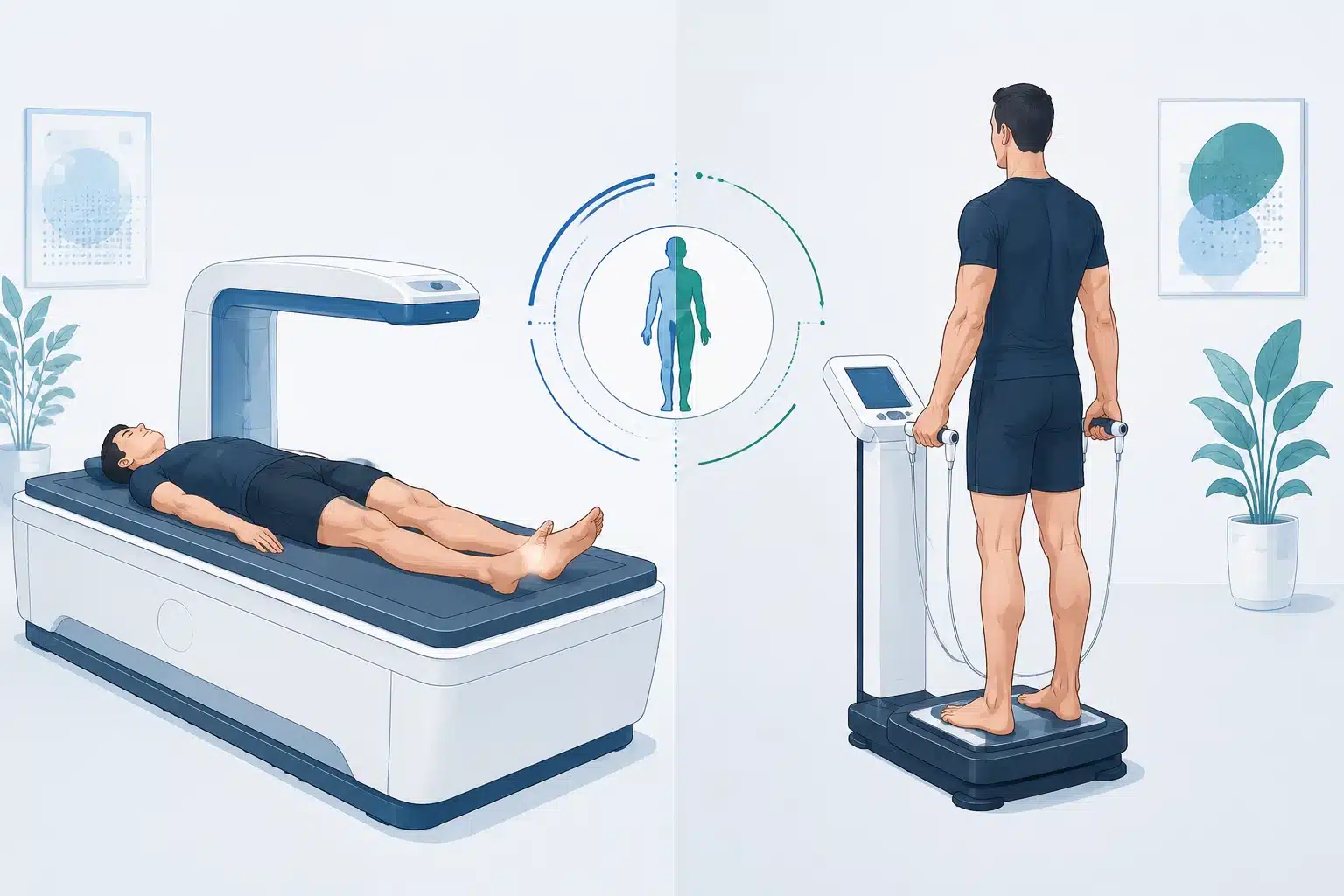
DEXA vs InBody: which body-composition test is more accurate? DEXA generally provides a more detailed research-oriented estimate of total and regional body composition, but it is not a perfect measurement of body fat or muscle. InBody is faster, cheaper and useful for repeated trends when conditions are standardized. The best method is the one you can repeat consistently—and interpret within its error.
Choose DEXA when you want a less frequent, detailed assessment with regional lean-soft-tissue and bone information. Choose InBody when accessibility makes regular standardized trend measurements more practical. Do not compare their body-fat percentages as if they were interchangeable, and do not treat either result as ground truth.
DEXA vs InBody at a glance
| Question | DEXA | InBody / multi-frequency BIA |
|---|---|---|
| What is measured? | X-ray attenuation is used to estimate bone mineral, fat mass and lean soft tissue. | Electrical impedance is used to estimate body water and derive fat-free mass and fat mass. |
| Detail | Total and regional estimates; includes bone-related output. | Total and segmental estimates; many models also report body-water values. |
| Practicality | More expensive, less available, requires lying still and involves a small radiation dose. | Fast, widely available, non-invasive and practical for repeat testing. |
| Main sensitivity | Food, fluid, exercise, positioning, machine and software. | Hydration, recent food/drink, exercise, skin temperature and prediction equation. |
| Best use | Occasional detailed baseline or research-style follow-up under a strict protocol. | Accessible trend tracking under the same repeatable conditions. |
How does a DEXA scan measure body composition?
Dual-energy X-ray absorptiometry sends two low-dose X-ray beams through the body. Tissues attenuate those beams differently, and the system estimates bone mineral content, fat mass and lean soft tissue for the whole body and specific regions.
DEXA’s strengths are detail, speed and generally good test–retest reliability when the same scanner, positioning and preparation protocol are used. Its limitation is equally important: DEXA still estimates body composition through assumptions. It does not directly separate skeletal muscle from every other component of lean soft tissue.
DEXA is useful when…
- You want regional information rather than one total-body percentage.
- You can repeat the same scanner and positioning protocol.
- You understand that small differences can be noise.
How does InBody measure body composition?
InBody devices use bioelectrical impedance analysis. A small electrical current travels through the body, and the device measures impedance. Because water-rich lean tissue conducts differently from fat tissue, the device estimates body water and uses proprietary equations to derive fat-free mass, fat mass and segmental values.
Multi-frequency and segmental devices are more sophisticated than a basic bathroom scale, but sophistication does not remove biological variability. The output still depends on hydration and the device’s model.
InBody is useful when…
- You value a quick test you can repeat under similar conditions.
- You use the trend rather than treating one result as a diagnosis.
- You avoid comparing results across different devices and protocols.
Is DEXA more accurate than InBody?
DEXA is usually the stronger choice when the goal is detailed body-composition assessment, but “more accurate” needs a reference method. In body-composition research, multi-compartment models can reduce the assumptions made by simpler two-compartment approaches. DEXA is often used as a criterion in device-validation studies, yet it is not a direct measurement of every tissue.
A study of collegiate female athletes found that InBody 720 estimated body-fat percentage 3.3 percentage points lower and fat-free mass 2.1 kg higher than DEXA on average. The individual limits of agreement were wide. The devices could therefore look similar at group level while giving meaningfully different values to one person.
DEXA is not “the truth” and InBody is not automatically “wrong.” They answer through different measurement models. For a lifter, consistency of method and conditions often matters more than chasing the most flattering percentage.
Why can body-fat and lean-mass results change?
Biological variation
- Hydration and sodium intake
- Glycogen and carbohydrate intake
- Food and fluid in the body
- Recent exercise and inflammation
- Menstrual-cycle-related fluid changes
Technical variation
- Positioning
- Scanner or device model
- Software version and equations
- Technician and region placement
- Different pre-test instructions
In a controlled DEXA study, normal daily activity and breakfast increased variability in total and regional lean-mass estimates. Another study found that drinking 500 ml of water increased measured lean mass by about 0.5 kg on average. The body had not built half a kilogram of muscle in minutes—the classification of the water changed the output.
Supplementation can also complicate interpretation: the 2026 creatine-without-exercise trial is a useful example of why a DXA lean-mass increase does not identify how much new muscle tissue was built.
Which body-composition test should you choose?
Choose the same InBody device and standardize the conditions.
Choose DEXA and repeat the same scanner and positioning protocol.
Use repeated measurements plus weight, waist, photos and performance.
Choose DEXA if:
- You want a detailed baseline and can afford infrequent follow-ups.
- Regional lean-soft-tissue and bone information matter to the question.
- The facility follows a standardized protocol.
Choose InBody if:
- You can access the same device repeatedly.
- You mainly need a practical trend rather than a one-time “true” percentage.
- You can test at the same time of day under similar hydration and food conditions.
How to make repeat measurements more useful
Which measurement should you use for FFMI?
FFMI uses body weight, height and estimated body-fat percentage. Therefore, any error in body-fat estimation changes the calculated fat-free mass and FFMI. The calculator cannot remove that uncertainty.
Use the method you can reproduce. Enter your best current estimate in the THG FFMI Calculator, then use its body-fat sensitivity table to see how another plausible estimate changes the result. For score interpretation, read What Is a Good FFMI?.
If your goal is to track a gaining phase, remember that a change in measured lean mass is not automatically the same amount of new muscle. THG’s guide to realistic yearly muscle-gain rates explains how to combine body-composition data with performance, bodyweight and circumference trends.
Neither test can determine your lifetime natural muscle potential or turn FFMI 25 into a doping verdict. Those questions require different evidence and remain uncertain at the individual level.
Choose a protocol before choosing a number
If you already have access to repeatable InBody measurements, do not abandon the trend merely because DEXA sounds more advanced. If you choose DEXA, treat it as a detailed estimate and reproduce the protocol. In both cases, confirm the story with performance, body weight, waist measurements and photos.
Frequently asked questions
Can InBody be off by 5% body fat?
Yes, an individual difference of several percentage points is plausible when compared with another method. Device, population, hydration and testing protocol all matter.
Is DEXA the gold standard for body fat?
DEXA is a useful and well-studied method, but it is not a direct ground-truth measurement of body fat or muscle. Multi-compartment reference models can reduce assumptions further.
Can I compare an InBody result with a DEXA result?
You can note both, but the difference cannot be interpreted entirely as body change. For tracking, compare like with like: same method, same device and similar conditions.
How often should I test body composition?
Changes need time to become larger than ordinary noise. For most lifters, testing every 8–12 weeks is more interpretable than testing every few days, provided conditions are standardized.
Research references
- Nana A, et al. Effects of daily activities on DXA estimates of body composition in active people. Med Sci Sports Exerc. 2012.
- Nana A, et al. Effects of exercise sessions on DXA measurements of body composition in active people. Med Sci Sports Exerc. 2013.
- Nana A, et al. Methodology review: using DXA for body-composition assessment. Int J Sport Nutr Exerc Metab. 2015.
- Esco MR, et al. Comparison of DXA and multifrequency bioimpedance in collegiate female athletes. J Strength Cond Res. 2015.
- Barreira TV, Tseh W. Effects of acute water ingestion on DXA body-composition analyses. Clin Nutr. 2020.
- McLester CN, et al. Reliability and agreement of InBody body-composition analyzers. Int J Exerc Sci. 2018.