Is FFMI 25 the Natural Limit?
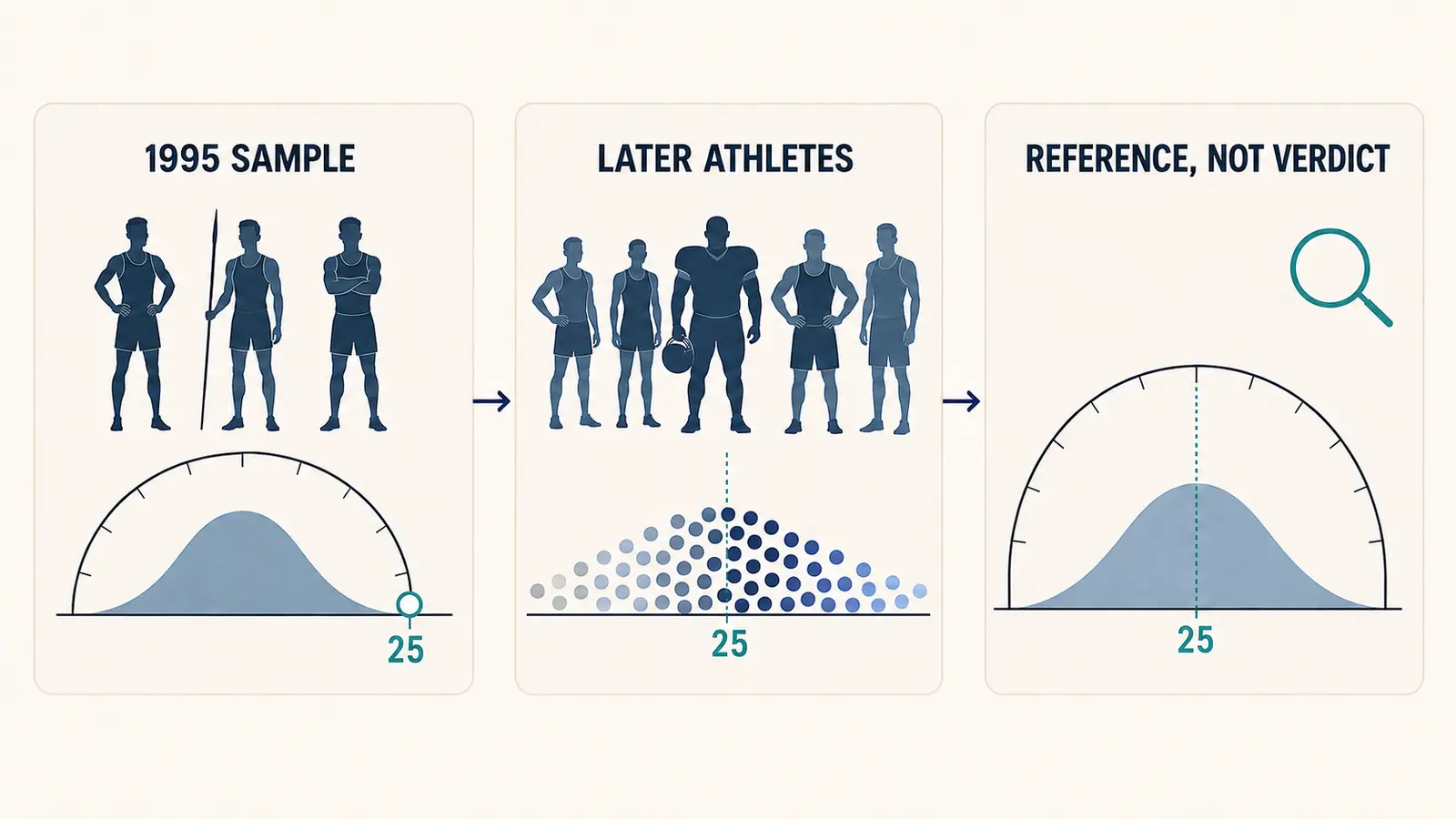
The FFMI 25 natural limit is not a proven biological ceiling. An FFMI of 25 cannot determine whether an individual uses anabolic steroids, and it is not a personalized estimate of how much muscle you can build.
The number came from a 1995 study in which 74 self-reported nonusers had normalized FFMI values up to approximately 25, while many of the 83 steroid users scored higher. That makes 25 an interesting group-level reference. It does not turn the number into a universal natural limit, a diagnostic drug test or a personalized estimate of how much muscle you can build.
The short answer
- FFMI 25 is unusual in most male populations, including trained populations.
- Steroid users tend to have more fat-free mass and are more likely to score above 25.
- Some historical physique estimates, collegiate athletes and tested natural-bodybuilding competitors have recorded values above 25.
- None of those observations can verify an individual’s lifetime drug-use history.
- Body-fat error, height adjustment, frame size and non-muscle fat-free mass all affect the result.
- The famous cutoff refers to normalized FFMI, not necessarily raw FFMI.
The most defensible conclusion is therefore not that 25 is meaningless. It is that 25 is a rough statistical reference—not a line separating natural and enhanced physiques.
If you need to calculate both versions first, use the THG FFMI Calculator. For population and athletic comparisons below 25, see What Is a Good FFMI?.
Why FFMI 25 Became So Famous
Like many lifters, I did not first encounter FFMI 25 by reading a medical journal. I heard about it through fitness videos, including content from Jeff Nippard and other evidence-focused creators.
The online version of the story is simple: bodybuilders from before widespread steroid use rarely exceeded an FFMI of 25, modern natural lifters usually remain below it, and steroid users often go above it. A simple number is easy to remember, easy to put on a chart and perfect for “natty or not” content.
It also contains a fragment of truth. FFMI values differ on average between groups of steroid users and nonusers, and a very high result is unusual. The problem begins when a group tendency becomes an individual verdict.
To understand that distinction, we need to return to the study that made 25 famous.
Where Did the FFMI 25 Limit Come From?
In 1995, Kouri and colleagues published a study of 157 male athletes:
- 74 reported that they had never used anabolic-androgenic steroids.
- 83 reported previous or current steroid use.
- Body fat was estimated using skinfold measurements.
- FFMI was calculated from estimated fat-free mass and height.
- The researchers added a height correction to normalize results to a 1.80-meter man.
The normalized FFMI values of the reported nonusers extended to approximately 25. Many steroid users exceeded 25, and some exceeded 30.
This was a useful observation. It showed that FFMI could help describe a visible difference between the two sampled groups. The researchers suggested that an unusually high FFMI might be useful as an initial screening measure for possible steroid use.
That wording matters. An initial screening measure is not the same as a diagnosis, and the paper did not establish that no drug-free human can exceed 25.
The cutoff refers to normalized FFMI
Raw FFMI is calculated as:
Raw FFMI = fat-free mass in kilograms ÷ height in meters²
The Kouri cutoff was based on an additional height adjustment toward 1.80 meters. The PubMed abstract reports the following version:
Normalized FFMI = raw FFMI + 6.3 × (1.80 − height in meters)
Some full-text reproductions and later calculators use 6.1 instead of 6.3. The practical difference is tiny for ordinary heights, but it is still important to label which formula you used. A raw score of 25 and a normalized score of 25 are not automatically the same result.
What the “Pre-Steroid Era” Data Actually Showed
The same paper estimated normalized FFMI for 20 Mr. America winners from 1939 to 1959. These historical competitors are frequently invoked as evidence for a natural ceiling.
Their average estimated FFMI was 25.4.
That detail alone should make us cautious about calling 25 an absolute limit. A later detailed review of the paper reported that many of the historical estimates were above 25, with the highest approaching 28.
However, those numbers do not prove that several verified natural bodybuilders had an FFMI of 28. Their body-fat percentages were estimated retrospectively from photographs, rather than measured under standardized conditions. Their lifetime drug-use status also cannot be verified today.
The historical analysis therefore cuts both ways:
- It weakens the claim that natural lifters cannot exceed 25.
- Its measurement uncertainty prevents it from establishing a new, higher natural limit.
The honest conclusion is uncertainty—not 25, 28 or any other perfectly precise ceiling.
Why the Original Study Cannot Establish a Biological Limit
The Kouri study remains important, but it was not designed to identify the largest amount of muscle any natural human could ever build.
1. The natural group was small
Seventy-four nonusers can describe a sample. They cannot reliably capture the most genetically unusual people in a much larger population.
If nobody in a small group exceeds a particular value, that tells us the value is uncommon in that group. It does not prove that exceeding it is biologically impossible.
2. The participants were not selected for being at their genetic ceiling
The group consisted of male athletes and lifters, not a purpose-built sample of elite natural bodybuilders who had spent decades maximizing hypertrophy under controlled conditions.
Training for several years also does not establish that someone has exhausted their potential. Programming quality, nutrition, recovery, injuries, consistency and life circumstances differ enormously.
3. Drug-use classification was not perfect
The study relied on reported steroid-use histories. A self-reported nonuser is not equivalent to a person whose lifetime natural status has been independently verified.
The reverse problem also matters: steroid use does not guarantee an FFMI above 25. Some users in the study remained below the cutoff. A score under 25 therefore cannot prove that somebody is natural.
4. FFMI inherits body-fat measurement error
FFMI does not measure skeletal muscle directly. It first estimates fat-free mass, so an underestimated body-fat percentage inflates FFMI and an overestimated percentage lowers it.
Skinfolds can be useful when the same skilled technician repeats them consistently, but the result still depends on measurement sites, calipers, technician skill and the prediction equation. Historical body-fat estimates from photographs are even less certain.
For a practical comparison of common testing methods and their sources of variation, see DEXA vs InBody.
5. The height correction was derived from limited male data
Normalized FFMI was created because raw FFMI still varied with height. The correction is helpful, but it is a statistical adjustment derived from the study sample—not a universal law of human scaling.
It should be especially cautious when applied to very short or tall people, women, and populations unlike the original male sample.
What Later Research Found Above FFMI 25
Later studies make it difficult to defend 25 as a hard ceiling. They do not, however, give us a perfect replacement number.
Collegiate American football players
A 2017 study assessed 235 NCAA Division I and II football players using DXA. The group had an average height-adjusted FFMI of 23.7 ± 2.1.
More notably:
- 62 players—26.4% of the sample—scored above 25.
- The 97.5th percentile was 28.1.
- Linemen generally recorded the highest values.
This demonstrates that scores above 25 occur in large, muscular athletic populations. It does not prove that every player above 25 was a verified lifetime natural. The study was not a controlled natural-bodybuilding trial or a definitive drug-screening study, and its DXA-based estimates are not directly interchangeable with the skinfold estimates used by Kouri.
Football players also carry substantial non-muscle fat-free mass. Bone, organs, connective tissue and the lean component associated with a much larger body all contribute to FFMI.
Tested natural bodybuilders
A 2018 observational study examined high-level natural bodybuilders competing in a federation that used drug testing and pre-competition polygraph screening.
Among placed male competitors with usable skinfold data, estimated FFMI averaged 22.74 ± 2.55, and two competitors exceeded 25.
These are reasonable examples of people who could potentially score above 25 naturally. They are not conclusive proof. Body-fat measurements were self-reported, the usable sample was small, and competition testing cannot verify an athlete’s entire lifetime history.
That is the recurring pattern in this field: the observations above 25 are enough to reject a hard cutoff, but not strong enough to identify a new universal ceiling.
Does an FFMI Above 25 Mean Steroid Use?
No. It may be unusual and it may change the context, but FFMI alone cannot determine the cause.
| Result | What it may tell you | What it cannot tell you |
|---|---|---|
| Below 25 | The result overlaps substantially with nonuser and general athletic samples. | That the person is natural or still has a specific amount of potential left. |
| Around 25 | The person carries a high amount of estimated fat-free mass relative to height in most populations. | That the person has reached a universal biological ceiling. |
| Above 25 | The result is unusual in most groups and appears more often in very muscular or steroid-using groups. | Whether drugs, genetics, frame, measurement error, sport or several factors produced the score. |
Important: These descriptions provide context, not a diagnostic cutoff. A result such as 24.9 versus 25.1 does not represent a meaningful biological transition.
The probability also depends on the population you started with. An FFMI of 25 means something different in a random group of adults, an elite football team, a drug-tested bodybuilding final and a group of known steroid users.
Without that base-rate information—and without a reliable body-fat measurement—you cannot convert one score into a defensible probability that an individual uses steroids.
Looking at the person’s physique does not solve the problem. Appearance can add context about leanness and muscle distribution, but it still cannot reveal a private drug-use history.
What FFMI 25 Would Mean for Me at 1.86 Meters
My current example makes the scale of the number easier to understand.
If you want to establish your own starting point first, calculate your current raw and normalized FFMI.
At a morning body weight of 86.7 kg, a height of 1.86 meters and an InBody-based body-fat estimate of 14–15%, my estimated results are:
- Raw FFMI: approximately 21.3–21.6
- Normalized FFMI: approximately 20.9–21.2
That feels believable to me. Years ago, I might have wanted the score to be higher. Today it is simply a number. It does not change how I look, how I feel or what I have achieved.
To reach a normalized FFMI of 25 at my height, I would need approximately 87.8 kg of estimated fat-free mass. At the same assumed body-fat range of 14–15%, that would mean a body weight of roughly 102–103 kg.
That is much larger than it sounds when 25 is presented as merely four points above my current score.
I have already tried weighing more than 100 kg
Around 2023, I deliberately bulked until I briefly reached 100–102 kg. I had never committed to gaining for that long because I disliked losing muscular definition, so part of the experiment was psychological: Could I make myself continue until the scale passed 100 kg, and how big would I look when I got there?
I was probably around 22–25% body fat, so it was not remotely equivalent to weighing 102 kg at 14–15%. I was stronger than I am now, and other serious lifters noticed the extra size. At a 30th birthday party, another man who trained was clearly impressed by how large I looked.
In the right clothes, I looked enormous. Without them, I did not think I looked better. I felt as though I constantly needed to hold my stomach in. I also felt heavier, slower and less comfortable, and my joints were not especially happy.
I always intended to cut afterwards, and I did not maintain the weight for long. The experience taught me that becoming as large as possible and building the physique I actually prefer are not the same goal.
It also shows why total body weight cannot substitute for FFMI. I had reached the scale number, but a substantial part of the gain was fat. Because my old body-fat estimate is only retrospective, calculating a precise historical FFMI would create false accuracy.
Your Maximum FFMI May Not Be Your Best Goal
I think I could still improve my current result. If I made muscle gain a central priority for the next two or three years, an FFMI around 22–22.5 might be realistic for me.
But I no longer have the same drive to maximize muscle at any cost. Training used to occupy far more of my identity. Now I have a wife, a full-time ecommerce career, The Hypertrophy Guide, other projects and hobbies, and I also like enjoying life outside the gym.
I could probably move my FFMI higher if I made muscle gain the center of my life again. I simply no longer think the trade-off would make my life better.
That does not mean I have reached my genetic ceiling. I can still become stronger when I train with more focus, and my recent training has often emphasized maintenance rather than fully optimized hypertrophy. The point is that remaining potential and worthwhile priorities are different questions.
Most natural lifters will never know exactly how close they are to their theoretical maximum. We are not laboratory subjects with every training session, meal, night of sleep and life stressor perfectly controlled. Progress slows after the beginner phase, but slow progress is not proof that no progress remains.
If your real question is lifetime development rather than a cutoff, read How Much Muscle Can You Gain Naturally?. For shorter planning horizons, use the broad expectations in How Much Muscle Can You Gain in a Year?.
When a Body-Composition Score Erases Real Progress
Numbers can be useful until they become more important than the person they are supposed to describe.
I once worked with a client who had become markedly stronger. I could see a visual improvement, she had lost weight, felt happier, had more energy and received positive comments from other people.
Then an InBody assessment reported a lower score and lower lean body mass than before.
The result affected her immediately. For a moment, it erased how she had felt before the measurement. Strength, energy, confidence and visible progress were pushed aside by one device-generated score.
That does not prove the measurement was wrong. Weight loss can include some fat-free mass, and the result may also have been influenced by hydration, glycogen, recent training, food, stress or ordinary device variation. It shows why one reading should not overrule every other form of evidence.
If weighing, scanning and scoring repeatedly makes you fixate on short-term fluctuations or compare yourself destructively with other people, measuring less—or not measuring at all—may be the more useful choice.
Why Some Lifters Are Drawn to a Hard Limit
A fixed ceiling can be comforting. It tells you where you stand, how far you have left and whether slow progress is supposedly your fault.
It can also make steroids seem like the obvious next step. After the rapid progress of the beginner phase, muscle gain becomes slower and the returns from each additional year become smaller. I understand why that frustrates people.
I would not use anabolic steroids, partly because of the potential health consequences, but also because of how I think they could affect me psychologically. I suspect I would struggle to stop and accept returning to my normal physique after seeing what pharmacological assistance could produce.
For me, protecting that relationship with my body matters more than finding out how high I could push one score.
How to Use FFMI Without Turning It Into a Verdict
FFMI is most useful when it is treated as one imperfect data point.
- Calculate a range. If your body fat is uncertain, enter more than one plausible estimate.
- Separate raw and normalized FFMI. Do not compare one with a reference based on the other.
- Use the same measurement method. Switching between InBody, DXA, skinfolds and visual estimates can create artificial changes.
- Standardize repeat measurements. Use similar food, fluid, training and time-of-day conditions.
- Track long-term trends. Changes across months matter more than small fluctuations across days or weeks.
- Use other evidence. Consider strength, body weight, waist and limb measurements, photos, energy and how the program is progressing.
- Do not use FFMI to accuse people. Neither 24.9 nor 25.1 reveals an individual’s drug-use history.
For the training process behind continued development, read What Causes Muscle Growth? and Progressive Overload Explained.
Frequently Asked Questions
Is an FFMI of 25 naturally possible?
Yes, it may be possible for some natural individuals to reach or exceed 25. Historical physique estimates, collegiate athletic cohorts and small tested natural-bodybuilding samples include scores above 25. None provides perfect verification of lifetime natural status, but collectively they show that 25 cannot be treated as an absolute biological ceiling.
Does an FFMI of 26 mean someone uses steroids?
No. An FFMI of 26 is unusual in most populations and overlaps more with very muscular and steroid-using groups, but it cannot prove the cause in an individual. Body-fat error, height adjustment, frame, sport and other fat-free tissues also affect the result.
Can someone use steroids and have an FFMI below 25?
Yes. Steroid use does not guarantee an FFMI above 25. Training history, dose, duration, nutrition, genetics and body-composition measurement all matter. A score below 25 cannot prove that someone is natural.
Is the FFMI 25 limit raw or normalized?
The famous Kouri cutoff refers to normalized FFMI adjusted toward a reference height of 1.80 meters. Raw and normalized FFMI should not be mixed silently.
Is there an FFMI natural limit for women?
There is no well-validated universal female cutoff. The original Kouri study included men only, so its proposed value of 25 should not simply be transferred to women. Female results require female reference data and the same caution about measurement and population.
Can FFMI tell me how much muscle I have left to gain?
No. FFMI describes current estimated fat-free mass relative to height. It does not know the quality of your previous training, your frame, genetics, future consistency or how much of your fat-free mass is skeletal muscle. It can add context, but it cannot calculate your remaining genetic potential.
Should I try to reach FFMI 25?
Not necessarily. Most natural lifters will never reach 25, and reaching the highest possible FFMI may require trade-offs in time, food intake, body fat, comfort and other priorities. A better goal is continued progress that supports the physique, performance and life you actually want.
Final Takeaway
FFMI 25 is best understood as a historical reference point.
The original study found that reported nonusers in one male sample stopped around a normalized FFMI of 25, while many steroid users exceeded it. That made 25 interesting—but not universal. The small sample, self-reported drug histories, skinfold estimates, retrospective historical data and imperfect height correction prevent it from functioning as a biological law or doping test.
Later studies have reported scores above 25 in muscular athletic populations and among some tested natural-bodybuilding competitors. Those studies also have limitations, so they cannot tell us the true highest naturally attainable FFMI.
Use FFMI to describe and track estimated fat-free mass. Do not use it to diagnose steroid use, define your identity or decide that your progress is finished.
Sources
- Kouri EM, Pope HG Jr, Katz DL, Oliva P. Fat-free mass index in users and nonusers of anabolic-androgenic steroids. Clinical Journal of Sport Medicine. 1995;5(4):223–228. PubMed
- Trexler ET, Smith-Ryan AE, Blue MNM, et al. Fat-free mass index in NCAA Division I and II collegiate American football players. Journal of Strength and Conditioning Research. 2017;31(10):2719–2727. Full text
- Chappell AJ, Simper T, Barker ME. Nutritional strategies of high-level natural bodybuilders during competition preparation. Journal of the International Society of Sports Nutrition. 2018;15:4. Full text
- VanItallie TB, Yang MU, Heymsfield SB, Funk RC, Boileau RA. Height-normalized indices of the body’s fat-free mass and fat mass. American Journal of Clinical Nutrition. 1990;52(6):953–959. PubMed
- Jagim AR, Tinsley GM, Merfeld BR, et al. Validation of skinfold equations and alternative methods for the determination of fat-free mass in young athletes. Frontiers in Sports and Active Living. 2023;5:1240252. Full text
- Nuckols G. What Everyone Gets Wrong About FFMI and the “Natty Limit.” 2016. Useful expert methodological commentary; not peer-reviewed primary research. Article
- Albano GD, Amico F, Cocimano G, et al. Adverse effects of anabolic-androgenic steroids: a literature review. Healthcare. 2021;9(1):97. PubMed