How Much Muscle Can You Gain in a Year? Beginner vs Advanced
How much muscle can you gain in a year? The realistic answer depends on your training experience, genetics, starting point, nutrition and how consistently you can train and recover. A productive first year of resistance training can produce visible muscle growth, but no research-backed formula can predict exactly how many kilograms of muscle one person will gain.
For planning—not prediction—a natural lifter might use a broad range of roughly 2–5 kg of muscle in a productive beginner year, 1–3 kg as an intermediate, and around 0.25–1.5 kg when advanced. These are THG coaching ranges, not validated biological limits. A year of scale-weight gain will also include water, glycogen, gut content and usually some fat.
How much muscle can you realistically gain in a year?
The most useful answer is a range that becomes wider—not narrower—when we are uncertain. Research interventions usually last weeks or months, use different methods to assess muscle, and report group averages. Extrapolating those averages to a full year assumes that the early rate continues, which it rarely does.
Important: the ranges describe potential new skeletal muscle under productive conditions. They are not expected changes in scale weight or fat-free mass, and they should not be used to judge whether someone is natural.
Muscle gain is not the same as lean-mass gain
A body-composition device does not place new muscle tissue on one side of the report and everything else on the other. “Lean mass” or “fat-free mass” includes water, glycogen, organs, connective tissue and bone-related components as well as skeletal muscle.
This distinction matters most at the start of a gaining phase. More carbohydrate can increase stored glycogen and associated water. Creatine can raise body water and measured lean mass. A meal, hydration change or recent exercise session can move a body-composition estimate without creating new contractile tissue.
Do not convert a 3 kg increase in “lean mass” directly into 3 kg of new muscle. Use it alongside performance, body weight, circumferences, photos and a repeatable measurement protocol.
Calendar years are not productive training years
Someone can have trained for six years without completing six years of progressive hypertrophy training. Long maintenance phases, frequent programme changes, low effort, injuries, inconsistent nutrition and months away from the gym all affect what “six years of experience” means.
I use productive training age as the better practical question: how long has the lifter trained the target muscles consistently, close enough to failure, with recoverable volume and a programme that made progression possible?
Large studies show substantial response variation even when participants complete the same training programme. In a 12-week study of 585 adults, changes in elbow-flexor size ranged from a small decrease to a 59% increase. Another pooled analysis found wide muscle-size responses across ages and sexes. Group averages are therefore useful context—not personal forecasts.
How much muscle can a beginner gain?
A true beginner has several advantages: almost any well-designed progressive programme is a new stimulus, starting muscularity is relatively low, and improvements in technique allow more productive loading over time. That is why the first productive year often creates the clearest visual change.
But the fastest early change is not all new muscle. Early increases in measured muscle size can partly reflect swelling associated with a novel training stimulus. Beginners also gain strength rapidly through better coordination and skill. Strength progress is encouraging, but it is not a one-to-one measure of hypertrophy.
A useful beginner target
- Train each major muscle consistently with a repeatable programme.
- Use performance trends to confirm that the training dose is productive.
- Gain scale weight slowly enough that waist growth does not outrun performance and visual change.
- Judge the year in 8–12 week blocks instead of reacting to individual weigh-ins.
How much muscle can an intermediate lifter gain?
Intermediate lifters still have meaningful room to grow, but they cannot rely on novelty. Exercise selection, weekly volume, proximity to failure, recovery and progression must fit together. A programme can feel hard without producing a useful trend.
The 1–3 kg planning range is intentionally wide. A smaller lifter who already carries substantial muscle may sit near the lower end, while someone whose earlier training was inconsistent may still progress more like a beginner.
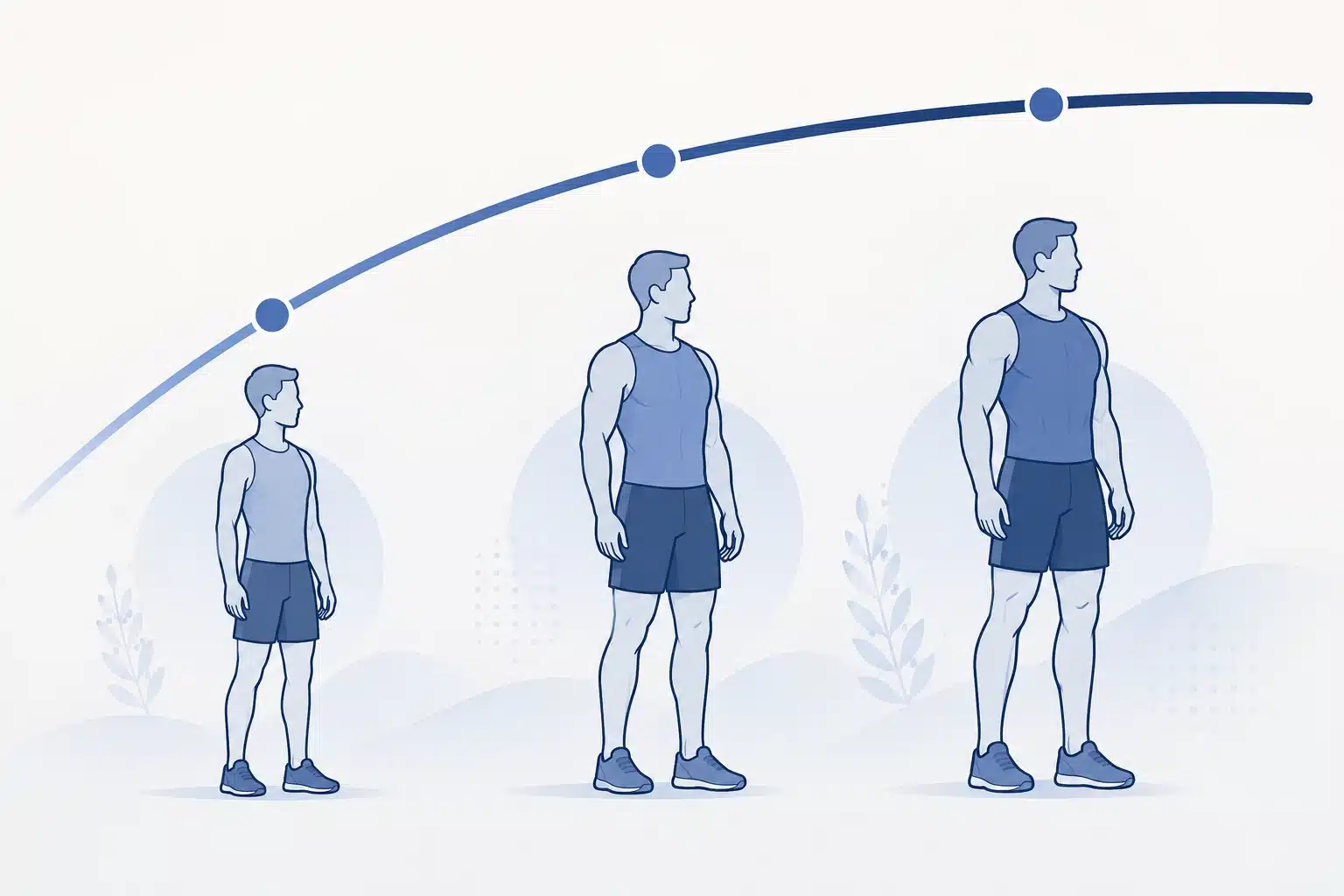
The bars communicate the general slowdown with development; they are not quantitative output from a validated model.
How much muscle can an advanced lifter gain?
For an advanced natural lifter, a small annual improvement can be an excellent result. The remaining adaptation is harder to create, while the signal is more difficult to separate from hydration, glycogen, body-fat estimation and ordinary measurement error.
Advanced lifters should be cautious about aggressive bulks. In resistance-trained individuals, a 2023 study comparing maintenance with small and larger energy surpluses found that faster body-mass gain primarily increased skinfold thickness; a larger surplus did not clearly accelerate most measured muscle-growth outcomes. More food is not automatically more hypertrophy.
Do men gain more muscle than women?
Men typically gain more muscle in absolute kilograms because they tend to start with more fat-free mass and larger muscles. That does not mean women respond poorly to resistance training. Meta-analytic evidence indicates broadly similar relative hypertrophy responses between men and women when they perform the same training.
For that reason, a woman should not automatically take a male estimate and divide it by two. Use body size, starting muscularity, productive training age and the actual progress trend.
How fast should you gain weight to build muscle?
The scale moves faster than muscle can grow. A calorie surplus can support training and weight gain, but the surplus is not a command that forces extra energy into muscle tissue.
| Training stage | Conservative scale-weight target | What to monitor | When to adjust |
|---|---|---|---|
| Beginner | About 0.1–0.25% of body weight per week | Performance, waist, average weight, photos | Increase food if weight and performance are flat for 2–3 weeks |
| Intermediate | About 0.05–0.2% per week | Standardized lifts, muscle measurements, waist | Use the lower end when fat gain is outpacing progress |
| Advanced | Maintenance to ~0.1% per week | Longer performance trend and standardized body composition | Avoid adding calories because of one poor session |
These are conservative THG starting targets for scale weight—not predicted rates of muscle growth. Larger or smaller targets may be appropriate depending on leanness, appetite, sport demands and the purpose of the phase.
Why your result may be above or below the range
How to know whether you are gaining muscle
- Use weekly average body weight. Compare averages, not single morning weigh-ins.
- Standardize a few performance markers. Track repeatable exercises in stable rep ranges.
- Measure the waist and relevant muscle circumferences. Use the same location and conditions.
- Take comparable photos. Same lighting, distance, pose and time of day.
- Repeat body-composition measurements under the same protocol. Do not compare one InBody reading with a later DEXA scan as though the methods were interchangeable. See DEXA vs InBody for a practical comparison.
Set a trend—not a muscle deadline
Choose a conservative weight-gain target, run the programme for at least 8–12 weeks, and use several signals to decide whether to hold, add food or change training. Use the THG Macro Calculator for a calorie starting point, then interpret long-term muscularity with the FFMI Calculator and the population context in What Is a Good FFMI?.
How this fits with natural muscle potential
This article concerns the rate of progress over a year. If your question is how much muscle a natural lifter may carry over an entire training career, read How Much Muscle Can You Gain Naturally?. To understand why one FFMI number cannot prove natural status, see Is FFMI 25 the Natural Limit?.
Frequently asked questions
Can a beginner gain 10 kg of muscle in one year?
Ten kilograms of scale weight is possible, but ten kilograms of verified new skeletal muscle would be an unusually strong outcome. Water, glycogen, food mass and fat contribute to weight and lean-mass changes.
Can an advanced lifter still build muscle?
Yes. The expected pace is simply slower, and small genuine improvements are harder to detect. A plateau in one lift does not prove that all hypertrophy has stopped.
Can you gain muscle without gaining weight?
Yes, especially in beginners, detrained lifters and people with more stored body fat. Recomposition becomes less predictable as a lifter becomes leaner and more advanced.
Does FFMI show how much muscle I gained this year?
It can provide context if weight and body-fat estimates are measured consistently, but a change in estimated body fat can move FFMI without an equivalent change in muscle. Use it as one trend signal.
Research references
- Hubal MJ, et al. Variability in muscle size and strength gain after unilateral resistance training. Med Sci Sports Exerc. 2005.
- Ahtiainen JP, et al. Heterogeneity in resistance training-induced muscle strength and mass responses. Age. 2016.
- Abe T, et al. Time course for strength and muscle thickness changes following upper and lower body resistance training. Eur J Appl Physiol. 2000.
- Morton RW, et al. Protein supplementation and resistance-training gains: systematic review and meta-regression. Br J Sports Med. 2018.
- Helms ER, et al. Effect of small and large energy surpluses in resistance-trained individuals. Sports Med Open. 2023.
- Roberts BM, et al. Sex differences in resistance training: a systematic review and meta-analysis. J Strength Cond Res. 2020.