Systemic vs Local Muscle Fatigue in Strength Training
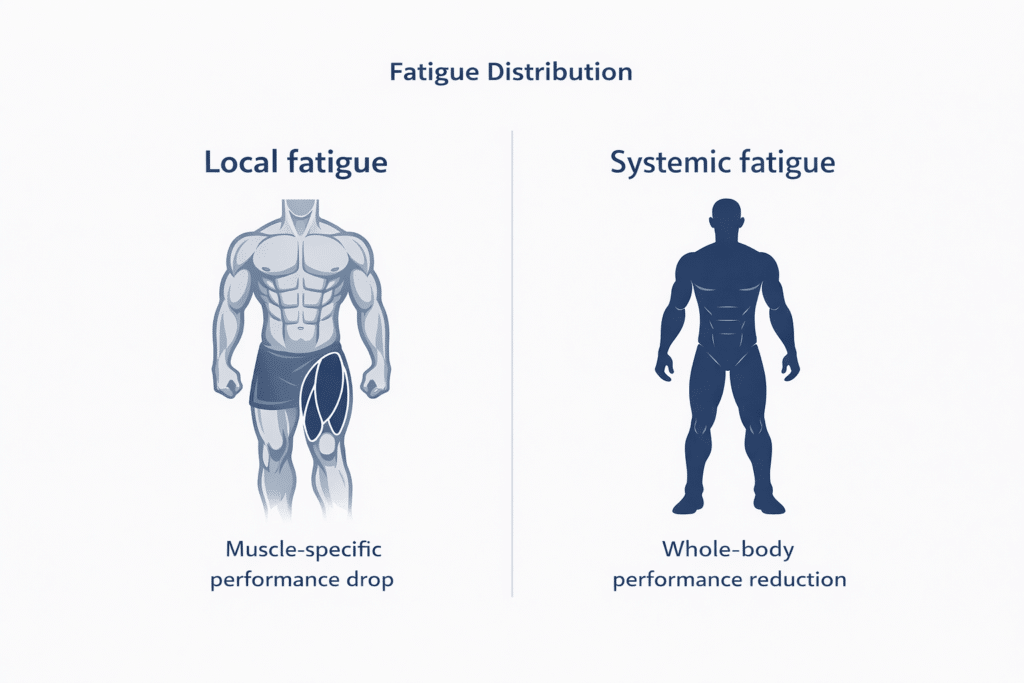
Systemic vs local fatigue describes how fatigue is distributed in strength training—whether it is concentrated within a specific muscle or spread across the body. Even when two workouts feel equally hard, the fatigue they produce can be very different in how it impacts performance, recovery, and subsequent training.
TL;DR
- Local fatigue is specific to the trained muscle and limits force production in that muscle.
- Systemic fatigue affects the whole body and can reduce performance across multiple exercises.
- Isolation exercises tend to create more local fatigue with lower systemic cost.
- Compound lifts usually create more systemic fatigue due to higher coordination and muscle mass involvement.
- High systemic fatigue can reduce overall session quality and recovery capacity.
- For hypertrophy, managing fatigue distribution is as important as managing volume and intensity.
Conceptual Foundation
While fatigue is often discussed as a single outcome, it can also be understood in terms of where it is expressed.
Local fatigue refers to fatigue that is primarily confined to the trained muscle. If your quads are exhausted after leg extensions, but your upper body performance remains unaffected, the fatigue is largely local. This type of fatigue is closely tied to what is happening inside the muscle itself, including metabolite accumulation and reduced contractile efficiency.
Systemic fatigue, on the other hand, is not limited to a single muscle group. It reflects a broader reduction in performance capacity across the body. After a long session with multiple heavy compound lifts, you may notice that everything feels slower, coordination is worse, and performance drops across unrelated movements. This is systemic fatigue.
This distinction complements the concept of central vs peripheral fatigue, which focuses more on where fatigue originates within the neuromuscular system rather than how it is distributed.
Evidence Review
Research on resistance exercise consistently shows that fatigue is task-dependent and influenced by both local muscular factors and broader systemic stress. Exercises involving large amounts of muscle mass and high coordination demands tend to create greater whole-body fatigue compared to more isolated movements.
Local fatigue is primarily driven by changes within the working muscle, including metabolite accumulation, impaired excitation-contraction coupling, and reduced contractile efficiency. These effects tend to be specific to the muscle being trained.
Systemic fatigue involves a wider set of factors, including neural drive, cardiovascular strain, and overall energetic demand. While it overlaps with central fatigue, it is better understood as a practical outcome: how much the entire system is affected rather than where the fatigue originates.
Studies comparing different resistance exercise protocols show that multi-joint, high-load training often results in greater perceived exertion and broader performance decrements than isolated work, even when local muscle fatigue is similar. This highlights that fatigue is not only about the muscle being trained but also about the total systemic demand placed on the body.
System-Level Implications
For programming, the key question is not just how much fatigue you generate—but where that fatigue is expressed.
This broader perspective on fatigue is closely tied to overall recovery, which we cover in more detail in our guide to recovery and muscle growth.
If most of your fatigue is local, you can often continue training other muscle groups effectively within the same session. This is one reason isolation work is useful for accumulating volume without excessively increasing overall fatigue.
If fatigue is highly systemic, it can reduce performance across the entire workout. Bar speed may drop, coordination may suffer, and subsequent exercises may become less productive—even if those muscles are not directly fatigued.
This is particularly relevant when structuring sessions. Starting with multiple high-effort compound lifts can quickly build systemic fatigue, which then limits the quality of the rest of the session. In contrast, distributing fatigue more strategically can help maintain performance across exercises.
This also ties closely into how volume and intensity interact in hypertrophy training, where managing both stimulus and fatigue determines long-term progress.
Practical Implementation
A useful way to think about fatigue distribution is through patterns you can observe in training:
Signs fatigue is mostly local
- Only the target muscle is limiting performance
- Other exercises feel unaffected
- You can continue training different muscle groups effectively
- Performance drops are exercise-specific
Signs fatigue is more systemic
- Multiple exercises feel harder than expected
- Bar speed drops across the session
- Coordination and focus decline
- Rest periods do not fully restore performance
- Overall session quality decreases
These patterns often overlap with broader recovery issues, which we explain in Not Recovering From Training? Signs You’re Under-Recovered (and Fixes That Work).
From a programming perspective:
When fatigue is mostly local
You can:
- Add more volume to other muscle groups
- Use isolation work to extend sessions
- Train at higher effort without large systemic cost
When fatigue is highly systemic
You may need to:
- Reduce total session length
- Limit the number of hard compound lifts
- Increase rest between sets
- Adjust frequency
- Consider deloading sooner
Balancing these two types of fatigue is key to sustaining performance across the week.
Why it matters:
Many lifters assume that a harder session is always a better session. But if fatigue is too systemic, it can reduce the quality of training that follows—both within the same workout and across the week.
This becomes especially relevant when approaching limits like Maximum Recoverable Volume (MRV): How Much Is Too Much?, where excessive systemic fatigue can reduce how much training you can productively recover from.
Local fatigue is often more directly tied to the stimulus in a specific muscle. Systemic fatigue is more about how much the entire system is taxed.
For hypertrophy, the goal is not just to train hard, but to allocate fatigue efficiently—so you can maintain performance, recover properly, and continue progressing over time.
References
- Zając A, et al. Central and Peripheral Fatigue During Resistance Exercise.
https://pubmed.ncbi.nlm.nih.gov/26839616/ - Taylor JL, et al. Neural Contributions to Muscle Fatigue.
https://pubmed.ncbi.nlm.nih.gov/27777320/ - Carroll TJ, et al. Recovery of neuromuscular fatigue after exercise.
https://pubmed.ncbi.nlm.nih.gov/27932676/