Too Much Volume for Hypertrophy? How to Tell (and What to Do Instead)
TL;DR
- More volume increases hypertrophy up to a point.
- Beyond that point, returns diminish — then regress.
- Chronic soreness, stalled loads, and declining performance are warning signs.
- Most lifters exceed their recoverable volume, not their minimum effective volume.
- The solution is usually less volume with better progression, not more sets.
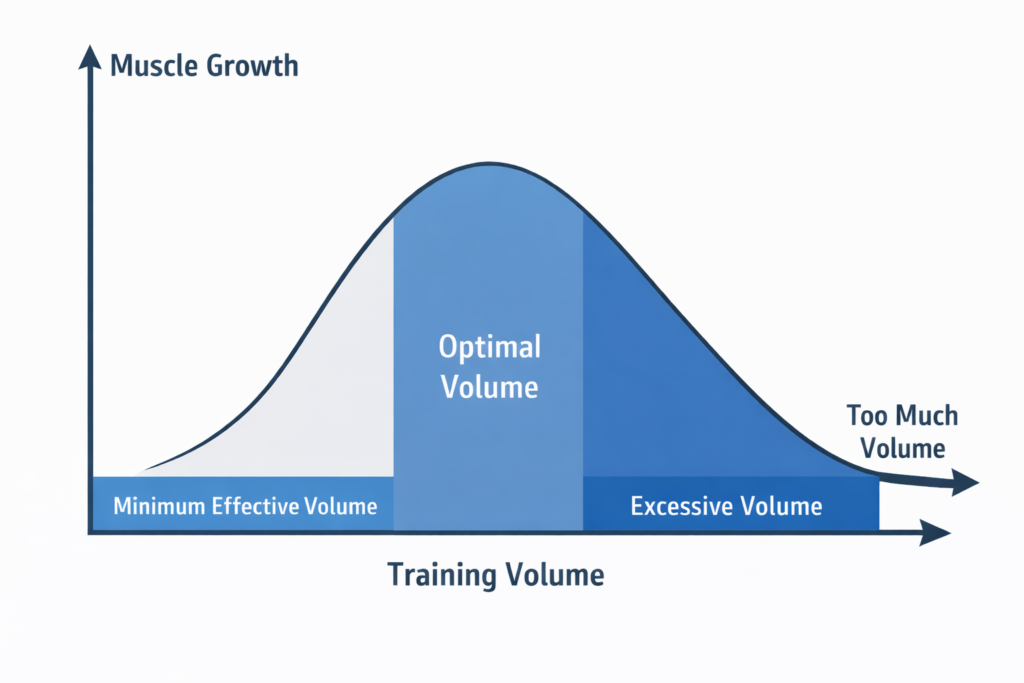
Conceptual Foundation: The Inverted U
Too much volume for hypertrophy does not improve muscle growth — it often slows it down.
- Too little volume → insufficient stimulus.
- Moderate volume → optimal growth.
- Excessive volume → fatigue outweighs adaptation.
This is where concepts like MEV (Minimum Effective Volume) and MRV (Maximum Recoverable Volume) become practical, not theoretical.
When weekly volume consistently exceeds your ability to recover, muscle protein synthesis cannot translate into measurable progress. You accumulate fatigue faster than adaptation.
Importantly, “too much” is individual and phase-dependent. What is productive in week 1 of a mesocycle may be excessive by week 5.
This is where concepts like minimum effective volume (MEV) become practical, not theoretical.
Evidence Review: Does More Volume Always Mean More Growth?
Meta-analyses suggest a dose–response relationship between volume and hypertrophy — up to moderate levels.¹ However, this relationship flattens at higher set volumes.
When volume becomes excessive:
- Performance declines
- Hormonal stress markers increase
- Neuromuscular fatigue accumulates
- Strength progression stalls
Schoenfeld et al. showed higher set volumes can produce greater hypertrophy than very low volumes, but this does not imply unlimited returns.²
In practical settings, most intermediate lifters stagnate not because they need more volume — but because they exceed their recoverable capacity.
In most cases, “too much volume” simply means that your training has exceeded your maximum recoverable volume (MRV) — the point where fatigue builds up faster than your body can recover.
How to Tell If Volume Is Too High
1. Load Progression Stalls (Despite Effort)
If you are:
- Hitting similar RIR
- Training close to failure
- Sleeping adequately
- Eating enough protein
… yet your loads are not increasing over multiple weeks, volume may be the bottleneck.
Hypertrophy and strength should trend upward over a mesocycle. If they don’t, stimulus may be excessive rather than insufficient.
2. Persistent Muscle Soreness
Soreness is not inherently bad. But:
- Constant soreness lasting 4–6 days
- Reduced force output
- “Flat” performance sessions
… suggests recovery debt.
Adaptation requires recovery windows. Chronic soreness shortens those windows.
3. Systemic Fatigue Signs
- Poor sleep quality
- Decreased motivation to train
- Reduced pump and mind-muscle connection
- Elevated resting heart rate
These are not always dramatic. Often, it’s subtle performance erosion.
When training volume exceeds your recovery capacity, adaptation slows down.
4. Volume Creep Across Mesocycles
A common pattern:
Week 1: 12 sets per muscle
Week 2: 14
Week 3: 16
Week 4: 18
Next mesocycle starts at 16 again
Over time, baseline volume drifts upward.
Without deliberate resets, MRV becomes the default starting point — which is unsustainable.
What to Do Instead
1. Reduce Volume by 20–30%
If stagnation occurs:
- Drop 2–4 sets per muscle group
- Keep intensity high (0–3 RIR)
- Prioritize load progression
Many lifters improve simply by cutting unnecessary “junk volume.”
2. Increase Effort Quality
Instead of adding sets:
- Improve proximity to failure
- Use controlled tempo
- Extend rest intervals
- Improve exercise selection
Better stimulus per set > more sets.
3. Program Deloads Strategically
A structured deload:
- Reduces accumulated fatigue
- Resensitizes volume tolerance
- Restores progression capacity
Deloads are not weakness — they are fatigue management tools.
4. Monitor Performance, Not Just Sets
Volume only matters if it produces measurable adaptation.
Track:
- Load progression
- Rep strength at fixed loads
- Perceived recovery
- Session performance quality
If those trend upward, volume is appropriate.
If not, more volume is rarely the answer.
Managing the balance between volume and intensity is critical for sustainable progression.
Why it matters:
Excessive volume is one of the most common hypertrophy mistakes among motivated lifters.
It feels productive. It increases fatigue. It increases soreness.
But hypertrophy is not about exhaustion — it is about sustainable progression.
The goal is not maximum volume.
The goal is maximum recoverable and productive volume.
FAQ
How many sets per week is too much for hypertrophy?
There is no fixed number, but many intermediate lifters may approach their maximum recoverable volume above roughly 15–20 hard sets per muscle group per week. The real limit depends on recovery capacity, sleep, nutrition, and how close sets are performed to failure.
Can too much volume stop muscle growth?
Yes. When training volume exceeds your ability to recover, fatigue accumulates faster than adaptation. This can reduce performance progression, impair recovery, and eventually stall hypertrophy despite high effort and consistency.
Should I reduce volume or intensity first?
In most cases, reduce total weekly volume first while maintaining moderate-to-high effort (around 0–3 RIR). Preserving stimulus quality is usually more effective than lowering intensity across all sets.
References
Schoenfeld BJ, Ogborn D, Krieger JW. Dose–response relationship between weekly resistance training volume and increases in muscle mass: A systematic review and meta-analysis. J Sports Sci. 2017.
https://pubmed.ncbi.nlm.nih.gov/27433992/
Pareja-Blanco F et al. Time course of recovery following resistance training leading or not to failure. Scand J Med Sci Sports. 2017.
https://pubmed.ncbi.nlm.nih.gov/27704699/