Volume vs Intensity for Hypertrophy
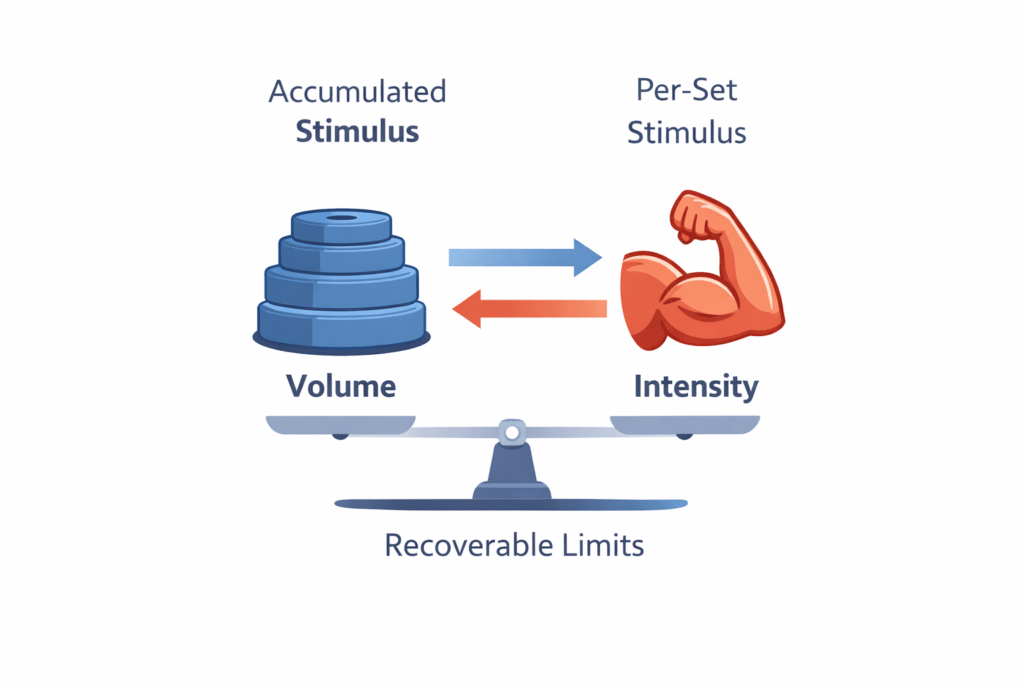
Volume vs intensity for hypertrophy is often framed as a debate — but they are not competing variables. Volume determines how much total stimulus you accumulate, while intensity determines how much stimulus each set produces.
Muscle growth depends on how both are managed within recoverable limits, which ultimately defines your optimal training volume and how much muscle you can realistically gain over time.
TL;DR
- Volume determines total hypertrophy stimulus across a week.
- Intensity determines stimulus per set.
- Very low intensity reduces effective stimulus.
- Extremely high intensity limits recoverable volume.
- Muscle growth depends on managing both within recoverable limits.
Watch: How to Find Your Optimal Training Volume
Prefer to watch? This video walks you through five practical questions for balancing training volume and intensity—including what counts as a productive set, how proximity to failure affects recovery, and when you should add, maintain, or reduce volume.
Conceptual Foundation
When people ask whether volume or intensity matters more for hypertrophy, they’re usually framing the question incorrectly.
They are not competing variables.
They are interacting variables.
Training volume typically refers to the total amount of work performed. In hypertrophy contexts, this is most often operationalized as the number of hard sets performed per muscle group per week.
Rest periods between sets also influence how much total volume you can perform within a session.
Intensity can mean two different things:
- Load relative to 1RM (%1RM)
- Effort (proximity to failure, e.g., RIR)
These are not identical. A set at 80% 1RM taken to 4 RIR is very different from a set at 65% taken to 0 RIR.
For hypertrophy, intensity determines how much stimulus you generate per set. Volume determines how much total stimulus you accumulate across time.
Muscle growth is not driven by effort alone. It is driven by recoverable stimulus accumulation — which is ultimately what causes muscle growth over time.
Before manipulating either variable, it’s useful to understand your Minimum Effective Volume.
Volume and intensity are not independent variables, but part of a broader system that determines how much effective stimulus you accumulate over time.
This concept is part of a broader framework explained in our hypertrophy training guide.
Evidence Review
Research consistently shows a dose–response relationship between training volume and hypertrophy, at least up to moderate-to-high weekly set ranges. More hard sets generally produce more growth — until recovery becomes limiting.
At the same time, studies comparing low vs moderate loads demonstrate that hypertrophy can occur across a broad loading spectrum (e.g., 30–85% 1RM), provided sets are taken sufficiently close to failure.
This tells us two things:
- Load magnitude alone is not the primary driver of hypertrophy.
- Effort standardizes stimulus across different loads.
However, there is a practical tradeoff.
Very low loads taken to failure can be systemically fatiguing and time-inefficient. Extremely high loads reduce total achievable volume due to neural and joint stress.
This is partly explained by central vs peripheral fatigue.
So while hypertrophy can occur across a wide load range, not all intensity configurations allow for optimal volume accumulation.
This is where most programming errors happen.
System-Level Implications
High intensity, low volume:
- Efficient stimulus per set
- Lower total weekly stimulus
- May cap hypertrophy if volume is insufficient
High volume, low intensity:
- High accumulated work
- Risk of “junk volume” if sets are too far from failure
- Fatigue without adequate stimulus
High volume, high intensity:
- High stimulus
- High fatigue
- Rapid recovery bottleneck
This is not a moral hierarchy.
It is a recovery management equation.
Hypertrophy depends on producing enough stimulus to drive adaptation while staying within your maximum recoverable volume (MRV).
Intensity influences how costly each set is. Volume determines how many costly sets you can accumulate before fatigue outpaces adaptation.
This balance is also influenced by how volume is distributed across sessions, which is determined by your training split for hypertrophy.
Hypertrophy is ultimately constrained by recovery capacity, which is why fatigue management frameworks are central to long-term progress.
Effort standardizes stimulus across loads, which is why the concept of effective reps becomes central when understanding how intensity drives hypertrophy.
Practical Implementation
If your primary goal is hypertrophy:
- Use moderate loads (roughly 60–80% 1RM)
- Keep most working sets within 1–3 RIR
- Accumulate sufficient weekly volume (often 10–20 hard sets per muscle, depending on training age and recovery capacity)
If your goal leans more toward strength:
- Use higher loads
- Reduce total volume
- Accept higher neural demand and longer recovery
For most intermediate lifters, the optimal strategy is not maximizing intensity or volume independently. It is maximizing recoverable volume at productive intensity, which in practice means learning how to manage your optimal training volume over time.
That means:
- Avoiding excessive failure training
- Avoiding meaningless low-effort sets
- Monitoring performance trends across weeks
- Adjusting volume based on recovery feedback
Hypertrophy is about maximizing recoverable volume at a productive intensity — which requires first identifying your Minimum Effective Volume and avoiding unnecessary volume that exceeds recovery capacity.
Hypertrophy is ultimately constrained by recovery capacity, not just training stimulus.
Why it matters:
If you misunderstand volume vs intensity:
- You may chase effort instead of stimulus.
- You may confuse muscle soreness (DOMS) with productivity.
- You may increase load while reducing total growth stimulus.
- You may accumulate fatigue faster than you accumulate muscle.
Hypertrophy is governed by sustainable stimulus accumulation, not single-set heroics.
Understanding the interaction between volume and intensity is foundational to long-term progress.
This balance is a core part of hypertrophy program design.
References
Schoenfeld BJ, Ogborn D, Krieger JW. Dose-response relationship between weekly resistance training volume and increases in muscle mass: A systematic review and meta-analysis. J Sports Sci. 2017.
https://pubmed.ncbi.nlm.nih.gov/27433992/
Schoenfeld BJ, Grgic J, Ogborn D, Krieger JW. Strength and hypertrophy adaptations between low- vs. high-load resistance training: A systematic review and meta-analysis. J Strength Cond Res. 2017.
https://pubmed.ncbi.nlm.nih.gov/28834797/
Zourdos MC, Klemp A, Dolan C, Quiles JM, Schau KA, Jo E, Helms E, Esgro B, Duncan S, Garcia Merino S, Blanco R, Whitehurst M. Novel resistance training-specific rating of perceived exertion scale measuring repetitions in reserve. J Strength Cond Res. 2016.
https://pubmed.ncbi.nlm.nih.gov/26049792/
Helms ER, Byrnes RK, Cooke DM, Haischer MH, Carzoli JP, Johnson TK, Cross MR, Cronin JB, Storey AG, Zourdos MC. RPE vs. Percentage 1RM Loading in Periodized Programs Matched for Sets and Repetitions. Front Physiol. 2018;9:247.
https://pubmed.ncbi.nlm.nih.gov/29628895/