Compound vs Isolation Exercises: Which Builds More Muscle?
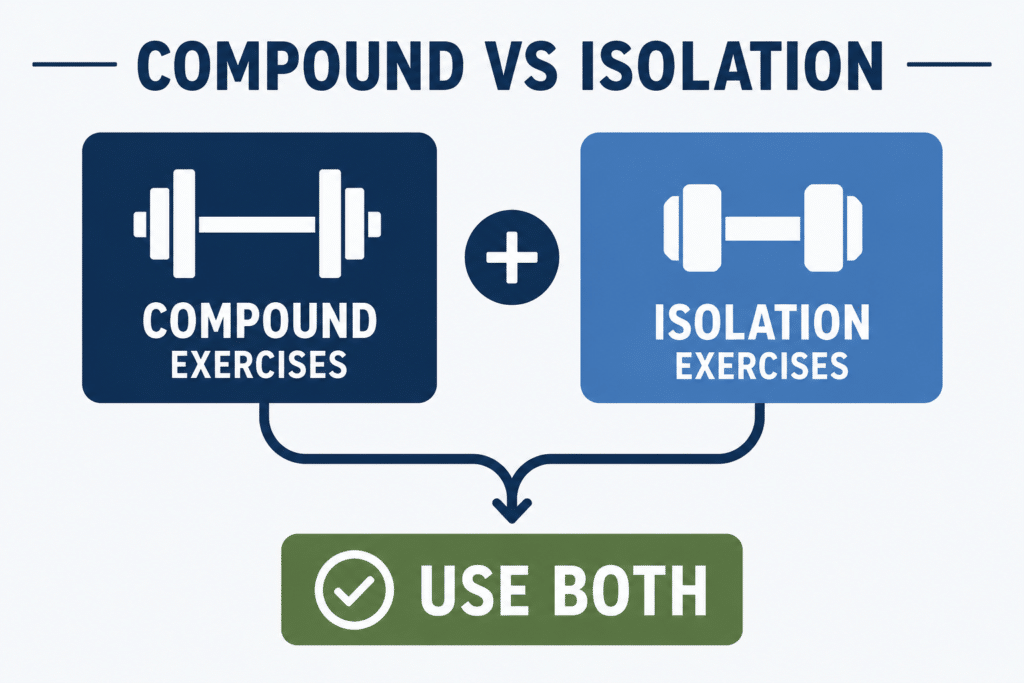
For building the most muscle, use both compound and isolation exercises. Compound exercises are usually the efficient base because one movement can train several muscles. Isolation exercises are the precision layer: they directly train muscles that a compound lift misses, underloads, or cannot take close to failure before another muscle or constraint ends the set.
If time is limited, start with a small number of compound patterns and add direct work for obvious gaps such as side delts, calves, knee-flexion hamstrings, and any priority muscle. If maximum hypertrophy is the goal, do not assume that a squat, press, or row provides a complete growth stimulus to every muscle involved.
This choice works best inside a complete program. Use the hypertrophy training guide to connect compound and isolation work with weekly volume, effort, progression, and recovery.
Compound vs Isolation Exercises at a Glance
| Factor | Compound exercises | Isolation exercises |
|---|---|---|
| Definition | Movement occurs at multiple joints and several muscles contribute meaningfully | Movement is concentrated mainly at one joint to emphasize a narrower target |
| Main advantage | Time-efficient muscle coverage and multi-joint strength practice | Target-muscle precision and easy gap-filling |
| Main limitation | A synergist, stability demand, grip, or technique may end the set before every involved muscle is well trained | More separate exercises are needed to cover the whole body |
| Loading | Usually allows more total external load, but that load is distributed across several tissues | Uses less total load, which does not mean less tension in the target muscle |
| Fatigue | Some large compounds are systemically demanding, although this varies greatly by exercise | Often easier to recover from systemically, although local fatigue can still be high |
| Best use | Efficient coverage when the target muscles are genuinely challenged | Muscles, regions, or functions that still need direct work |
What Counts as a Compound or Isolation Exercise?
A compound, or multi-joint, exercise involves meaningful movement at more than one joint. Squats, leg presses, presses, rows, pulldowns, and pull-ups are common examples. An isolation, or single-joint, exercise focuses movement mainly at one joint: curls, triceps extensions, lateral raises, leg extensions, leg curls, and calf raises.
The classification is a description, not a quality score. It can also become blurry. A hip thrust primarily trains hip extension but involves several joints and stabilizers. A lateral raise is called an isolation exercise even though the scapula and shoulder complex move together. Your muscle does not know the label; it responds to the force it produces, its length and range of motion, effort, volume, and recovery.
That is why a broader exercise-selection framework is more useful than starting with “compound good, isolation optional.”
What Does the Research Show?
Average Comparisons Do Not Show a Universal Winner
A systematic review and meta-analysis found only trivial average differences between single- and multi-joint training for limb-muscle hypertrophy.1 That is useful, but it does not prove that the two categories are interchangeable for every muscle. Few studies met the review criteria, exercises and measurement sites differed, and a whole-muscle average can hide regional or muscle-specific differences.
An eight-week trial in trained men found no statistically significant additional arm-size benefit from adding curls and triceps extensions to a multi-joint program.2 This supports a modest conclusion: isolation work is not automatically necessary for every beginner, trained lifter, or muscle. It does not support the stronger claim that compound exercises completely train every synergist.
Direct Comparisons Show Why Muscle-by-Muscle Thinking Matters
Newer direct comparisons make the limitation of category-level conclusions clearer. A 2026 comparison of leg press and knee extension found similar overall quadriceps and vasti growth, more rectus femoris growth from knee extensions, and additional gluteus maximus and adductor magnus growth from the leg press.3
The correct takeaway is not “leg extensions beat leg presses.” It is that a compound exercise can efficiently train several muscles while an isolation exercise better covers a particular muscle within the group. For complete quadriceps development, a squat or leg press paired with a leg extension can therefore be more defensible than treating either movement as universally complete.
The same principle appears in upper-body research. In a small within-person study, biceps curls produced greater elbow-flexor muscle-thickness gains than one-arm dumbbell rows when both were trained to failure.4 The row was still useful for the back and still involved the elbow flexors; involvement was simply not equivalent to direct training.
Exercise Specificity Matters for Strength
If your goal includes improving a specific lift, practise that lift or a close variation. Squat training improves squat performance more directly than leg-extension-only training. Isolation work can support muscle size and manage fatigue, but it cannot fully replace the skill and coordination of the strength task.
The Target-Limitation Test
A compound set ends when the exercise can no longer be completed—not when every participating muscle has reached the same proximity to failure. During a bench press, the chest, front delts, and triceps contribute in different proportions. If the triceps fail first, the chest may still have repetitions in reserve. If the chest fails first, the triceps may receive useful but incomplete work.
- Which muscle or constraint ends the set? The target muscle, a synergist, grip, balance, breathlessness, pain, or technique?
- Does the exercise train the function you need? A hip hinge does not replace knee-flexion hamstring work, and pressing does little for the side delts.
- Can you progress it without changing the movement? More weight is not useful if range shortens or other muscles increasingly take over.
- What fatigue does the target stimulus cost? Compare exercises at the muscle level, not by how exhausting the whole movement feels.
If a movement repeatedly fails these tests, revisit the complete guide to choosing exercises for muscle growth.
Muscle-by-Muscle Guide
| Muscle | Useful compound base | When isolation is valuable | Example pairing |
|---|---|---|---|
| Chest | Horizontal or incline press | When triceps or front delts limit pressing, or more chest work is wanted without more pressing fatigue | Machine press + cable fly |
| Back | Pulldown or pull-up plus a row | When grip, elbow flexors, or spinal loading limits the target; pullovers can add shoulder-extension work | Chest-supported row + cable pullover |
| Front delts | Horizontal and overhead pressing | Often little extra work is needed unless they are a specific priority | Incline press; front raise only when justified |
| Side delts | Overhead pressing provides some involvement | High value because presses do not directly reproduce shoulder-abduction demands | Overhead press + cable lateral raise |
| Biceps | Rows, pulldowns, and pull-ups | When arm growth is a goal or back work does not sufficiently challenge the elbow flexors | Pulldown + curl |
| Triceps | Bench, incline, and overhead presses | When pressing volume is limited or direct long-head work is desired | Press + overhead cable extension |
| Quadriceps | Squat or leg press | For the rectus femoris and additional quad work without more axial loading | Leg press + leg extension |
| Hamstrings | Hip hinges train hip-extension function | High value because squats and leg presses provide little knee-flexion hamstring training | Romanian deadlift + seated leg curl |
| Glutes | Deep squat, leg press, and hip-hinge patterns | When more hip-extension volume is wanted without repeating the same squat fatigue | Squat + hip thrust |
| Calves | Indirect involvement in lower-body compounds is usually limited | Usually needed when calf hypertrophy matters | Standing + seated calf raise |
These are starting hypotheses, not anatomical guarantees. Technique, limb lengths, equipment, and execution change which muscle is challenged. The best pairing is one you can evaluate through repeatable performance and recovery.
Use the THG Exercise Guides for complete technique, variation and progression guidance on the individual movements.
The triceps provide another example of why the isolation choice itself matters. Overhead elbow-extension training produced substantially greater triceps growth than extensions performed with the arm in a neutral position, particularly for the long head.5 “Add an isolation” is only the first decision; joint position, stability, and resistance profile still matter.
Choose the Mix Based on Your Goal
| Goal or constraint | Recommended emphasis | Why |
|---|---|---|
| Minimum-time muscle gain | Mostly compounds, plus a few high-value isolations for uncovered muscles | Maximizes muscle coverage per exercise |
| Maximum hypertrophy | Compounds and isolations selected muscle by muscle | Combines efficient coverage with target precision |
| Powerlifting or lift strength | Specific compounds first; isolations afterward as assistance | Strength is highly task-specific |
| Weak-point specialization | Direct priority work earlier in the session or week | Protects performance for the priority muscle |
| Limited recovery | Keep productive compounds; replace redundant, costly work with stable isolations or machines | Maintains local stimulus while reducing unnecessary whole-body demands |
| Beginner program | A simple compound base, then only the isolations needed for coverage and enjoyment | Builds skill without pretending one exercise trains everything equally |
Practical Compound-and-Isolation Sessions
Upper-Body Example
- Stable chest press: 2–3 sets
- Chest-supported row: 2–3 sets
- Lat pulldown: 2–3 sets
- Cable lateral raise: 2–3 sets
- Overhead triceps extension: 2 sets
- Curl variation: 2 sets
The first three exercises provide broad coverage. The final three fill predictable gaps rather than existing merely to make the session longer.
Lower-Body Example
- Squat or leg press: 2–3 sets
- Romanian deadlift: 2–3 sets
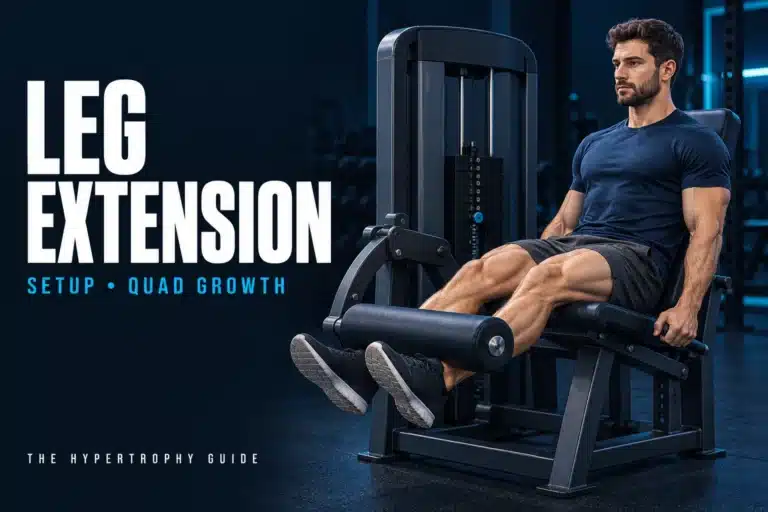
- Leg extension: 2 sets
- Seated leg curl: 2 sets
- Calf raise: 2–3 sets
Here, the isolation work is not redundant. Leg extensions add rectus-femoris-focused knee-extension work; leg curls train knee flexion; calf raises directly train muscles that the larger lower-body patterns may not develop sufficiently.
These set numbers belong inside a weekly plan. Count direct and indirect work at the muscle level with the guide to sets per muscle group per week.
Do Compound Exercises Always Create More Fatigue?
No. “Compound” does not automatically mean fatiguing, and “isolation” does not automatically mean easy. A supported machine press can be less disruptive than a high-repetition unilateral isolation exercise taken to failure. Fatigue depends on muscle mass involved, stability, axial loading, range of motion, set duration, proximity to failure, session placement, and the individual.
- If heavy squats train your quads well and recovery is good, keep them.
- If extra squat sets mainly add lower-back fatigue, leg extensions may be a better way to add quad volume.
- If a press already challenges the triceps close to their limit, more direct work may add little.
- If the chest ends the press while the triceps still have capacity, an extension can supply missing direct work.
This is also why free weights vs machines should be decided exercise by exercise rather than ideologically.
Should Isolation Exercises Come After Compounds?
Usually, but not always. A systematic review and meta-analysis found little evidence that exercise order changes average hypertrophy when the same work is completed. Strength gains tend to favor the exercise performed earlier, when performance is highest.6
Put the highest-priority or most technically demanding movement first. If side delts are your priority, lateral raises can come before pressing. If squat performance is the priority, squat first. Pre-fatiguing a muscle is not automatically better for growth; it is useful only when it improves the target stimulus without degrading work that matters more.
How I Apply This in My Own Training
In my own upper/lower training, I often use only two hard working sets per exercise. That makes exercise selection important: I cannot afford to keep a movement simply because it is traditionally called “foundational.”
I use stable compound patterns for efficient coverage, then add direct work where the compounds have a predictable gap—such as lateral raises, curls, triceps extensions, leg curls, and calf work. I keep an exercise when the target muscle is clearly challenged, technique is repeatable, and performance can progress without recovery becoming a problem.
That is the same four-part method I use when assessing a program:
- Coverage: does the week train every priority muscle and its important functions?
- Limitation: can the target muscle approach its limit, or does something else stop the set?
- Cost: can performance and recovery remain stable?
- Progression: can technique, repetitions, load, and effort be tracked over time?
A compound stays because it passes these tests—not because it is “foundational.” An isolation stays because it fills a measurable gap—not because every workout needs a pump exercise. This logic belongs inside a complete hypertrophy program design.
Bottom Line
Compound vs isolation exercises is not a contest with one winner. Compounds provide efficiency. Isolations provide precision. The research suggests that both can build muscle, while the specific exercise can change which muscle or region receives the best stimulus.
Start with movements that cover several targets well. Then identify what those movements do not adequately train and add direct work. Judge the final program muscle by muscle—not label by label.
Frequently Asked Questions
Are compound exercises better than isolation exercises for hypertrophy?
Not inherently. Compound exercises are usually more time-efficient and useful for multi-joint strength, while isolation exercises can provide an equal or better stimulus to a specific muscle. Most complete hypertrophy programs use both.
Can you build muscle with only compound exercises?
Yes, especially as a beginner or when time is limited. However, muscles such as the side delts, calves, knee-flexion hamstrings, arms, or rectus femoris may benefit from additional direct work.
Do rows and pulldowns count as biceps work?
They count as indirect biceps work, but not necessarily as the same stimulus as curls. Add direct curls when biceps growth is a priority or progress from pulling exercises alone is insufficient.
Should isolation exercises come after compound exercises?
Usually, but not always. Put the highest-priority or most technically demanding movement first. Exercise order appears to have little effect on average hypertrophy when the same work is completed, while strength gains favor exercises performed earlier.
Are isolation exercises less functional?
Functional only has meaning relative to a goal. A curl is specific to elbow-flexor hypertrophy and strength, while a squat is specific to a multi-joint squat task. For muscle growth, choose exercises that train the target effectively and fit the program.
References
- Rosa A, Vazquez G, Grgic J, et al. Hypertrophic effects of single- versus multi-joint exercise of the limb muscles: a systematic review and meta-analysis. Strength & Conditioning Journal. 2023.
- de França HS, et al. The effects of adding single-joint exercises to a multi-joint resistance-training program on upper-body muscle strength and size in trained men. Applied Physiology, Nutrition, and Metabolism. 2015.
- Kinoshita M, et al. Hypertrophic effects of single- versus multi-joint exercise: a direct comparison between knee extension and leg press. Medicine & Science in Sports & Exercise. 2026.
- Mannarino P, et al. Single-joint exercise results in higher hypertrophy of elbow flexors than a multi-joint exercise. Journal of Strength and Conditioning Research. 2021.
- Maeo S, et al. Triceps brachii hypertrophy is substantially greater after elbow-extension training performed in the overhead versus neutral arm position. European Journal of Sport Science. 2023.
- Nunes JP, et al. What influence does resistance exercise order have on muscular strength gains and muscle hypertrophy? A systematic review and meta-analysis. European Journal of Sport Science. 2021.