Free Weights vs Machines for Muscle Growth
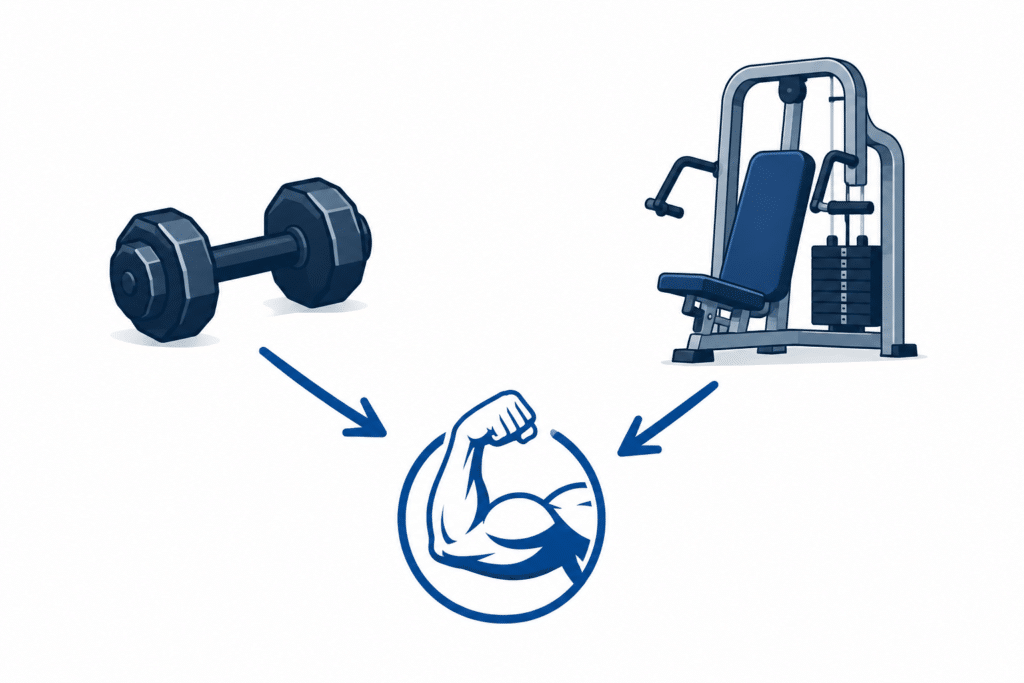
Free weights vs machines is one of the most common debates in strength training. Some lifters believe free weights are superior because they require more balance, coordination, and stabilizer involvement. Others prefer machines because they feel safer, easier to control, and more targeted.
For hypertrophy, the better question is not which tool is universally best.
The better question is which tool helps you train the target muscle effectively, recover well, and progress consistently.
TL;DR
- Free weights and machines can both build muscle effectively.
- Free weights are useful for coordination, versatility, and exercises that match your structure well.
- Machines are useful for stability, targeted loading, and adding volume with less technical demand.
- For hypertrophy, muscle tension, effort, range of motion, and progression matter more than the equipment category.
- Most lifters should use both free weights and machines.
What Are Free Weights?
Free weights are external loads that are not fixed to a guided path. This includes barbells, dumbbells, kettlebells, and other handheld or plate-loaded implements.
Common examples include:
- Barbell squats
- Dumbbell presses
- Romanian deadlifts
- Barbell rows
- Dumbbell lateral raises
The main advantage of free weights is freedom of movement. You can adjust your joint angles, grip, stance, and range of motion to better fit your body.
This can be a major benefit when the movement feels natural. However, it can also increase the technical demand of the exercise.
What Are Machines?
Machines use a fixed or semi-fixed movement path. This includes selectorized machines, plate-loaded machines, Smith machines, cables, and guided resistance systems.
Common examples include:
- Leg presses
- Hack squats
- Chest press machines
- Seated rows
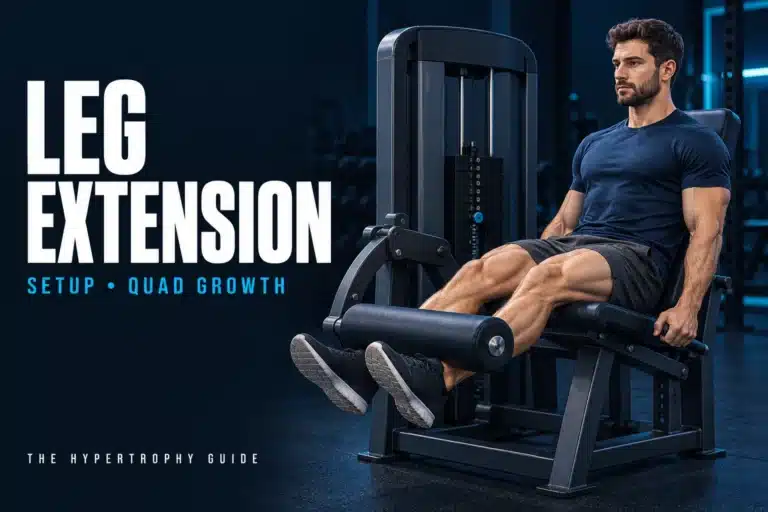
- Leg extensions
- Leg curls
- Cable exercises
The main advantage of machines is stability. Because the movement path is more controlled, machines often make it easier to focus on the target muscle instead of balance, coordination, or setup complexity.
This is especially useful when the goal is hypertrophy rather than skill practice. For a deeper discussion, see Stable vs Unstable Exercises for Hypertrophy.
Are Free Weights Better for Muscle Growth?
Free weights are not automatically better for muscle growth.
They can be excellent tools because they allow natural movement, high loading, and large compound exercises. A barbell squat, bench press, or Romanian deadlift can provide a strong hypertrophy stimulus when performed with good technique and appropriate effort.
However, free weights are not superior simply because they are harder to stabilize. For hypertrophy, more instability is not always better. If balance and coordination become the limiting factors, the target muscle may receive less effective tension.
This is why exercise selection should be based on the muscle you are trying to train, not on whether an exercise looks more “functional.” For a broader framework, read How to Choose Exercises for Muscle Growth.
For practical technique and progression guidance on specific free-weight, machine and cable movements, browse the THG Exercise Guides.
Can Machines Build as Much Muscle as Free Weights?
Yes. Machines can build muscle very effectively when they load the target muscle through a useful range of motion and allow progressive overload.
Research comparing free-weight and machine-based training generally does not show a clear hypertrophy advantage for either category when training is matched reasonably well. In practice, both can work because both can create mechanical tension, sufficient effort, and progressive loading.
Machines may even be better in some situations because they reduce unnecessary stability demands. For example, a chest-supported row may allow the back to be trained harder because the lower back is no longer the limiting factor. A hack squat may allow more quad-focused loading than a free-weight squat for some lifters.
This does not mean machines are always better. It means they should not be dismissed as inferior.
Free Weights vs Machines: The Real Difference
The real difference is not that one builds muscle and the other does not.
The real difference is how each tool distributes stimulus, fatigue, and skill demand.
- Free weights usually require more coordination and stabilization.
- Machines usually provide more external stability.
- Free weights often allow more movement freedom.
- Machines often make it easier to isolate the target muscle.
- Free weights may have more carryover to specific strength skills.
- Machines may be easier to push close to failure safely.
This overlaps with the broader distinction between movement categories discussed in Compound vs Isolation Exercises for Hypertrophy.
When Free Weights Make Sense
Free weights are especially useful when the exercise fits your structure well and you can perform it with consistent technique.
Use free weights when you want:
- More movement freedom
- High loading potential
- More coordination practice
- Exercises that transfer well to specific strength goals
- Simple equipment that can be used in many ways
For example, dumbbell presses may feel better than a fixed chest press machine for some lifters because the shoulder can move more naturally. Romanian deadlifts are also difficult to fully replace with many machine variations because the movement pattern and loading profile can be very effective for the posterior chain.
When Machines Make Sense
Machines are especially useful when stability helps you train the target muscle harder.
Use machines when you want:
- More external stability
- Less technical complexity
- Targeted muscle loading
- Safer sets close to failure
- Less fatigue from balance or setup demands
For example, leg presses, hack squats, leg extensions, chest-supported rows, and cable exercises can all be excellent hypertrophy tools. They may allow you to accumulate productive volume without every set becoming a full-body coordination challenge.
Machine and cable exercises can also be useful when you want to keep tension high in specific positions, including exercises that emphasize longer muscle lengths or techniques such as lengthened partials.
This is especially important when weekly volume increases. If you are unsure how much work a muscle needs, read How Many Sets Per Muscle Group Per Week?.
System-Level Implications
A good hypertrophy program should not be built around equipment loyalty. It should be built around stimulus, fatigue, progression, and recovery.
Free weights may provide a strong stimulus, but they can also create more fatigue or technical breakdown when pushed hard. Machines may reduce fatigue from stabilization and allow more direct loading of the target muscle.
This matters because more difficult does not always mean more effective. A set that feels harder because it is unstable, awkward, or technically demanding is not always a better hypertrophy stimulus.
The goal is to choose exercises that create high target-muscle tension with manageable fatigue. This is closely related to the balance between productive work and recovery discussed in Volume vs Intensity for Hypertrophy.
Practical Implementation
A simple approach is to use free weights where they feel strong and repeatable, then use machines to add targeted volume.
Example lower-body session:
- Barbell squat or hack squat
- Romanian deadlift
- Leg press
- Leg curl
- Calf raise
Example upper-body session:
- Dumbbell press
- Chest-supported row
- Machine shoulder press
- Cable lateral raise
- Triceps pushdown
- Biceps curl
The exact split is less important than the logic:
- Use free weights when they fit your body and goals.
- Use machines when stability improves the stimulus.
- Use both when the combination gives better coverage and recovery.
Why It Matters:
Many lifters turn free weights vs machines into an identity issue. One side sees machines as inferior. The other side avoids free weights because they feel intimidating or overly technical.
For muscle growth, neither extreme is necessary.
A machine that lets you train the target muscle hard through a controlled range of motion can be an excellent hypertrophy exercise. A free-weight lift that fits your structure and can be progressively overloaded can also be excellent.
Effort still matters. Whether you use free weights or machines, your working sets need to be performed close enough to failure to create a meaningful stimulus. For more on this, read RIR for Hypertrophy.
FAQ
Are free weights better than machines for muscle growth?
Not automatically. Free weights can be excellent for muscle growth, but machines can be equally effective when they load the target muscle well and allow progressive overload.
Can you build muscle using only machines?
Yes. You can build muscle using only machines if your program includes enough volume, effort, progression, and exercise variety. However, free weights can still be useful for movement freedom and specific strength goals.
Can you build muscle using only free weights?
Yes. Many lifters build impressive muscle with mostly free weights. However, machines can make it easier to add targeted volume, reduce technical demands, and train safely close to failure.
Should beginners use free weights or machines?
Beginners can use both. Machines may be easier to learn at first, while free weights help develop coordination and movement skill. The best choice depends on confidence, coaching, exercise setup, and the target muscle.
Are machines safer than free weights?
Machines can be safer in some situations because the movement path is guided and setup is often simpler. However, any exercise can cause problems if load, range of motion, or technique is poorly managed.
Do machines reduce stabilizer muscle activation?
Often, yes. But this is not always a disadvantage for hypertrophy. Reducing stability demands can sometimes help the target muscle receive more focused work.
References
- Schwanbeck SR, et al. Effects of Training With Free Weights Versus Machines on Muscle Mass, Strength, Free Testosterone, and Free Cortisol Levels. J Strength Cond Res. 2020.
- Heidel KA, et al. Machines and free weight exercises: a systematic review and meta-analysis. J Strength Cond Res. 2022.
- Haugen ME, et al. Effect of free-weight vs. machine-based strength training on maximal strength, hypertrophy and jump performance: a systematic review and meta-analysis. BMC Sports Sci Med Rehabil. 2023.
- Gentil P, et al. Single vs. Multi-Joint Resistance Exercises: Effects on Muscle Strength and Hypertrophy. Asian J Sports Med. 2015.
- Schoenfeld BJ, et al. Strength and Hypertrophy Adaptations Between Low- vs. High-Load Resistance Training: A Systematic Review and Meta-analysis. J Strength Cond Res. 2017.