Lengthened Partials for Muscle Growth: Are They Better Than Full Reps?
By Alexander Kekec Larsen
Lengthened partials for muscle growth have gained significant attention in recent years. Emerging research suggests that performing partial repetitions in stretched positions may provide a powerful stimulus for hypertrophy.
TL;DR
- Lengthened partials are repetitions performed in the stretched portion of an exercise.
- Recent research suggests that lengthened partials can produce muscle growth comparable to or greater than full range of motion training in certain exercises.
- The hypertrophic benefits likely stem from greater loading at longer muscle lengths.
- Full range of motion training should still form the foundation of most hypertrophy programs.
- Lengthened partials are best viewed as a powerful tool rather than a replacement for traditional training.
What Are Lengthened Partials?
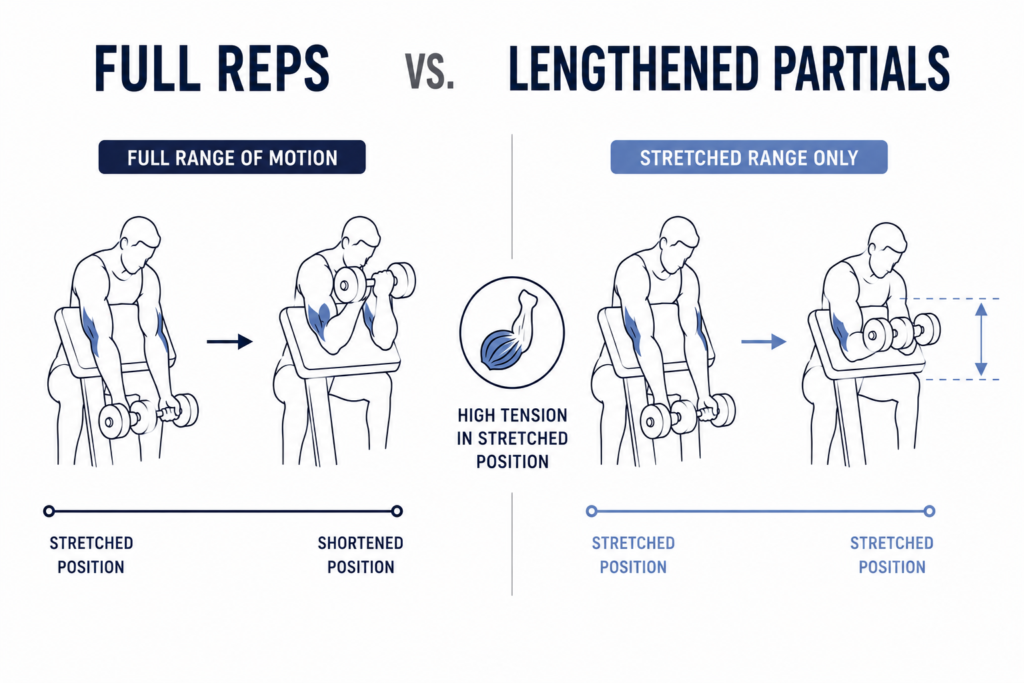
Lengthened partials are partial repetitions performed in the stretched position of an exercise.
Unlike traditional partial reps, which may occur anywhere within the movement, lengthened partials intentionally emphasize the portion of the exercise where the target muscle is under high tension while elongated.
Examples include:
- Performing only the bottom half of a dumbbell chest fly.
- Using only the stretched portion of a leg extension.
- Performing calf raises primarily in the deep stretched position.
- Completing short repetitions near the bottom of a squat after reaching failure.
These repetitions have gained significant attention due to emerging evidence suggesting that training muscles at longer lengths may maximize muscle growth.
Why Might Lengthened Partials Be Effective?
Several mechanisms may explain why lengthened partials appear highly effective for muscle growth.
Greater Tension at Long Muscle Lengths
Resistance training performed at longer muscle lengths often produces greater hypertrophy than training only in shortened positions.
Muscles subjected to high mechanical tension while stretched may experience:
- Greater active tension.
- Increased passive tension from connective tissues.
- Enhanced muscle fiber recruitment.
- Region-specific hypertrophy in previously under-stimulated areas.
This concept is often referred to as stretch-mediated hypertrophy.
For a broader discussion of exercise execution variables, see our article on range of motion for muscle growth.
What Does the Research Say?
Recent studies comparing full range of motion training with lengthened partials have produced intriguing findings.
In several exercises, lengthened partials have produced hypertrophy that was similar to or even greater than traditional full-ROM training.
For example, some studies have found superior growth when participants performed repetitions exclusively in the stretched portion of movements such as calf raises and leg extensions.
However, findings are not entirely consistent across all muscles and exercises.
Importantly, most studies have been relatively short in duration and often involve trained but not elite lifters.
Therefore, while the evidence is promising, it is premature to conclude that lengthened partials are universally superior.
Full Range of Motion vs Lengthened Partials
For most lifters, this should not be viewed as an “either-or” question.
Full range of motion training offers several advantages:
- Develops strength across the entire movement.
- Improves mobility and movement competency.
- Produces robust hypertrophy across multiple joint angles.
- Better reflects real-world and athletic movement demands.
Lengthened partials may provide additional hypertrophic stimulus when strategically incorporated.
For example, a lifter might perform:
- Full-ROM sets close to failure.
- Follow these with several lengthened partial repetitions.
This approach allows the lifter to benefit from both full ROM and additional loading in the stretched position. It may also extend a set after full repetitions are no longer possible, especially when the lifter is already training close to failure using sensible reps in reserve.
Practical Applications
Lengthened partials may work particularly well for exercises such as:
- Leg extensions.
- Leg curls.
- Calf raises.
- Cable flyes.
- Lateral raises.
- Preacher curls.
- Pulldowns.
- Romanian deadlifts.
Exercises selected using sound exercise selection principles and which provide a stable, heavily loaded stretched position appear especially suitable.
Stable machine exercises may often be preferable to highly unstable movements when using this technique. Learn more in our article on stable vs unstable exercises for hypertrophy.
Conversely, lengthened partials may be less practical for technically demanding free-weight compound exercises where fatigue substantially increases injury risk.
Potential Limitations
Lengthened partials are not magic.
Potential drawbacks include:
- Greater muscle soreness.
- Increased fatigue.
- Higher discomfort during training.
- Reduced specificity for full-range strength development.
As with any training method, training volume, recovery, and progressive overload remain important drivers of long-term hypertrophy.
Why It Matters
Lengthened partials represent one of the most interesting recent developments in hypertrophy research.
Current evidence suggests that exposing muscles to high tension in stretched positions may enhance muscle growth. However, full range of motion training remains an extremely effective strategy and should still comprise the majority of most programs.
Rather than replacing traditional training, lengthened partials should be viewed as an advanced technique that can potentially augment hypertrophy.
FAQ
Are lengthened partials better than full reps?
Not necessarily. Current research suggests they may be equally effective or slightly superior in some exercises, but full-ROM training remains highly effective.
Should beginners use lengthened partials?
Beginners should primarily focus on mastering technique, selecting appropriate exercises using evidence-based exercise selection principles, and performing movements through a controlled full range of motion.
How should I use lengthened partials?
A practical strategy is to perform full-ROM sets first and then add a few lengthened partial repetitions near the end of a set.
References
- Wolf CJ, et al. Partial versus full range of motion resistance training and muscle hypertrophy. Sports Medicine. 2023. PubMed
- Pedrosa GF, et al. Effects of resistance training at long muscle lengths on muscle hypertrophy: A systematic review. Sports Medicine. 2023. PubMed
- Kassiano W, et al. Full versus partial range of motion resistance training: A systematic review. Journal of Strength and Conditioning Research. 2023. PubMed