Stable vs Unstable Exercises for Hypertrophy
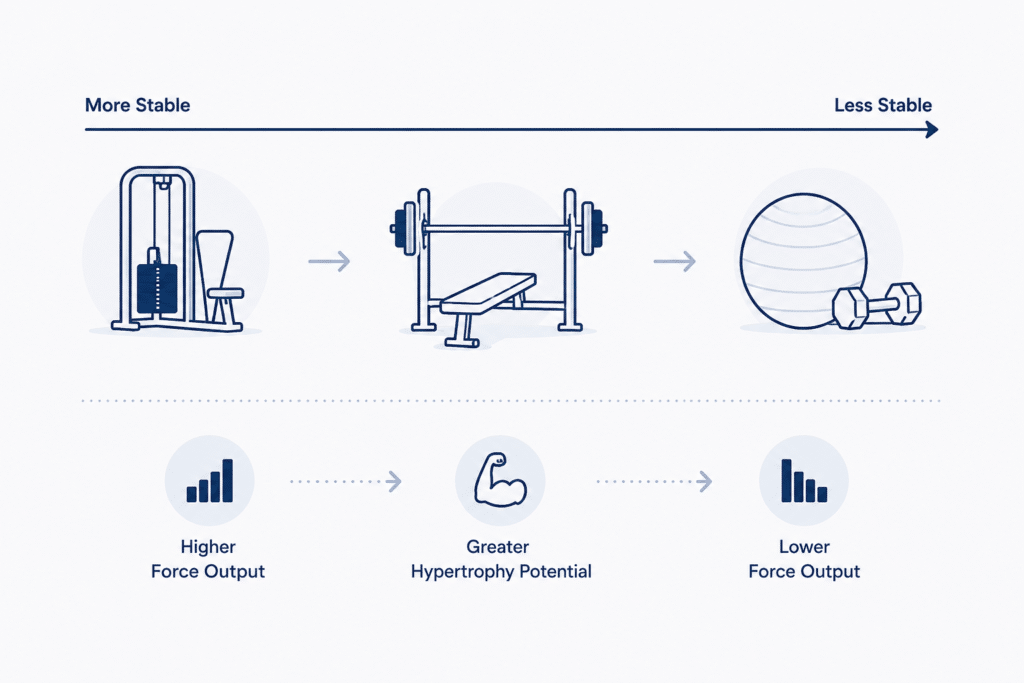
When comparing stable vs unstable exercises for hypertrophy, the key question is not which exercise feels harder, but which one allows the target muscle to produce enough force, accumulate quality volume, and progress over time.
Many lifters assume that making an exercise harder automatically makes it better for muscle growth. Bosu balls, balance discs, Swiss balls, and suspension straps are often promoted as “functional” tools that challenge more muscles at once.
But for hypertrophy, harder is not always better.
The main limitation of unstable exercises is that they usually reduce how much force you can produce. When balance becomes the limiting factor, the target muscle may receive less mechanical tension—which makes the exercise less efficient for building muscle.
TL;DR
- Stable exercises are usually better for hypertrophy because they allow higher force output and more controlled loading.
- Unstable exercises can improve balance, coordination, and trunk control, but they are usually not ideal for maximizing muscle growth.
- Instability often reduces load, rep quality, and proximity to true muscular failure.
- Machines, cables, chest-supported exercises, and stable free-weight movements are usually better primary hypertrophy tools.
- Unstable exercises can still be useful in rehab, athletic preparation, or as accessory work.
Conceptual Foundation
Hypertrophy training is primarily about exposing muscles to sufficient mechanical tension, accumulating enough productive volume, and progressively increasing training demands over time.
Choosing between stable and unstable exercises is ultimately an exercise selection decision. As explained in our guide on how to choose exercises for muscle growth, the best hypertrophy exercises are typically those that allow consistent technique, high target-muscle tension, and long-term progression.
Exercise stability matters because it influences how much force you can generate.
In a stable exercise, the target muscle can usually work harder because fewer resources are spent on maintaining balance and coordination. For example, a machine chest press allows you to focus almost entirely on producing force and taking the muscle close to failure.
In contrast, unstable exercises require additional neuromuscular effort to control the body or implement. Although these exercises often feel harder, they may actually provide a weaker hypertrophy stimulus because less force can be directed toward the target muscle.
This is why a Swiss-ball dumbbell press may feel challenging, yet still be inferior for muscle growth compared with a stable dumbbell bench press or machine press.
Evidence Review
Research consistently shows that unstable conditions reduce maximal force production. This reduction is important because force production is closely linked to mechanical tension—one of the primary drivers of hypertrophy.
Unstable exercises may increase activation of certain stabilizing muscles, but greater activation does not necessarily translate into greater muscle growth.
For hypertrophy, increased difficulty is only beneficial if it increases the stimulus to the target muscle. If instability forces you to use substantially lighter loads, terminate sets early, or compromise technique, the hypertrophic stimulus may actually decrease.
This is also why machines should not automatically be considered inferior. As discussed in our article on free weights vs machines for hypertrophy, stable environments often allow greater force production, improved exercise execution, and more productive training volume.
Similarly, if instability prevents you from pushing a set sufficiently hard, you may accumulate fewer effective reps, potentially limiting muscle growth.
System-Level Implications
Exercise stability exists on a continuum rather than as a simple stable-versus-unstable distinction.
Highly Stable Exercises
- Machine chest press
- Leg press
- Hack squat
- Chest-supported row
- Cable lateral raise
- Seated leg curl
These exercises are often excellent hypertrophy tools because they allow high effort with relatively low technical and balance demands. They may also make it easier to use a consistent range of motion from set to set.
Moderately Stable Exercises
- Barbell squat
- Barbell bench press
- Dumbbell bench press
- Romanian deadlift
- Bulgarian split squat performed on the floor
These exercises require meaningful stabilization, but remain sufficiently stable to produce robust hypertrophy adaptations.
Highly Unstable Exercises
- Squats performed on a Bosu ball
- Swiss-ball dumbbell presses
- Suspension trainer push-ups
- Single-leg exercises performed on unstable surfaces
These exercises can be useful for balance, coordination, rehabilitation, or sport-specific preparation, but they rarely represent optimal choices when hypertrophy is the primary objective.
Practical Implementation
If your primary goal is muscle growth, most of your training program should consist of stable or moderately stable exercises. This fits the broader logic of compound vs isolation exercises: the best choice depends on which exercise allows the target muscle to be trained effectively, not which category sounds more advanced.
A practical guideline is:
- 70–90% of training volume: stable or moderately stable exercises.
- 10–30% of training volume: coordination-demanding exercises if they serve a specific purpose.
- Minimal volume: highly unstable exercises unless required for rehabilitation or sport-specific reasons.
For example, if your goal is chest hypertrophy, machine presses, barbell bench presses, and dumbbell presses will generally outperform Swiss-ball pressing variations.
Likewise, a chest-supported row may be preferable to unsupported rowing if lower-back fatigue limits performance and prevents you from training the back muscles effectively.
Stable exercises also make it easier to train with high effort and approach training close to failure without balance becoming the limiting factor.
Stable exercises can also be useful when applying advanced techniques such as lengthened partials, because the target muscle can remain the limiting factor in the stretched portion of the movement.
Why it matters:
Many lifters mistakenly assume that making an exercise more difficult automatically increases its hypertrophy potential.
However, muscle growth is not about making exercises look impressive or excessively challenging. The goal is to create a repeatable, progressive, high-tension stimulus for the target muscle.
Stable exercises typically allow you to apply more force, perform more productive repetitions, and recover more effectively between sessions.
Unstable exercises certainly have value, particularly for rehabilitation, balance training, and athletic development. But if maximizing hypertrophy is your main objective, stability should usually be prioritized.
FAQ
Are unstable exercises good for hypertrophy?
Unstable exercises can build muscle if they are performed with sufficient effort, but they are generally less efficient than stable exercises because instability often reduces force output and loading potential.
Do Bosu ball exercises build more muscle?
Bosu ball exercises may improve balance and coordination, but they are unlikely to build more muscle than stable resistance exercises performed with heavier loads.
Are machines better than unstable free-weight exercises?
For hypertrophy, machines are often superior to highly unstable exercises because they provide greater stability and allow the target muscles to be trained closer to their true limits.
Should beginners perform unstable exercises?
Most beginners will benefit more from mastering stable movement patterns first. Stable exercises make it easier to learn technique, progressively overload muscles, and build strength.
When should unstable exercises be included?
Unstable exercises can be valuable during rehabilitation, for improving balance, or for athletes with sport-specific stability demands. They are usually best viewed as supplementary rather than foundational hypertrophy exercises.
References
- Behm DG, Anderson KG. The role of instability with resistance training. Journal of Strength and Conditioning Research. 2006.
- Behm DG, Drinkwater EJ, Willardson JM, Cowley PM. The use of instability to train the core musculature. Applied Physiology, Nutrition, and Metabolism. 2010.
- Schoenfeld BJ. The mechanisms of muscle hypertrophy and their application to resistance training. Journal of Strength and Conditioning Research. 2010.