Omega-3 for Muscle Growth: Benefits, Dosage, and What the Research Says
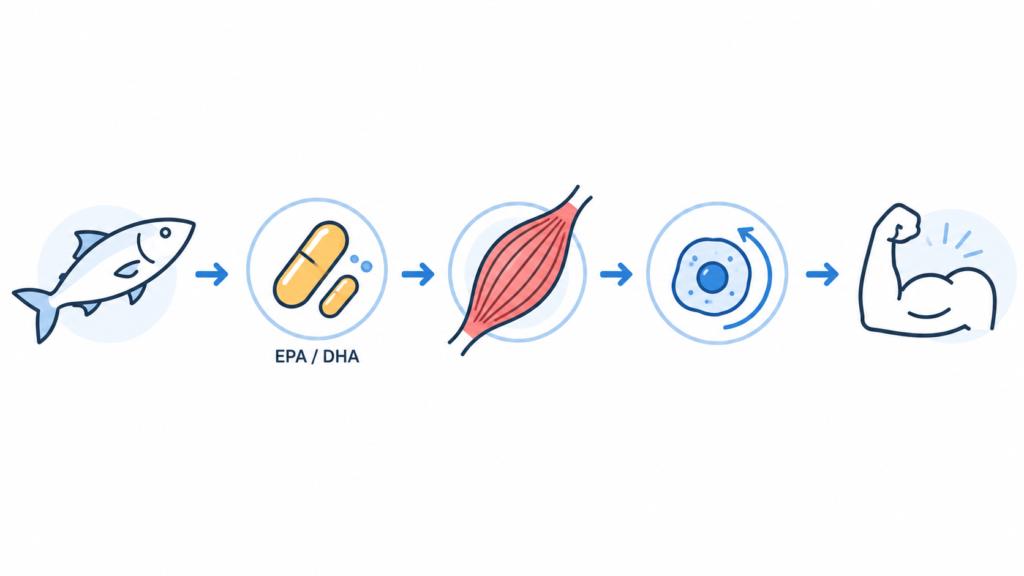
Omega-3 for muscle growth is a topic that creates a lot of confusion among lifters. Fish oil is often recommended for recovery, inflammation, and general health, but does it actually help you build more muscle?
Some trials report changes in muscle-related outcomes, particularly in older adults, but results cannot be assumed to apply to young trained lifters. Omega-3 supplementation has not established a consistent extra hypertrophy benefit in that group. Its role differs from the better-established performance use of creatine monohydrate.
If you already train hard, eat enough protein, sleep well, and recover properly, omega-3 may be a useful addition. But it should not be treated as a shortcut.
Key Takeaways
- Omega-3 does not directly build muscle on its own.
- EPA and DHA are the most relevant forms for lifters.
- Recovery and muscle-related findings vary across studies; benefits are not guaranteed in healthy trained adults.
- The direct hypertrophy evidence is stronger in older adults than in young trained lifters.
- There is no established EPA/DHA dose specifically for muscle growth in healthy lifters.
- If you already eat fatty fish regularly, supplementation may be unnecessary.
What Is Omega-3?
Omega-3 fatty acids are essential fats that the body needs for normal function. The three main types are ALA, EPA, and DHA.
| Type | Main sources | Relevance for lifters |
|---|---|---|
| ALA | Flaxseed, chia seeds, walnuts | Healthy, but conversion to EPA and DHA is limited |
| EPA | Fatty fish, fish oil, algae oil | Relevant for inflammation and recovery |
| DHA | Fatty fish, fish oil, algae oil | Important for cell membranes and overall health |
For muscle growth and recovery, EPA and DHA are the most important forms. Plant-based omega-3 sources can still be healthy, but they are not always equivalent to fatty fish or supplements that directly provide EPA and DHA.
Does Omega-3 Help Muscle Growth?
Omega-3 may help muscle growth indirectly, but it is not a direct muscle-building supplement.
Muscle growth is mainly driven by resistance training, sufficient protein intake, enough calories, and recoverable training stress. For a deeper explanation, read What Causes Muscle Growth?.
Some research suggests omega-3 can improve muscle protein synthesis and anabolic sensitivity, especially in older adults. This means the muscles may respond better to amino acids and training-related signals.
However, in young and already trained lifters, the evidence is less consistent. If your training, nutrition, and recovery are already strong, omega-3 is unlikely to produce dramatic muscle growth by itself.
| Question | THG verdict |
|---|---|
| Does omega-3 directly build muscle? | No, not directly |
| Can it support recovery? | Possibly |
| Is it useful for general health? | Depends on the outcome; eating fish and taking fish oil are not equivalent |
| Is it more important than creatine? | No |
| Is it worth considering? | Yes, but as a support supplement |
How Omega-3 May Support Lifters
Muscle Protein Synthesis
Muscle protein synthesis is the process of building new muscle proteins. Resistance training and protein intake are the main drivers, but omega-3 may influence how muscle tissue responds to anabolic signals.
This effect appears most relevant in older adults or people with low omega-3 intake. For younger lifters who already eat enough protein, the effect is likely smaller.
For protein-related supplementation, see Whey Protein for Muscle Growth.
Recovery
Omega-3 may help some lifters recover better between sessions, but the effect should not be exaggerated.
If recovery is poor, the first things to check are training volume, sleep, calories, protein intake, and exercise selection. Supplements can support recovery, but they cannot fix a poorly designed program.
For a broader breakdown, read Recovery and Muscle Growth.
Inflammation Balance
Inflammation is not automatically bad. Short-term inflammation after training is part of the normal adaptation process.
Changes in inflammatory markers do not automatically translate into better recovery or greater hypertrophy. Suspected chronic inflammation or persistent symptoms should be assessed clinically rather than treated with a generic supplement stack.
Joint Comfort
Research in clinical joint conditions should not be treated as proof that fish oil improves training-related joint discomfort in healthy lifters. It is not a joint-repair supplement.
For lifters, this matters because irritated joints can limit exercise selection, loading, range of motion, and consistency. Still, load management and smart exercise selection matter more than supplements.
EPA vs DHA: Which Is Better?
Most lifters do not need to choose between EPA and DHA. Both are useful, and most studies use a combination of the two.
The practical approach is to focus on the combined amount of EPA and DHA per serving.
| Fatty acid | Simple role |
|---|---|
| EPA | Often linked to inflammation-related effects |
| DHA | Important for cell membranes, brain health, and overall physiology |
When comparing supplements, do not only look at the total fish oil amount. Look at the actual EPA and DHA content.
Omega-3 Dosage for Muscle Growth and Recovery
There is no established EPA/DHA dose specifically for hypertrophy. A dose used in a particular trial should not become a default recommendation for every lifter. Start with your food intake and the reason you are considering a supplement.
If you choose a supplement, compare its combined EPA and DHA content rather than only the total fish oil weight. Dietary recommendations differ by country and purpose; treatment of high triglycerides is a separate clinical use. See the NIH omega-3 fact sheet for the wider evidence and safety context.
| Label example | What it means |
|---|---|
| Fish oil: 2000 mg | Total oil amount |
| EPA: 360 mg | Active omega-3 content |
| DHA: 240 mg | Active omega-3 content |
| EPA + DHA: 600 mg | The number that matters most |
In this example, the product provides 600 mg of EPA and DHA, not 2000 mg.
Best Food Sources of Omega-3
The best food sources of EPA and DHA are fatty fish.
- Salmon
- Mackerel
- Sardines
- Herring
- Anchovies
- Trout
If you eat fatty fish regularly, you may already get enough omega-3 from food. If you rarely eat fish, a supplement can be a practical option.
Fish Oil, Krill Oil, or Algae Oil?
| Type | Best for | THG note |
|---|---|---|
| Fish oil | Most lifters | Usually the most practical and cost-effective option |
| Krill oil | People who prefer krill-based products | Often more expensive and lower in EPA/DHA per serving |
| Algae oil | Vegans and vegetarians | The best plant-based source of EPA/DHA |
Krill oil is not automatically better for muscle growth. The most important factor is still the amount of EPA and DHA you actually get.
Should Lifters Take Omega-3?
If you rarely eat oily fish, review your EPA/DHA sources. A supplement can provide these fatty acids when fish does not fit your diet, but that is not a guarantee of improved recovery, joint comfort or long-term health.
But for pure hypertrophy, it should come after the fundamentals:
- A structured hypertrophy program
- Progressive overload
- Enough training volume
- Sufficient protein intake
- Enough calories
- Good sleep
- Creatine, if tolerated
For the full supplement hierarchy, read Best Supplements for Muscle Growth and the Evidence-Based Supplements Hub.
Safety and Side Effects
Omega-3 supplements are generally well tolerated, but side effects can happen.
- Fishy burps
- Reflux
- Nausea
- Loose stools
- Unpleasant aftertaste
Taking omega-3 with meals can reduce digestive issues.
People using blood-thinning medication, preparing for surgery, or managing medical conditions should speak with a healthcare professional before taking high-dose omega-3 supplements.
THG Verdict
Omega-3 is a useful support supplement, not a primary muscle-building supplement.
Potential muscle and recovery effects depend on the population and outcome studied. Do not translate those findings into a promise of additional muscle growth. Training quality, adequate protein and energy, sleep, and optional creatine have clearer roles in a hypertrophy plan.
If you eat oily fish regularly, supplementation may be unnecessary. If you rarely eat fish, review food options or consider fish oil or an algae product containing EPA/DHA. Low fish intake alone does not establish a deficiency or justify a high-dose regimen.
FAQ
Does omega-3 build muscle?
Omega-3 does not directly build muscle by itself. Muscle growth mainly comes from resistance training, protein intake, calories, and recovery. Omega-3 may support the process, but it is not a standalone hypertrophy supplement.
Is fish oil good for bodybuilding?
Fish oil can be useful for bodybuilders who do not eat much fatty fish. It can supply EPA/DHA, but extra muscle growth, recovery or joint benefits are not assured. Training, nutrition and sleep remain the foundation.
How much omega-3 should lifters take?
There is no established EPA/DHA dose specifically for muscle growth in healthy lifters. Check the EPA and DHA content on the label rather than only looking at the total fish oil amount.
Is EPA or DHA better for muscle growth?
Most lifters do not need to choose one over the other. EPA and DHA both have important roles, and most research uses a combination. Focus on total EPA and DHA intake.
Can I get enough omega-3 from food?
Yes. Fatty fish such as salmon, mackerel, sardines, herring, and trout are good sources of EPA and DHA. If you rarely eat fish, supplementation may be useful.
Should I take omega-3 before or after training?
Timing is not very important. Omega-3 works through consistent intake over time. Taking it with a meal is usually best for digestion and absorption.
Is omega-3 better than creatine for muscle growth?
No. Creatine has stronger evidence for strength, performance, and hypertrophy support. Omega-3 may support recovery and health, but it is not more important than creatine for lifters.
References
- Smith GI, et al. Dietary omega-3 fatty acid supplementation increases the rate of muscle protein synthesis in older adults. American Journal of Clinical Nutrition. 2011.
- McGlory C, et al. The influence of omega-3 fatty acids on skeletal muscle protein turnover in health, disuse, and disease. Frontiers in Nutrition. 2019.
- Cornish SM, et al. Effects of omega-3 supplementation alone and combined with exercise on skeletal muscle in older adults: A systematic review and meta-analysis. Nutrients. 2022.
- Heileson JL, et al. The effect of fish oil supplementation on resistance training-induced adaptations. Sports Medicine – Open. 2023.
- Uchida Y, et al. Effects of omega-3 fatty acids supplementation and resistance training on muscle strength and physical performance: A systematic review and meta-analysis. 2024.
- Fernández-Lázaro D, et al. Omega-3 fatty acid supplementation on post-exercise inflammation, muscle damage, and soreness: A systematic review. 2024.