Vitamin D for Muscle Growth and Strength: Does It Matter?
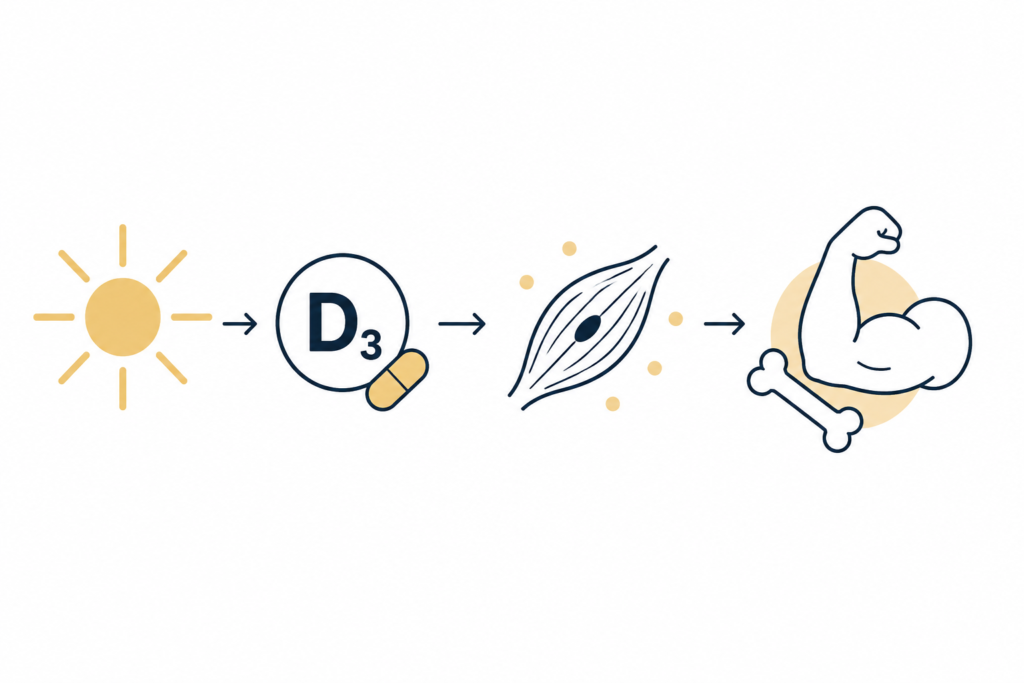
Vitamin D for muscle growth is a popular topic because vitamin D affects bone health, immune function, and normal muscle function. Many lifters also wonder whether taking more vitamin D can improve strength, recovery, or hypertrophy.
The answer depends mostly on your vitamin D status. If you are deficient, correcting that deficiency may support muscle function and strength. If your levels are already sufficient, taking extra vitamin D is unlikely to directly increase muscle growth.
Vitamin D is best viewed as a deficiency-correcting supplement, not a direct hypertrophy supplement like creatine monohydrate.
Key Takeaways
- Vitamin D is important for normal muscle function, bone health, and overall health.
- Low vitamin D may negatively affect strength, performance, and muscle function.
- Correcting a deficiency may help, but more vitamin D is not always better.
- If your levels are already sufficient, extra vitamin D is unlikely to directly build more muscle.
- Vitamin D3 is usually preferred over vitamin D2 for supplementation.
- Use recommendations appropriate to your country, age and circumstances; there is no universal extra vitamin D dose for lifters.
What Is Vitamin D?
Vitamin D is a fat-soluble vitamin that acts more like a hormone in the body. It helps regulate calcium and phosphate balance, which makes it important for bone health, muscle function, and many other physiological processes.
Your body can produce vitamin D when your skin is exposed to sunlight. You can also get smaller amounts from food and supplements.
Vitamin D status is usually measured through blood levels of 25-hydroxyvitamin D, often written as 25(OH)D.
| Source | Example | THG note |
|---|---|---|
| Sunlight | UVB exposure | Main natural source for many people |
| Food | Fatty fish, egg yolks, fortified foods | Helpful, but often not enough alone |
| Supplements | Vitamin D3 or D2 | Useful when sun exposure or intake is low |
Does Vitamin D Help Muscle Growth?
Vitamin D may support muscle growth indirectly, but it does not build muscle by itself.
Muscle growth is mainly driven by resistance training, progressive overload, enough protein, enough calories, and recovery. For the full foundation, read What Causes Muscle Growth?.
The most important distinction is deficiency versus sufficiency.
| Vitamin D status | Expected effect of supplementation |
|---|---|
| Deficient | May improve muscle function, strength, and general health |
| Insufficient or low-normal | May help depending on baseline levels and lifestyle |
| Sufficient | Unlikely to directly increase hypertrophy |
This is why vitamin D is different from supplements like creatine or whey protein. Creatine can support performance even when you are not “deficient” in creatine, and whey protein can help you reach your daily protein target. Vitamin D is most useful when your current intake, sun exposure, or blood levels are too low.
Why Vitamin D Matters for Lifters
Muscle Function
Vitamin D receptors are found in muscle tissue, and vitamin D is involved in normal muscle function. Low vitamin D status has been associated with poorer muscle performance in some populations.
For lifters, this does not mean vitamin D acts like an anabolic steroid. It means that having adequate vitamin D may help support the normal physiological environment needed for good training performance.
Strength
Some studies suggest vitamin D supplementation can improve strength in people with low vitamin D levels, older adults, or specific populations. However, research in athletes and already-sufficient individuals is less consistent.
The practical takeaway is simple: if your vitamin D is low, fixing it may help your strength potential. If your vitamin D is already normal, taking more is unlikely to make your squat, bench press, or deadlift suddenly increase.
Bone Health
Vitamin D helps regulate calcium absorption and bone metabolism. This matters for lifters because strength training places repeated loading stress on the skeleton.
Healthy bones do not directly equal bigger muscles, but they support long-term training consistency. Injuries, pain, or poor skeletal health can limit your ability to train hard over time.
Recovery
Vitamin D may play a role in recovery through its effects on muscle function, inflammation, and overall health. However, it should not be treated as a primary recovery supplement.
If recovery is poor, first look at training volume, sleep, calories, and protein intake. For a broader breakdown, read Recovery and Muscle Growth.
Who Is Most Likely to Benefit?
Vitamin D supplementation is most useful for people who are likely to have low vitamin D levels.
- People with low sun exposure
- People living in northern climates
- People who spend most of the day indoors
- People who cover most of their skin outdoors
- People with darker skin
- Older adults
- People who rarely eat vitamin D-rich foods
- People with medically confirmed deficiency
If you live in a country with long winters, train indoors, and rarely eat fatty fish, vitamin D is worth paying attention to.
My Experience With Vitamin D During Winter
I do not notice an immediate difference when I take vitamin D. During the darker winter months, however, I sometimes feel that my mood is better when I supplement.
I cannot know whether vitamin D itself is responsible. Mood can also be influenced by daylight exposure, sleep, activity levels, expectations, and many other factors. I therefore treat this as a personal observation rather than evidence that vitamin D improves mood.
This experience has made me view vitamin D differently from supplements such as pre-workout. It is not something I expect to “feel” after taking a capsule. Its value is more likely to come from correcting or preventing an inadequate intake—particularly during periods with limited sunlight—than from producing an obvious short-term effect.
Vitamin D Dosage for Lifters
There is no established extra vitamin D requirement simply because you lift weights. For context, the US recommended total daily intake is 600 IU (15 mcg) for adults aged 19–70 and 800 IU (20 mcg) above 70. These are total intake targets, not automatic supplement doses. Local public-health advice may recommend supplements for particular seasons or groups. If you also take a multivitamin, count the vitamin D it already provides. Our multivitamin label check helps you spot overlapping ingredients.
The 2024 Endocrine Society guideline advises against routine supplementation above recommended dietary intakes and routine vitamin D testing in generally healthy adults under 75. This does not replace treatment for established deficiency or other clinical indications. A clinician should guide those situations.
| Amount | Equivalent | THG note |
|---|---|---|
| 1000 IU | 25 mcg | Example supplement amount; not a universal requirement |
| 2000 IU | 50 mcg | Example supplement amount; low sun exposure alone does not determine dose |
| 4000 IU | 100 mcg | US adult upper limit from all sources; not a target |
Vitamin D is fat-soluble, so taking it with a meal that contains some fat may improve absorption.
Vitamin D2 vs Vitamin D3
Vitamin D supplements usually come as D2 or D3.
| Type | Source | THG note |
|---|---|---|
| Vitamin D2 | Plant/fungal sources | Can work, but may be less effective at raising 25(OH)D |
| Vitamin D3 | Usually animal-derived or lichen-derived | Generally preferred for supplementation |
For most lifters, vitamin D3 is the simplest choice. Vegan D3 from lichen is also available.
Best Food Sources of Vitamin D
Food can contribute to vitamin D intake, but many people do not get enough from food alone.
- Salmon
- Mackerel
- Sardines
- Egg yolks
- Cod liver oil
- Fortified milk or plant milk
- Fortified cereals
Fatty fish is one of the best natural food sources. This also overlaps with omega-3 intake, which may support health and recovery in a different way.
Can You Take Too Much Vitamin D?
Yes. Vitamin D is fat-soluble, which means excessive amounts can accumulate in the body.
Very high vitamin D intake can lead to elevated calcium levels, which may cause nausea, weakness, confusion, kidney problems, and other serious issues.
This usually comes from excessive supplementation, not normal sun exposure or normal food intake.
Count vitamin D from all products you use, including multivitamins and cod liver oil. More is not automatically better. Follow applicable public-health guidance, and use individual clinical advice when there is an established medical reason for testing or treatment.
Should Bodybuilders Take Vitamin D?
Bodybuilders and strength athletes should care about vitamin D status, but not because vitamin D directly forces muscle growth.
It matters because low vitamin D can potentially affect muscle function, strength, bone health, and general health. All of these can influence training consistency over time.
| Goal | Vitamin D usefulness | THG verdict |
|---|---|---|
| Direct hypertrophy | Limited | Not a primary muscle-building supplement |
| Strength | Possible benefit if deficient | Worth correcting low levels |
| Bone health | High | Important for long-term training |
| Recovery | Indirect | Supportive, not central |
| General health | High | Worth monitoring if risk is high |
For the broader hierarchy of supplements, read Best Supplements for Muscle Growth and the Evidence-Based Supplements Hub.
THG Verdict
Vitamin D is important, but it is not a direct muscle-building supplement.
If you are deficient, correcting low vitamin D may support muscle function, strength, bone health, and overall training consistency. If your vitamin D levels are already sufficient, extra supplementation is unlikely to produce meaningful additional muscle growth.
For most lifters, vitamin D is worth considering if sun exposure is low, dietary intake is poor, or deficiency is likely. It should support the fundamentals, not replace them.
FAQ
Does vitamin D build muscle?
Vitamin D does not directly build muscle by itself. It may support muscle function and strength if you are deficient, but hypertrophy mainly comes from resistance training, protein intake, calories, and recovery.
Can low vitamin D reduce strength?
Low vitamin D may negatively affect muscle function and strength in some people. Correcting a deficiency may help restore normal function, especially in people with low baseline levels.
Should bodybuilders take vitamin D?
Bodybuilders should consider vitamin D if they have low sun exposure, low dietary intake, or confirmed deficiency. It is useful for health and muscle function, but it should not be treated as a primary hypertrophy supplement.
Is vitamin D3 better than D2?
Vitamin D3 is generally preferred because it tends to be more effective at raising vitamin D status. Vitamin D2 can still work, but D3 is the simpler default for most people.
How much vitamin D should lifters take?
There is no universal additional dose for lifters. Follow age- and country-appropriate intake guidance, account for existing products, and seek individual advice for established deficiency or other medical indications. Routine blood testing is not recommended for otherwise healthy adults.
Can you get enough vitamin D from sunlight?
Yes, sunlight can be a major source of vitamin D. However, season, latitude, skin tone, clothing, sunscreen, time outdoors, and lifestyle all affect how much vitamin D you produce.
Is vitamin D better than creatine for muscle growth?
No. Creatine has stronger evidence for strength, performance, and hypertrophy support. Vitamin D is mainly useful for correcting low levels and supporting normal muscle and bone function.
References
- National Institutes of Health Office of Dietary Supplements. Vitamin D Fact Sheet for Health Professionals. Updated 2025.
- Demay MB, et al. Vitamin D for the Prevention of Disease: An Endocrine Society Clinical Practice Guideline. Journal of Clinical Endocrinology & Metabolism. 2024.
- Ceglia L. Vitamin D and Its Role in Skeletal Muscle. Current Opinion in Clinical Nutrition and Metabolic Care. 2009.
- Halfon M, et al. Vitamin D: A Review on Its Effects on Muscle Strength, the Risk of Fall, and Frailty. BioMed Research International. 2015.
- Sist M, et al. Effects of Vitamin D Supplementation on Maximal Strength and Power in Athletes: A Systematic Review and Meta-Analysis. Nutrients. 2023.
- Książek A, et al. Vitamin D, Skeletal Muscle Function and Athletic Performance in Athletes. Nutrients. 2019.