Leg Press for Muscle Growth: Foot Placement, Depth & Reps
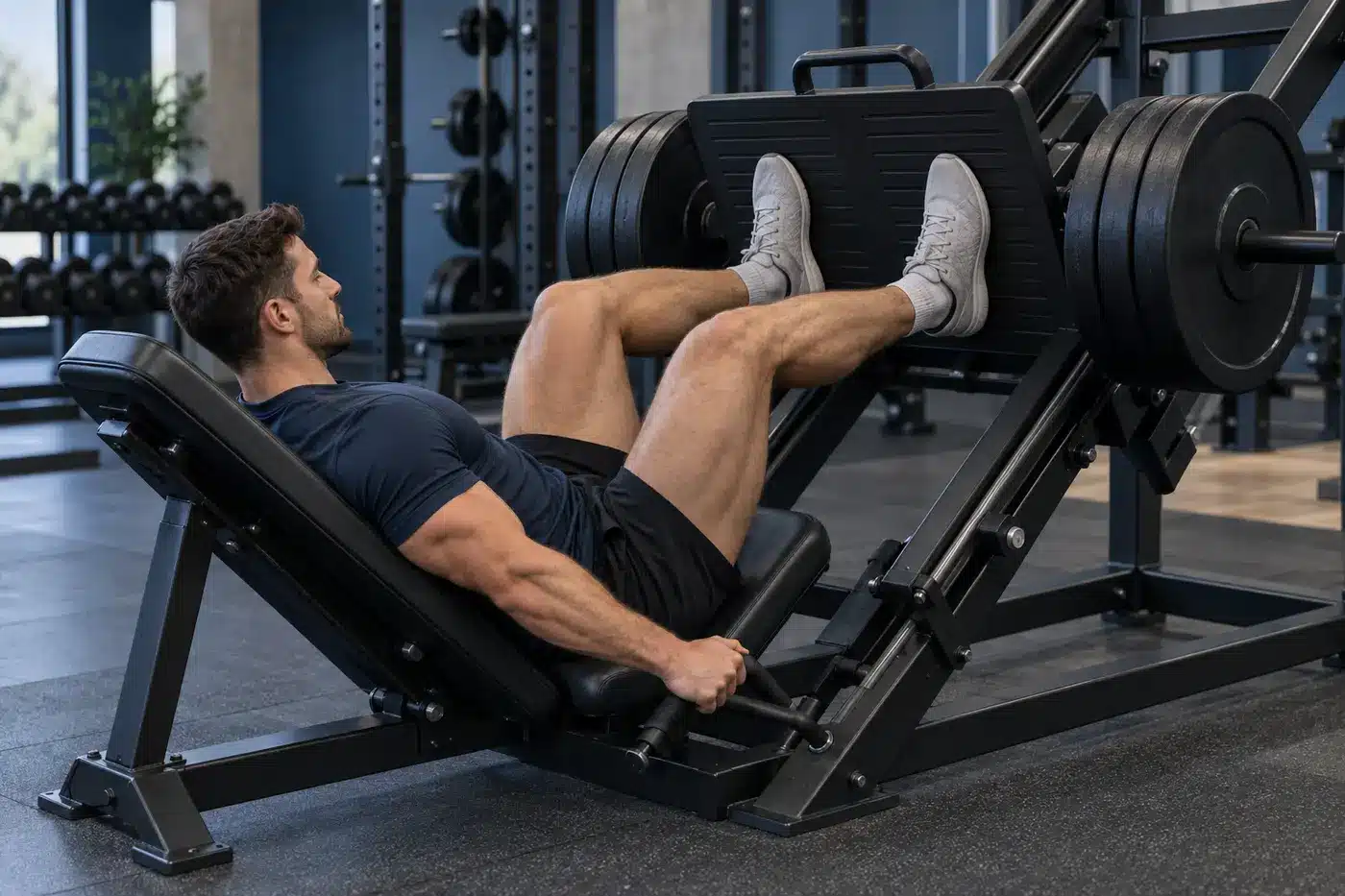
The leg press is an effective machine exercise for training the quadriceps, with additional contribution from the glutes and adductors. Foot placement can change comfort and joint angles, but small stance changes do not create a reliable “inner quad,” “outer quad” or glute-isolation switch.
What Muscles Does the Leg Press Work?
The quadriceps extend the knee and are usually the main target. The gluteus maximus and adductor magnus contribute to hip extension, particularly as the hips reach greater flexion. The hamstrings cross both the hip and knee, which limits how much their length changes during a leg press; they assist but should not be treated as fully trained by the movement alone.
A recent within-person training study found similar overall quadriceps growth from leg presses and knee extensions in previously untrained adults, but knee extensions produced more rectus-femoris growth while the leg press increased gluteus maximus and adductor magnus size. The study was small and does not make either exercise universally better; it shows why combining movements can cover different regions.1
For posterior-chain work, pair the leg press with a hip hinge such as the Romanian deadlift. For unilateral training, the Bulgarian split squat is a useful alternative or complement.
Where Should You Place Your Feet?
Start with the feet around shoulder width and near the middle of the platform. Turn the toes out slightly if that helps the knees track comfortably. From there, adjust stance based on your build, the machine and which position allows the best controlled depth.
| Foot position | Likely practical effect | Important limitation |
|---|---|---|
| Higher on platform | Often permits more hip flexion and less forward knee travel | Does not turn the exercise into a hamstring isolation movement |
| Lower on platform | Often increases knee travel and ankle demand | Heels may lift or depth may become limited |
| Wider stance | May feel better for deeper hip flexion and involve more adductor demand | Not a guaranteed inner-thigh or glute shortcut |
| Narrower stance | May feel more quad-focused for some lifters | Does not selectively isolate the outer quad |
Acute research comparing foot positions on an inclined leg press has generally found smaller muscle-activation differences than common coaching claims suggest. Those data cannot directly predict hypertrophy, but they provide little support for treating small stance changes as precise muscle-isolation tools.2
Can you target the inner or outer quads?
You cannot reliably transform a compound leg press into a selective vastus-medialis or vastus-lateralis exercise merely by turning the toes or moving the feet a few centimetres. Individual anatomy and machine mechanics influence what you feel. Choose the stance that lets the knees track in line with the toes and supports repeatable progression.
How Deep Should You Leg Press?
Use the deepest range you can control while the pelvis remains stable against the pad, the heels stay planted and the knees track comfortably. Do not chase depth by allowing the lower back and pelvis to roll away from the backrest.
A 2025 within-person study in trained participants compared a deep leg-press range with a shallower range and found similar quadriceps hypertrophy over eight weeks. This does not prove that range never matters; the study assessed a specific exercise, population and duration. It does show that forcing maximum depth is not automatically required for quad growth.3
How to Perform the Leg Press
- Set the seat and safety stops. You should be able to reach the handles, unrack the sled and use the intended depth without getting trapped.
- Place the feet consistently. Begin around shoulder width in the middle of the platform with the entire foot in contact.
- Brace against the pad. Keep the hips and upper back supported. Hold the handles if that improves stability.
- Lower under control. Let the knees bend and travel in line with the toes. Stop at your repeatable depth.
- Press through the whole foot. Extend the knees and hips without allowing the heels to rise or the knees to collapse inward.
- Finish without a violent lockout. Reach a controlled top position. Locking the knees gently is not inherently dangerous, but snapping into hyperextension is unnecessary.
Is the leg press safe for the knees?
No exercise is risk-free, but knee travel itself is not automatically harmful. Load, range, fatigue, previous injury and individual tolerance matter. A stance that keeps the feet planted and the knees tracking comfortably is more useful than an arbitrary rule that the knees may never move forward.
Leg Press vs Squat
| Factor | Leg press | Squat |
|---|---|---|
| Stability | High; trunk supported by the machine | Requires more whole-body coordination |
| Loading the legs | Easy to push close to failure with limited balance demand | Fatigue may be limited by trunk or technique |
| Transfer | Specific to machine pattern | Builds the squat skill and free-weight strength |
| Hypertrophy role | Excellent quad-focused option | Excellent compound option when well tolerated |
You do not have to choose only one. The leg press can provide stable high-effort sets after squats, or it can be the main knee-dominant exercise for someone who does not need to specialise in barbell squatting.
Sets, Reps and Progression
| Use | Sets × reps | Effort | Rest |
|---|---|---|---|
| Heavier compound work | 3–4 × 6–10 | 1–3 RIR | 3–4 min |
| Hypertrophy default | 2–4 × 8–15 | 1–3 RIR | 2–4 min |
| Higher-rep option | 2–3 × 15–20 | 1–3 RIR | 2–3 min |
Use a broad load range, but remember that high-rep leg presses can become limited by breathlessness or discomfort before the target muscles are adequately challenged. Rest long enough for the next set to be productive. General evidence indicates that both lower and higher loads can build muscle when effort is sufficient.4
For double progression, keep the seat, foot position and depth consistent. Add reps within the chosen range, then increase the load when all sets reach the top at your target RIR. This makes progress measurable rather than turning every session into a different variation.
Common Leg Press Mistakes
Frequently Asked Questions
Where should my feet go for quad growth?
Start around shoulder width in the middle of the platform. A slightly lower position may increase knee travel, but keep the heels planted and use a comfortable range.
Does a high foot position target the glutes?
It may allow more hip flexion and glute contribution, but it does not remove the quads or make the leg press a pure glute exercise.
Does leg press train hamstrings?
The hamstrings contribute, but the movement changes hip and knee angles together, so it is not a complete hamstring exercise. Add a hip hinge and/or leg curl.
How many leg press sets should I do?
Two to four hard sets per session is a good starting point. Adjust around the rest of your quad, glute and adductor training.
Should I lock my knees at the top?
A calm, controlled lockout is not inherently dangerous for healthy knees. Avoid snapping into hyperextension or resting for long periods between reps.
Bottom Line
The leg press is a strong hypertrophy exercise because it provides stability and lets the legs work hard without balance becoming the main limitation. Use a comfortable middle-platform stance, lower to the deepest controlled position your pelvis and heels permit, and progress with a consistent technique standard.
References
- Larsen S, et al. Hypertrophic effects of single- versus multi-joint exercise: a direct comparison between knee extension and leg press. 2026.
- Martín-Fuentes I, et al. Influence of feet position and execution velocity on muscle activation during the inclined leg press. Int J Environ Res Public Health. 2022.
- Larsen S, et al. Knee flexion range of motion does not influence muscle hypertrophy in the leg press exercise. 2025.
- Schoenfeld BJ, et al. Strength and hypertrophy adaptations between low- vs high-load resistance training: a systematic review and meta-analysis. J Strength Cond Res. 2021.