Lifting Shoes for Squats: Are They Worth It?
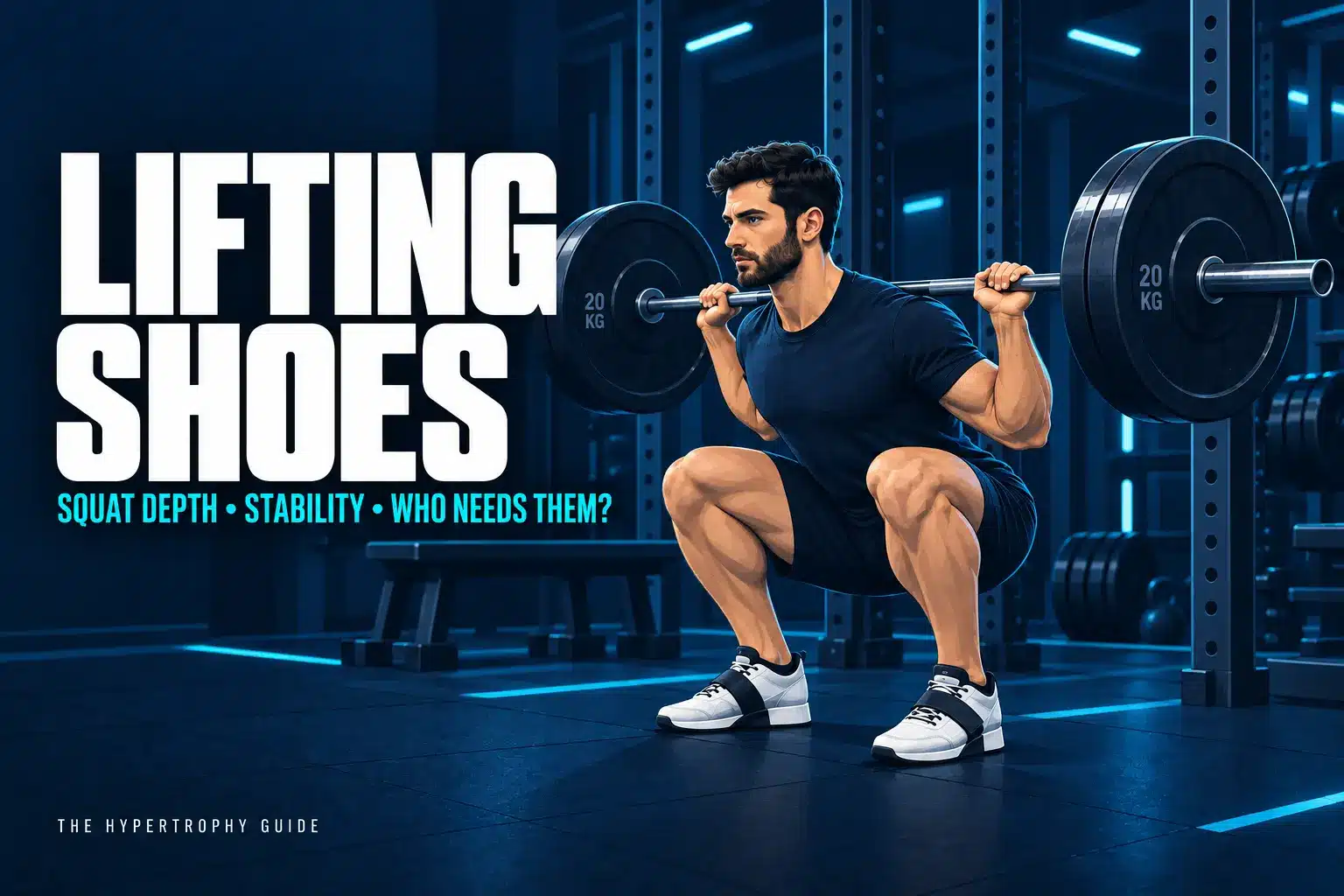
Lifting shoes for squats can be worthwhile when you take squatting or Olympic lifting seriously and the raised heel improves your position. They are not a requirement for building muscle, and they are usually a poor choice for deadlifts or an entire mixed gym session.
What Are Lifting Shoes?
Dedicated lifting shoes—often called weightlifting shoes or squat shoes—use a firm, elevated heel and a relatively rigid sole. Most also secure the midfoot with laces plus one or more straps. The design is very different from a running shoe, where soft foam is intended to cushion repeated steps.
The heel does not magically improve technique. It changes the geometry between your foot, shin, knee, hip and torso. Whether that change is helpful depends on your anatomy, ankle mobility, squat style and exercise selection.
Do Lifting Shoes Help You Squat Better?
They can, but the effect is individual. Elevating the heel allows the knee to travel forward with less ankle dorsiflexion demand. For some lifters, that makes it easier to keep the whole foot planted, reach the desired depth and maintain a more upright torso.
A 2021 review concluded that footwear and heel elevation can influence squat mechanics, but the available studies vary in the shoes, heel heights, loads, squat styles and experience levels tested.1 This is why simple claims such as “lifting shoes always fix squat depth” go beyond the evidence.
In a study of 25 college-aged participants squatting at 60% of one-repetition maximum, weightlifting shoes produced less forward trunk displacement than running shoes, but they did not significantly change peak thigh flexion.2 Another study found changes in some kinetic and kinematic measures when experienced lifters used weightlifting shoes, without establishing that one condition was universally superior.3
Other research has found smaller or no meaningful changes in several trunk, knee and muscle-activation outcomes, while experiments using heel elevation have also shown that responses can differ with training experience and the load used.4, 6 The sensible conclusion is that lifting shoes are a positioning tool—not a guaranteed performance or injury-prevention device.
Will lifting shoes make you stronger?
They may help you express strength if the shoe creates a more repeatable and comfortable squat position. That does not mean the shoe adds strength by itself. Acute biomechanics studies cannot tell us whether buying lifting shoes will increase your squat one-repetition maximum over months.
A new pair can also create a psychological “equipment effect”: you feel prepared, stable and serious when you put them on. That confidence can be useful, but it should not be confused with proof that the shoe directly increased force production.
Are Lifting Shoes Better for Muscle Growth?
There is no direct evidence that lifting shoes produce more hypertrophy than stable flat shoes. Their value for muscle growth is indirect. If the raised heel lets you perform a comfortable squat through a useful range of motion with consistent technique, it may improve the exercise you are already using to train your legs.
A heel-elevated squat often allows more forward knee travel and can help some lifters remain upright. That may suit a knee-dominant squat, but footwear does not guarantee greater quadriceps growth. Training volume, effort, exercise fit, progression and recovery still matter far more than the logo on the shoe.
Do Lifting Shoes Fix Poor Ankle Mobility?
They do not increase the mobility of your ankle. The raised heel changes the starting position and reduces the dorsiflexion demand needed for a given squat depth. That can be a useful accommodation, but the underlying ankle range of motion is unchanged when the shoes come off.
Ankle mobility and body-segment proportions both influence squat posture. Research has linked available ankle range and relative limb lengths with the amount of trunk lean used during a barbell squat.5 This helps explain why the same shoe can feel transformative for one lifter and unnecessary for another.
A simple knee-to-wall check
Place one foot in front of a wall, keep the heel down and move the knee forward until it touches the wall. Gradually move the foot farther away while maintaining heel contact and keeping the knee aligned with the toes. Compare sides rather than chasing one universal pass-or-fail number.
I previously found a difference of roughly one to two centimetres between my ankles. I used the knee-to-wall movement during squat warm-ups and periodically retested it. The asymmetry improved over time. Controlled calf raises through a full, comfortable bottom position can also expose the ankle to dorsiflexion, although mobility changes take repeated practice.
If pain, swelling or a sudden restriction is present, do not assume it is simply “tight ankles.” A qualified clinician can assess whether the limitation is appropriate to train around.
Lifting Shoes vs Flat Shoes vs Cross-Training Shoes
| Shoe type | What it feels like | Best fit | Main limitation |
|---|---|---|---|
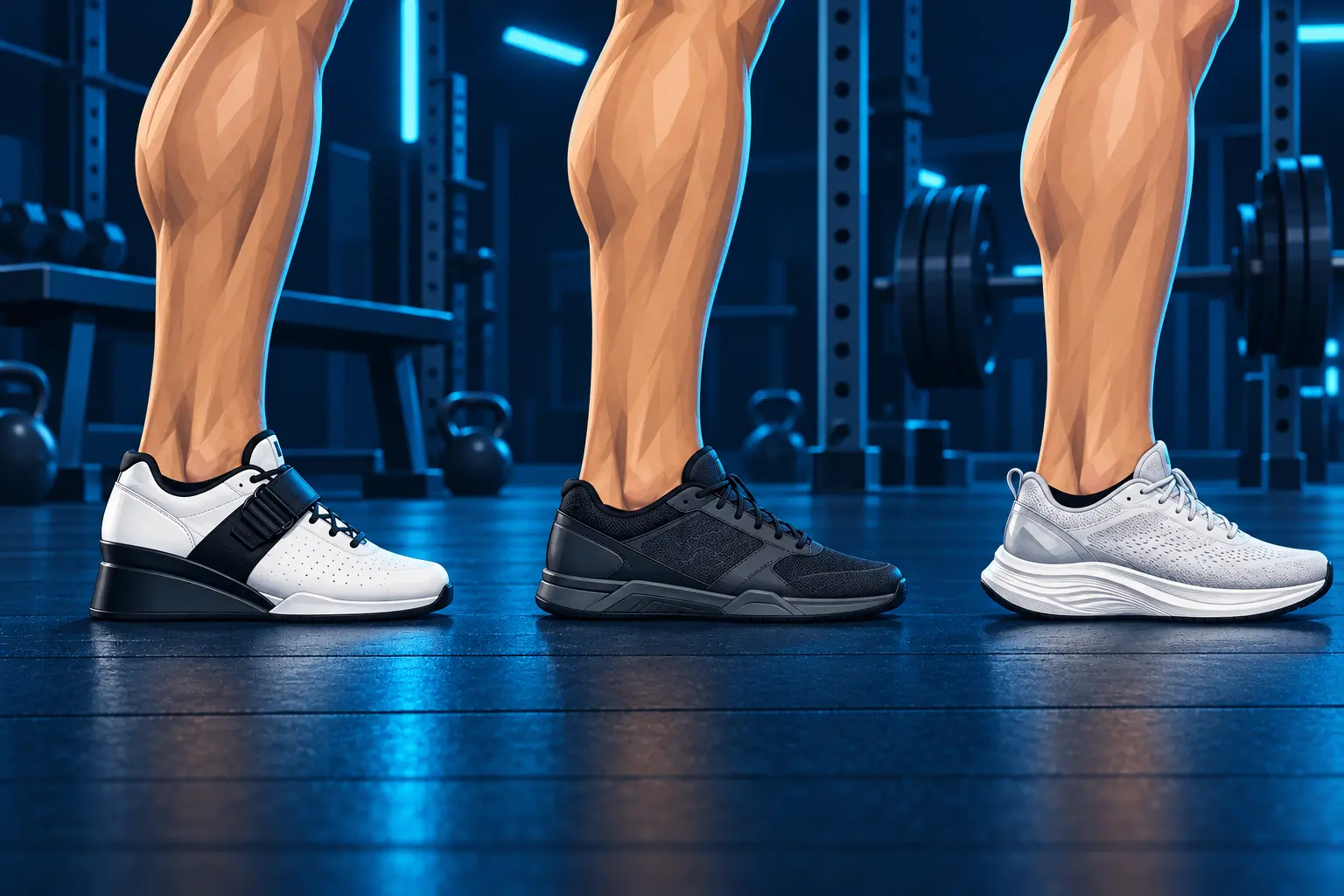
| Weightlifting shoe | Hard, raised heel with a secure and rigid base. | High-bar squats, front squats, snatches and cleans. | Specialised, less comfortable for mixed training and poorly suited to deadlifts. |
| Cross-training shoe | Stable heel with more flexibility and versatility than a lifting shoe. | General gym training, split squats, lunges, machines and short conditioning work. | Does not provide the same heel elevation or rigidity as a dedicated lifting shoe. |
| Flat shoe | Low, relatively firm sole with little heel-to-toe drop. | Deadlifts, general strength training and lifters who already squat well flat. | May make deep, upright squatting harder for someone limited by ankle position. |
| Running shoe | Soft, cushioned and often curved to support forward movement. | Running and everyday walking. | The compressible base can make loaded squats and lunges feel less stable. |
Which Shoes Should You Wear for Each Exercise?
| Exercise | Practical default | Reason |
|---|---|---|
| High-bar or front squat | Lifting shoe if the raised heel improves your position; otherwise a stable training shoe | These squat styles often benefit from forward knee travel and an upright torso. |
| Olympic lifts | Dedicated weightlifting shoe | The rigid raised heel is designed for receiving cleans and snatches in a deep squat. |
| Low-bar squat | Individual choice | Some lifters prefer a raised heel; others prefer a flatter shoe for their stance and mechanics. |
| Bulgarian split squat | Stable cross-training or flat shoe | A firm base matters more than a specialised raised heel for most lifters. See the Bulgarian split squat guide. |
| Walking lunge | Stable cross-training or flat shoe | Avoid excessive cushioning that makes each step harder to control. |
| Romanian deadlift | Flat shoe or socks where gym rules allow | A low base keeps you close to the floor and avoids the forward pitch of a raised heel. See the Romanian deadlift guide. |
| Conventional or sumo deadlift | Flat, thin and secure footwear | A raised heel increases the starting height and changes the pulling position. Footwear can measurably affect deadlift mechanics and performance.7 |
| Leg press, hack squat and leg extensions | Whichever stable shoe gives comfortable contact | The machine already supplies much of the external stability, so a dedicated lifting shoe is optional. |
Should you deadlift in lifting shoes?
I would not recommend it as the default. The raised heel effectively increases the distance from the floor and changes your starting position. I have deadlifted in socks for years because I prefer the close contact and low starting height. A firm flat shoe is the practical alternative when socks or barefoot lifting are not allowed.
How to Choose Lifting Shoes
- Start with your main exercise. Buy a raised-heel shoe for serious squatting or Olympic lifting—not merely because you strength train.
- Choose a heel you can control. More elevation is not automatically better. The shoe should improve your position without pushing you uncomfortably forward.
- Look for a firm sole. It should not compress like a running shoe under load.
- Secure the heel and midfoot. Your foot should not slide inside the shoe when you descend or change direction.
- Leave functional toe room. The fit should be secure without painfully compressing the toes.
- Check sport rules. Competition requirements may influence what you can wear.
Try the shoe with the stance and socks you actually use. Perform controlled bodyweight squats and light warm-up sets before judging it. A shoe that feels impressive while standing can still feel wrong at the bottom of your squat.
My Progression From Running Shoes to Lifting Shoes
I started training in ordinary sneakers or running shoes. Once I became more interested in powerlifting-style training, I switched to Converse after seeing experienced lifters use flat shoes. The difference was obvious: the flatter, firmer base felt more stable than standing on soft running foam.
A few years into training, I bought dedicated lifting shoes after learning more about squat mechanics from evidence-based coaches. The raised heel helped my depth and made it easier to keep my whole foot down instead of allowing the heel to lift as I descended.
Today I mostly wear stable training shoes with a firm, relatively flat sole because they work across an entire session. I bring dedicated lifting shoes only when squatting is important enough to justify them. For deadlifts, I still prefer socks or a flat shoe.
This is why I do not treat footwear as a hierarchy where the most specialised option is always best. A weightlifting shoe is the best tool for a narrow job. A cross-training shoe is often the better tool for a whole workout.
Frequently Asked Questions
Do beginners need lifting shoes?
No. A beginner should first learn the squat and determine whether footwear is limiting the desired position. Lifting shoes can still be useful early if the person is committed to squatting or Olympic lifting and clearly feels better in a raised heel.
Can lifting shoes compensate for limited ankle mobility?
They can reduce the ankle range required for a given squat position, but they do not permanently improve ankle mobility. You can use the shoes while separately training the range of motion you want.
Are lifting shoes good for knee pain?
Not automatically. A raised heel changes knee and hip mechanics, but pain has many possible causes. Choose the variation and footwear that can be performed comfortably and seek an appropriate assessment for persistent or worsening symptoms.
Can I squat in Converse or other flat shoes?
Yes. If you can reach your intended depth with the whole foot planted and maintain a stable position, a firm flat shoe can work well. It simply does not provide the positional assistance of a raised heel.
Are cross-training shoes good enough for squats?
For many recreational lifters, yes. They are usually firmer and more stable than running shoes while remaining practical for the rest of the session. Dedicated lifting shoes become more compelling when barbell squats or Olympic lifts are a major priority.
Why should I avoid running shoes for lifting?
You do not need to avoid them for every machine or light exercise, but soft cushioning can compress and shift during loaded squats, lunges and hinges. A firmer shoe usually provides a more predictable base.
Bottom Line
Lifting shoes are worth considering when the raised heel and rigid base clearly improve your squat or Olympic lifting position. They can make depth, balance and an upright torso easier for some lifters, particularly when ankle position is restrictive. They are not required for hypertrophy, they do not permanently fix mobility and they are usually not the best choice for deadlifts or an entire mixed workout.
For most gym users, a stable cross-training or flat shoe is the best first purchase. Move to a dedicated lifting shoe when you know exactly which lift it will improve and why.
References
- Pangan AM, Leineweber MJ. Footwear and Elevated Heel Influence on Barbell Back Squat: A Review. J Biomech Eng. 2021;143(9):090801.
- Sato K, Fortenbaugh D, Hydock DS. Kinematic Changes Using Weightlifting Shoes on Barbell Back Squat. J Strength Cond Res. 2012;26(1):28–33.
- Legg HS, Glaister M, Cleather DJ, Goodwin JE. The Effect of Weightlifting Shoes on the Kinetics and Kinematics of the Back Squat. J Sports Sci. 2017;35(5):508–515.
- Lee SP, Gillis CB, Ibarra JJ, Oldroyd DF, Zane RS. Heel-Raised Foot Posture Does Not Affect Trunk and Lower Extremity Biomechanics During a Barbell Back Squat in Recreational Weight Lifters. J Strength Cond Res. 2019;33(3):606–614.
- Fuglsang EI, Telling AS, Sørensen H. Effect of Ankle Mobility and Segment Ratios on Trunk Lean in the Barbell Back Squat. J Strength Cond Res. 2017;31(11):3024–3033.
- Sayers MGL, et al. The Effect of Elevating the Heels on Spinal Kinematics and Kinetics During the Back Squat in Trained and Novice Weight Trainers. J Sports Sci. 2020;38(9):1000–1008.
- Valenzuela KA, et al. Footwear Affects Conventional and Sumo Deadlift Performance. Sports. 2021;9(2):27.