Bulgarian Split Squat for Muscle Growth: Technique, Muscles & Programming
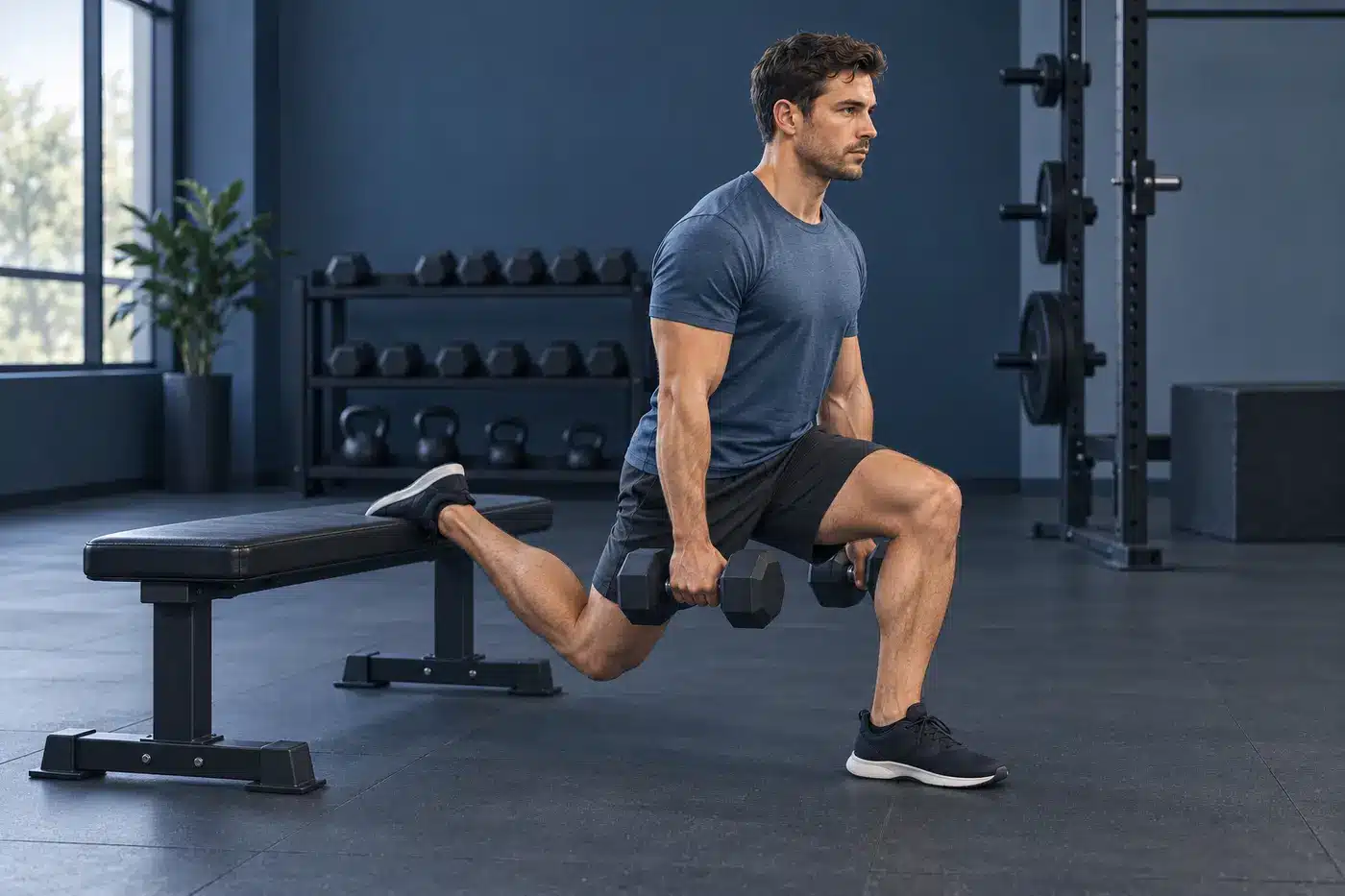
The Bulgarian split squat is a strong option for building the quads and glutes, especially when you want a challenging leg exercise without using as much total external load as a bilateral squat. It is not proven to be universally superior to squats, and balance can become the limiting factor. Good setup and stable execution matter more than forcing one “perfect” variation.
- Perform 2–4 working sets of 6–15 reps per leg.
- Finish most sets with approximately 1–3 reps in reserve.
- Use a controlled range of motion and let the front leg do most of the work.
- Choose dumbbells, a Smith machine or light hand support according to which setup lets you train the target muscles most consistently.
What Is a Bulgarian Split Squat?
A Bulgarian split squat is a rear-foot-elevated split squat. Your front leg produces most of the force while the top of the rear foot rests on a bench or pad behind you. Unlike a lunge, the feet normally stay in place throughout the set.
The exercise combines a large potential range of motion with unilateral loading. That makes moderate dumbbells feel demanding, but the movement also requires coordination and balance. For hypertrophy, it belongs in the same decision framework as any other exercise: it is useful when you can perform it comfortably, progress it and train the intended muscles close enough to failure. See our guide to exercise selection for hypertrophy.
Muscles Worked
The front-leg quadriceps and gluteus maximus are the main targets. The exact distribution changes with technique, anatomy and external load; no stance isolates one muscle completely.
| Muscle group | Role in the exercise | Practical interpretation |
|---|---|---|
| Quadriceps | Extend the front knee as you rise. | More knee flexion and forward knee travel generally increase the knee-extension demand. |
| Gluteus maximus | Extends the hip from the bottom position. | A deep, controlled repetition with meaningful hip flexion can make the glutes work hard. |
| Adductors | Assist hip extension and control the thigh. | They contribute rather than acting only as “inner-thigh” stabilisers. |
| Hamstrings | Assist at the hip and help stabilise the leg. | The exercise does not replace a leg curl, because the hamstrings are not trained through their knee-flexion function. |
| Calves and trunk | Help maintain foot, pelvis and torso position. | They should support the repetition rather than become the main limiting factor. |
What does the research actually show?
Biomechanical and muscle-activation studies confirm substantial demands on the front-leg quads and hip extensors during rear-foot-elevated split squats. Technique variables such as trunk angle and stance geometry can shift those demands.1–4 However, muscle activation and modelled muscle forces do not directly prove greater long-term muscle growth.
Direct hypertrophy comparisons are limited. The sensible conclusion is therefore that the Bulgarian split squat is a viable muscle-building exercise—not that it is automatically better than a back squat, leg press or conventional split squat.
How to Perform the Bulgarian Split Squat
Quad vs Glute Emphasis
You can bias the movement, but you cannot turn either muscle group off. Small, comfortable adjustments are preferable to an exaggerated stance.
| Goal | Useful adjustments | Watch for |
|---|---|---|
| More quad emphasis | Use a moderate or slightly shorter stance, stay relatively upright and allow controlled forward knee travel. | Do not shorten the stance so far that the heel lifts or the setup feels cramped. |
| More glute emphasis | Use a moderate-to-longer stance and a slight forward torso lean, creating more hip flexion at the bottom. | Do not turn the movement into an unstable reach or lose spinal and pelvic control. |
| Balanced development | Use the stance that gives you a deep, repeatable rep with both knee and hip motion. | Avoid constantly changing technique before you have time to progress one version. |
A 2025 study in trained women found that a more flexed trunk increased activation in several lower-body muscles during the Bulgarian split squat, including the gluteus maximus. That finding may help explain why torso position changes how a repetition feels, but it should not be treated as proof of greater hypertrophy.2
Sets, Reps and Progression
Bulgarian split squats can work across a broad repetition range. Very low reps may make setup and balance disproportionately important, while very high reps can be limited by discomfort and breathing before the target muscles are adequately challenged. For most lifters, 6–15 reps per leg is a practical default.
| Training level or use | Sets and reps | Effort |
|---|---|---|
| Learning the movement | 2 × 8–12 per leg | Keep 2–4 reps in reserve while technique becomes consistent. |
| Primary hypertrophy exercise | 3–4 × 6–12 per leg | Usually finish with 1–3 reps in reserve. |
| Secondary or pump work | 2–3 × 12–20 per leg | Use stable execution; stop if balance or conditioning takes over. |
One set performed on both legs counts as one set for each leg—not two sets for the same muscle. Your total weekly work should still fit within the rest of your lower-body programme. Read more about training volume for hypertrophy and reps in reserve.
A simple progression method
Example in a full-body programme
Bulgarian split squat: 3 sets of 8–12 reps per leg at 1–3 RIR, followed later by a knee-flexion exercise such as a seated or lying leg curl. This gives the exercise a clear role without expecting it to cover every lower-body function. See our full-body hypertrophy guide.
Common Mistakes
Bulgarian Split Squat vs Other Squats
| Exercise | Main advantage | Potential limitation |
|---|---|---|
| Bulgarian split squat | Challenges each leg with relatively modest total external load and allows useful hip and knee motion. | Balance, setup and local discomfort may limit performance. |
| Conventional split squat | Usually easier to set up because both feet remain on the floor. | Some lifters prefer the range or loading feel of the rear-foot-elevated version. |
| Back squat | Stable bilateral exercise that is efficient for loading both legs together. | Requires more total external load and may not suit every lifter equally. |
| Leg press | Highly stable and simple to take close to failure. | Machine geometry dictates the movement and unilateral differences may be less obvious. |
You do not have to choose only one. A stable bilateral exercise and a unilateral exercise can coexist when each has a clear purpose and your total training volume remains recoverable.
Frequently Asked Questions
Are Bulgarian split squats good for muscle growth?
Yes. They can train the quads and glutes through a meaningful range of motion and can be progressively overloaded. They are a viable hypertrophy exercise, although current evidence does not show that they are universally superior to other squat patterns.
Do Bulgarian split squats target the glutes or quads?
Both. A more upright, knee-forward execution tends to be more knee-dominant, while greater hip flexion and a slight forward lean can increase hip-extensor demand. These are biases rather than isolation techniques.
How many reps should I do?
Start with 6–15 reps per leg. Sets of 12–20 can also work, but balance, breathing or discomfort may become limiting before the target muscles.
Can the front knee travel past the toes?
It can if the movement is comfortable and the heel stays planted. Forward knee travel is a normal way to create knee flexion and load the quadriceps; it does not need to be avoided categorically.
How high should the rear foot be?
Only high enough to support a comfortable, repeatable setup. A standard bench often works, but a lower pad can be better for some lifters. Higher is not automatically more effective.
Are dumbbells or the Smith machine better?
Neither is inherently best. Dumbbells are accessible and flexible; the Smith machine reduces balance demands and may make progression easier. Choose the version that lets you train the intended muscles safely and consistently.
Why do I feel Bulgarian split squats mostly in my balance?
The stance may be too narrow, the rear support may be too high, or the load may have increased before the movement became stable. Try light hand support, a Smith machine or a more comfortable stance.
Bottom Line
The Bulgarian split squat is a useful quad-and-glute exercise, not a mandatory test of balance and not a proven replacement for every squat. Use a stable setup, let the front leg do most of the work, train through a controlled range and progress repetitions or load over time. If support makes the target muscles easier to train, use it.
References
- Mackey ER, Riemann BL. Biomechanical Differences Between the Bulgarian Split-Squat and Back Squat. International Journal of Exercise Science. 2021.
- Aygun-Polat E, et al. Targeted muscle activation in Bulgarian split squat variations: effects of trunk position and suspension-based execution. BMC Sports Science, Medicine and Rehabilitation. 2025.
- Jones MT, et al. Muscle Activity in Single- vs. Double-Leg Squats. International Journal of Exercise Science. 2016.
- Kipp K, Kim H, Wolf WI. Muscle Forces During the Squat, Split Squat, and Step-Up Across a Range of External Loads in College-Aged Men. Journal of Strength and Conditioning Research. 2022.
- Schellenberg F, et al. Towards evidence based strength training: a comparison of muscle forces during deadlifts, goodmornings and split squats. BMC Sports Science, Medicine and Rehabilitation. 2017.