Squat Wedges vs Lifting Shoes: Which Setup Fits Your Squat?
Take your usual squat stance and look at the floor. If you put a board underneath both heels, will your feet still fit where you naturally put them? That question can rule out a squat wedge before you even get to the angle or price.
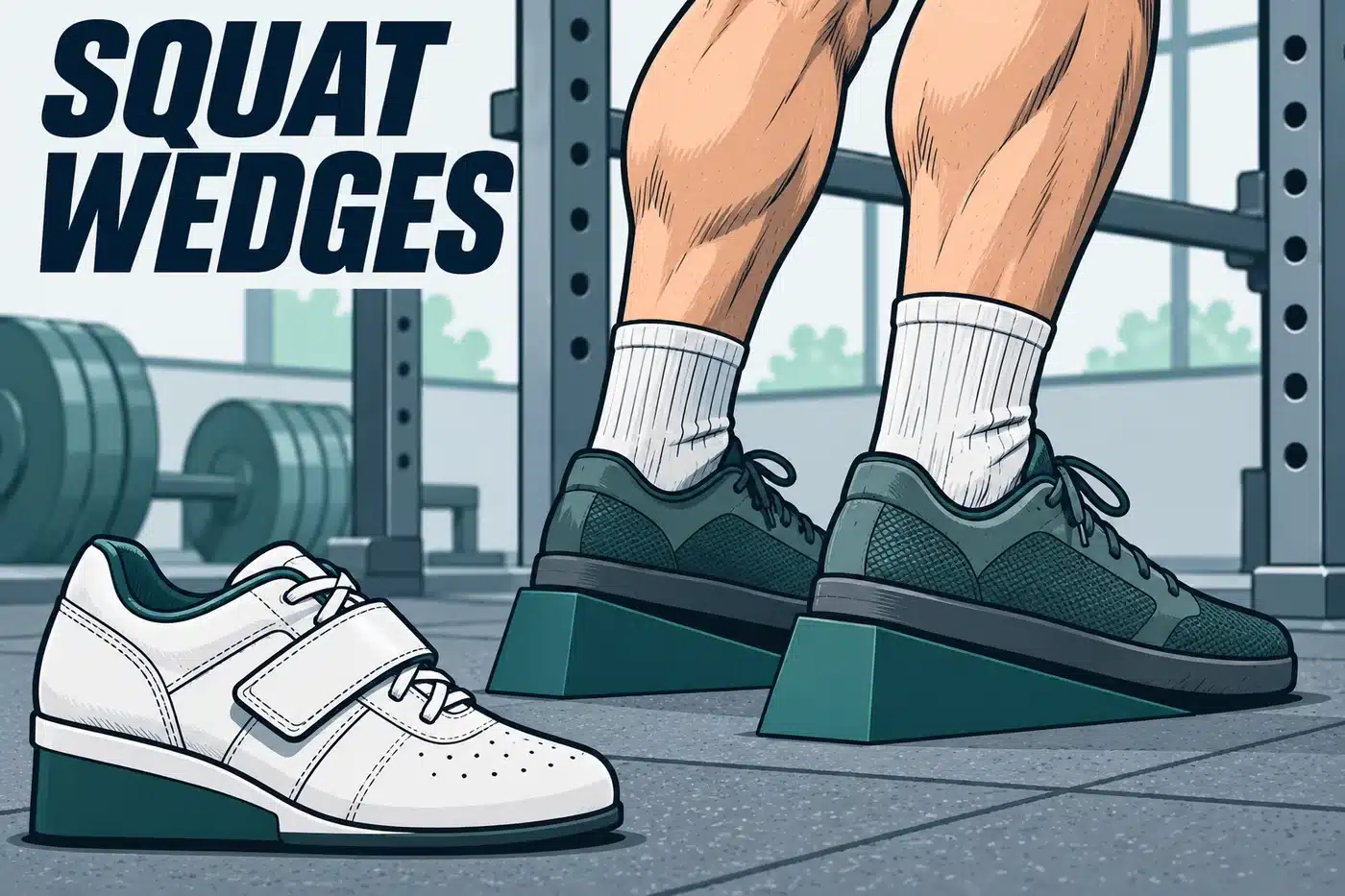
Choose separate wedges if you want to keep your own shoes and adjust the width and angle of each foot. Choose a single slant board if it comfortably fits your whole stance and you prefer one piece to set down. Consider lifting shoes if you regularly squat in different racks or do Olympic lifts and want the heel to travel with you. If you already squat comfortably in stable shoes, you can skip all three.
Start with the problem you are trying to solve
Imagine two lifters in the same gym. One reaches the bottom of a goblet squat comfortably with the heels raised, but tips forward in flat shoes. The other has enough depth and feels unsteady because the soft running shoes underneath them compress. The first lifter has a reason to try a heel lift. The second has a reason to try a firmer shoe on level ground first. Buying a wedge leaves the soft sole in the equation.
Wedges, a slant board or lifting shoes?
| Setup | Where it earns its place | What to check |
|---|---|---|
| Two separate wedges | Your feet turn out, your stance is wide, or different people share the equipment. | Each wedge must stay put independently. Check both sides after resetting your stance. |
| One wide board | You repeat one stance at a home station and want a quick setup. | Measure the space from the outer edge of one shoe to the outer edge of the other at your usual toe angle. Compare that with the usable surface. |
| Weightlifting shoes | You use several racks, or need an elevated heel for lifts where your feet move. | Try the shoe for midfoot security, heel hold and toe room. A wedge stays on the floor when you take a step. |
Why a 15-degree wedge and a 15 mm shoe heel are different purchases
Degrees describe a slope. Millimeters describe a height difference. For a straight ramp, the rise depends on the horizontal distance along it. Over 100 mm of horizontal run, a 10° ramp rises about 18 mm. Over 150 mm it rises about 26 mm. Both ramps are still 10°. Where your heel and forefoot actually rest matters, especially when your forefoot extends past the ramp. Treat a shoe’s effective heel height and a board’s labeled angle as different specifications.
Commercial examples show how much the equipment can vary. Rogue lists its compact resin wedge as a 10° pair with a depth of 6 in (15.2 cm). Its steel line includes 8.5 in (21.6 cm) individual-foot wedges sold in pairs and 20 or 30 in (50.8 or 76.2 cm) boards sold singly. On the steel line, width and incline are separate choices. Compare the exact variant in the cart. These are manufacturer specifications, not a hands-on THG review.
What a raised heel changes in a squat
A 2026 analysis of 14 studies with 177 participants reported that heel elevation increased knee range of motion by about 5° and ankle range by about 4° on average. Those are changes in how far the joints moved during the tested squats. They tell us little about your preferred incline, your balance under a heavy load, or how much muscle you might gain. An earlier review also found that shoes and external wedges can change squat mechanics, with the response depending on how the squat is performed. Read the 2026 meta-analysis or the review of barbell squat footwear.
Try a comparison before you buy
- Establish your baseline. In stable shoes, perform five comfortable bodyweight squats at your usual stance. Note your depth, whether your heels stay planted and whether you can pause in balance.
- Change one thing. If the gym has a purpose-built wedge, try its shallowest available comfortable option using the same shoes, stance and pace. Check the wedge grips the floor and your shoe grips the top. If either moves, end the trial there.
- Repeat the useful version. If the change feels promising, use a light goblet squat. A side-view video from the same spot can show whether you reached a different position or simply squatted faster. Keep the setup only if you can reproduce it.
If the wedge helps only when empty, that still tells you something. You might keep it for a light goblet squat and wear your normal shoes for barbell work. If it makes no meaningful difference, keep the money. For shoe fit, sole stiffness and Alex’s experience under the bar, see the lifting shoes guide. For other equipment decisions, visit the weightlifting equipment hub.
Frequently asked questions
How do I check whether a slant board fits my stance before ordering?
Mark the outside edges of your shoes on the floor in your usual squat stance, including your normal toe angle. Compare that span with the usable width of the sloped surface. Separate wedges let you position each foot independently.
Can I match my lifting shoes to a wedge by comparing the numbers on the box?
A shoe’s heel-to-toe drop is a height. A wedge angle is a slope. You also need the horizontal distance between the heel and forefoot contact points to estimate the rise, so a 15 mm shoe and a 15° wedge are two different specifications.