Incline Dumbbell Press for Upper-Chest Growth: Angle, Form & Programming
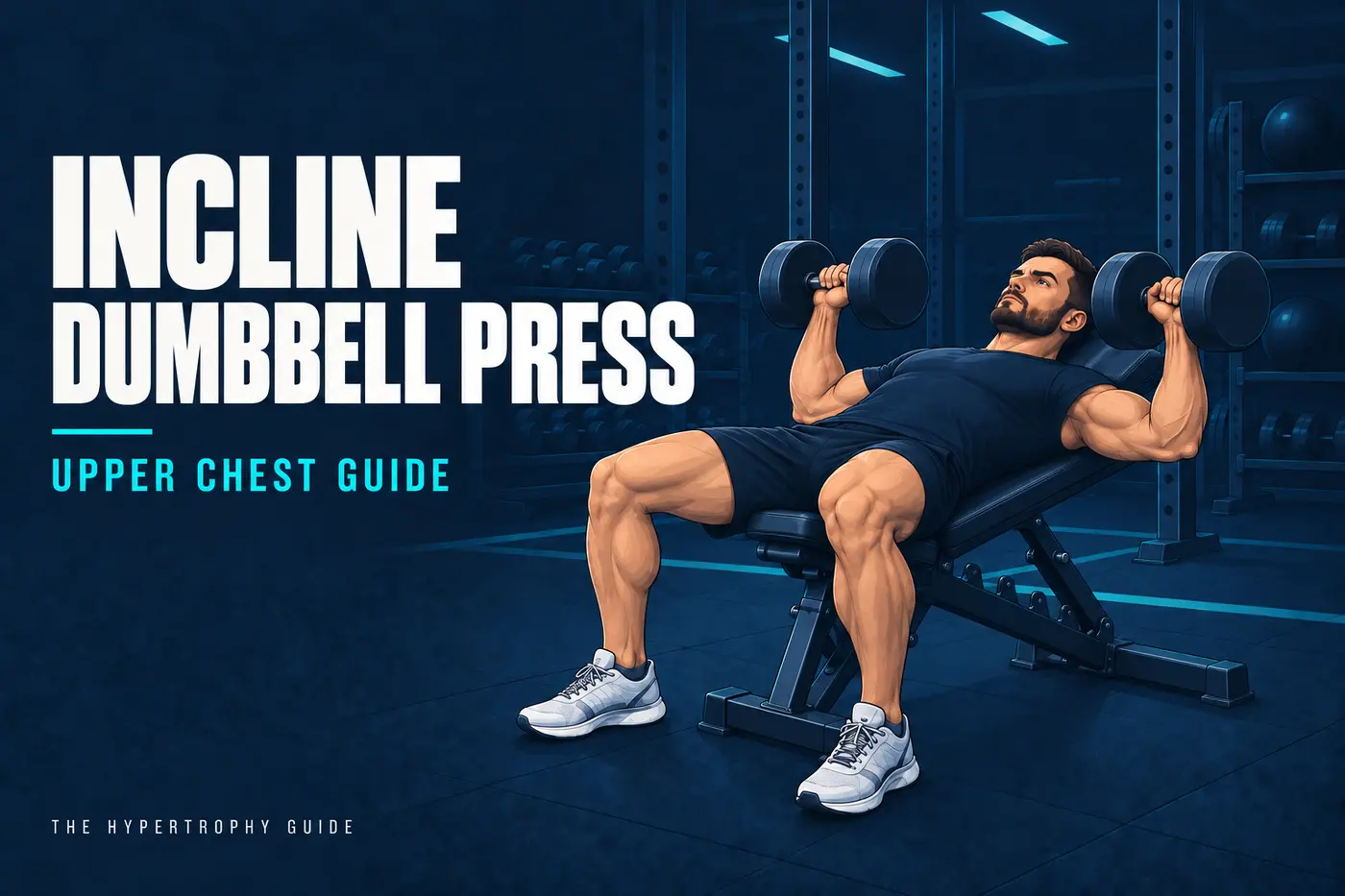
The incline dumbbell press is a practical upper-chest exercise that combines independent arm movement, a deep range and relatively fast setup. A bench angle around 15-45 degrees works well; the best choice balances chest emphasis, shoulder comfort and progression.
What Is the Best Incline Angle?
| Angle | Practical effect |
|---|---|
| 0-15 degrees | Similar to a flat press with only a small change in emphasis |
| 15-30 degrees | Strong chest contribution and usually good loading potential |
| 30-45 degrees | Useful upper-chest/front-delt compromise |
| Above 45 degrees | Increasingly shoulder-dominant for many lifters |
Incline pressing can change how regions of the pectoralis major are recruited, but it does not isolate one strip of the chest. The entire muscle contributes, and individual anatomy matters.1, 2
I use both. At 30 degrees I can usually press more load, while 45 degrees gives a useful middle ground between chest and front-deltoid work. That makes 45 degrees especially practical in a two- or three-day full-body programme where one press needs to cover several functions.
Muscles Worked
How to Perform the Incline Dumbbell Press
- Set the bench between roughly 15 and 45 degrees.
- Bring the dumbbells to the shoulders and plant both feet.
- Use a neutral-to-semi-pronated grip and keep the wrists stacked.
- Lower with the elbows around 30-60 degrees from the torso.
- Reach the deepest comfortable position without the shoulder rolling forward.
- Press up and slightly inward without colliding the dumbbells.
I normally use an elbow angle around 45 degrees with a slight neutral turn of the dumbbells. It feels better on my shoulders and gives a longer range than flaring the elbows straight out. I teach a stiff, neutral wrist with the load stacked over the forearm.
How Deep Should the Dumbbells Go?
Lower until you reach a strong but comfortable chest stretch while the upper back stays supported and the shoulder remains organised. Greater controlled range can be useful, but pain and forced shoulder translation are not productive range.3
I usually ask the lifter to let the inside of each dumbbell lightly touch the shoulder. It creates a clear, repeatable standard and discourages the common habit of shortening the bottom as the weight gets heavier. Use this cue only while the position is painless and the shoulder does not roll forward.
The dumbbells do not need to touch at the top. Bringing them closer can increase the sensation of contraction, but forcing them together may reduce stability without adding useful tension.
Incline Dumbbell vs Barbell Press
| Factor | Dumbbells | Barbell |
|---|---|---|
| Range | Often permits a deeper individual path | Bar stops at the chest |
| Setup | Fast at moderate loads | More rack and warm-up setup |
| Loading | Each arm independent; heavy setup can limit | Usually greater absolute loading potential |
| Progression | Gym dumbbell jumps may be large | Small plate increments are easy |
At heavy loads, lying back with flat dumbbells can feel awkward because the weights move away from you. The incline position is easier to set up, and dumbbells allow a deep stretch with less preparation than a barbell. Both variations have a place; I choose according to the goal and how quickly I want to get into the working sets.
Sets, Reps and Progression
| Use | Sets x reps | Effort | Rest |
|---|---|---|---|
| Heavier press | 3-4 x 5-8 | 1-3 RIR | 2-4 min |
| Hypertrophy default | 2-4 x 8-12 | 1-3 RIR | 2-3 min |
| Secondary press | 2-3 x 10-15 | 1-3 RIR | 90-180 sec |
Place it early when upper-chest progression is a priority, or after another main press when it supplies additional volume. Increase load only after reaching the top of the rep range with the same depth and elbow path. Wrist wraps are optional; for most people, learning to stack the wrist is more important.
Common Mistakes
Frequently Asked Questions
Is 30 or 45 degrees better?
Both work. Thirty degrees usually permits more chest-dominant loading; 45 degrees includes more front-deltoid work and can be efficient in a full-body programme.
Why do I only feel it in my shoulders?
Try a lower bench angle, reduce the load, keep the elbows around 45 degrees and preserve the upper-back position. Persistent pain should be assessed appropriately.
Are dumbbells better than a barbell?
Not universally. Dumbbells offer independent movement and often more range; a barbell usually allows more absolute load and smaller progression steps.
Bottom Line
Use a 15-45-degree incline, a comfortable semi-neutral grip and a full pain-free depth. For most lifters, 8-12 controlled reps provide a productive combination of contact, technique and progression. Do not let heavier dumbbells quietly erase the bottom half of the exercise.
References
- Chaves SFN, et al. Effects of horizontal and incline bench press on neuromuscular adaptations. Int J Exerc Sci. 2020.
- Albarello JC, et al. Non-uniform excitation of pectoralis major induced by changes in bench press inclination. J Strength Cond Res. 2022.
- Pallares JG, et al. Effects of range of motion on resistance training adaptations. Scand J Med Sci Sports. 2020.
- Schoenfeld BJ, et al. Strength and hypertrophy adaptations between low- vs high-load resistance training. J Strength Cond Res. 2021.