Are BCAAs Worth It for Muscle Growth?
Are BCAAs worth it for muscle growth? For most lifters, probably not. While BCAAs play a role in muscle protein synthesis, they are usually unnecessary if you already consume enough complete protein from foods or protein supplements.
TL;DR
- BCAAs are three essential amino acids: leucine, isoleucine, and valine.
- They are not useless, but they are incomplete compared with whole protein or protein powder.
- Muscle growth requires all essential amino acids, not just BCAAs.
- If you already eat enough high-quality protein, BCAA supplements are usually redundant.
- For most lifters, whey, casein, creatine, or simply more total protein is a better investment.
What Are BCAAs?
BCAAs stands for branched-chain amino acids. The three BCAAs are leucine, isoleucine, and valine.
They are called essential amino acids because your body cannot produce them on its own. You need to get them through food or supplementation.
BCAAs became popular because leucine plays an important role in stimulating muscle protein synthesis. That part is real. The problem is that muscle growth does not depend on leucine alone.
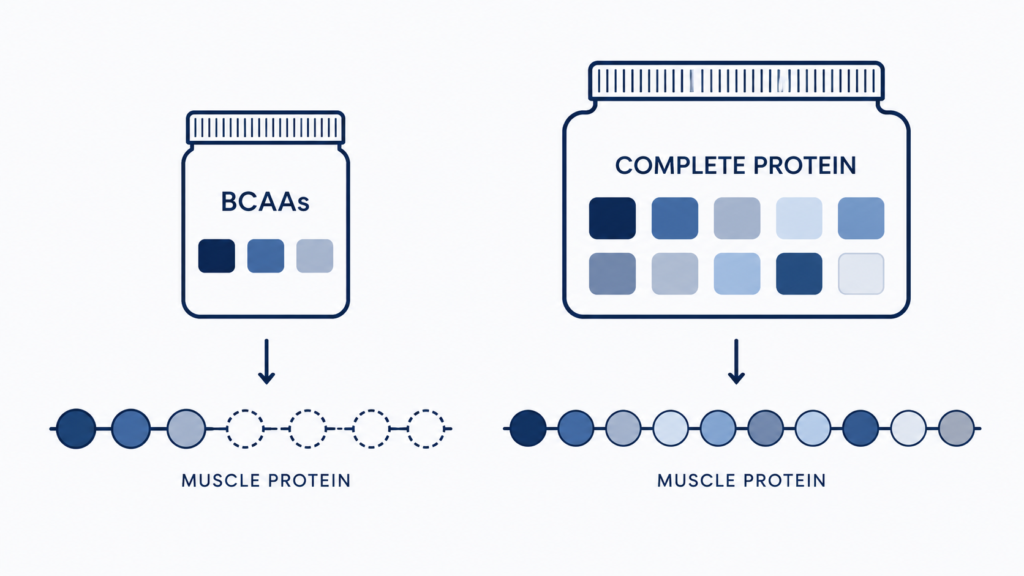
To build new muscle protein, your body needs a complete pool of essential amino acids. BCAAs provide three of them, but not all of them.
Why People Take BCAAs
Most people take BCAAs because they want a simple supplement that supports muscle growth, reduces soreness, improves recovery, or prevents muscle breakdown during training.
The appeal is easy to understand. If amino acids are involved in building muscle, then drinking amino acids during training sounds like a direct shortcut to better results.
But this is where supplement marketing often gets ahead of the evidence.
BCAAs are involved in muscle metabolism, and leucine is an important anabolic signal. However, sending a signal is not the same as providing all the materials needed to build new muscle tissue.
The Main Problem: BCAAs Are Incomplete
The biggest limitation of BCAA supplements is simple: they are incomplete.
BCAAs only provide leucine, isoleucine, and valine. But muscle protein is built from a broader set of essential amino acids. If the other essential amino acids are missing or limited, BCAAs alone cannot fully support muscle protein synthesis.
This is why BCAAs are very different from complete protein sources like whey, casein, eggs, dairy, meat, fish, and soy. These foods contain BCAAs, but they also contain the rest of the essential amino acids needed to support muscle growth.
For most lifters, the better question is not:
“Should I take BCAAs?”
It is:
“Am I eating enough complete protein?”
If the answer is no, fixing total protein intake should come first. If the answer is yes, BCAA supplements usually add very little.
BCAAs vs Complete Protein
Complete protein sources provide all essential amino acids. BCAAs do not.
That is the key difference.
Whey protein, for example, contains a high amount of leucine and other BCAAs, but it also provides the full essential amino acid profile. That makes it more useful for hypertrophy than isolated BCAAs in most situations.
Casein is also a complete protein, but it digests more slowly. It can be useful if it helps you reach your daily protein target or distribute protein intake across the day. You can read more in casein protein before bed.
In practical terms, BCAAs are like giving your body part of the recipe. Complete protein gives your body the full set of ingredients.
Are BCAAs Useful If You Already Eat Enough Protein?
Usually, no.
If you already consume enough daily protein from complete sources, you are already getting plenty of BCAAs through your diet.
Whey protein, casein, eggs, dairy, meat, fish, and soy all contain meaningful amounts of BCAAs. In that context, a separate BCAA supplement is usually redundant.
This matters because most lifters are not limited by a lack of isolated BCAAs. They are more often limited by inconsistent training, insufficient total protein, poor sleep, poor recovery, or a poorly structured program.
For most resistance-trained people, a useful target is roughly 1.6–2.2 grams of protein per kilogram of body weight per day, depending on body composition, calorie intake, and training goals. For a deeper breakdown, read how much protein you should eat per day.
When Might BCAAs Make Sense?
BCAAs are not automatically useless in every possible context.
They may be more relevant if your total protein intake is very low, if you train fasted and do not plan to eat protein soon after, or if you simply want a low-calorie flavored amino acid drink during training.
Even then, the better option for muscle growth is usually a complete protein source or, in some cases, an essential amino acid supplement rather than BCAAs alone.
That could mean:
- adding a serving of whey protein
- using casein before bed if it helps you reach your protein target
- eating more high-quality protein at meals
- choosing complete plant protein sources if you avoid animal products
If you are choosing between BCAAs and whey, whey is usually the better muscle-building supplement because it provides both BCAAs and the full essential amino acid profile. You can read more in whey protein for muscle growth.
Do BCAAs Help With Soreness and Recovery?
Some people take BCAAs because they feel less sore when using them.
That may happen in some contexts, especially if protein intake is low. But less soreness does not automatically mean more muscle growth.
Soreness is not a reliable indicator of hypertrophy. You can grow with very little soreness, and you can be very sore without making better progress.
If recovery is the issue, first look at:
- total protein intake
- sleep quality
- training volume
- calorie intake
- program structure
For most lifters, these factors matter more than adding BCAAs. You can read more about the bigger picture in recovery and muscle growth.
Practical Recommendation
For most lifters, BCAAs are not worth prioritizing for muscle growth.
They are not the worst supplement. They are simply unnecessary for many people who already eat enough complete protein.
A better hierarchy looks like this:
- Hit your total daily protein target.
- Use complete protein sources most of the time.
- Use whey or casein if they help with convenience.
- Use evidence-based supplements where they solve a real problem.
- Skip BCAAs unless you have a specific reason to use them.
If your budget is limited, spend it on food, protein powder if needed, creatine, and caffeine before isolated BCAAs. For a broader overview, read best supplements for muscle growth.
For a broader overview of evidence-based supplementation, see the Supplements Hub.
Why It Matters
BCAAs are a good example of how supplement marketing can take a real biological mechanism and turn it into an exaggerated product claim.
Leucine matters. Essential amino acids matter. Protein quality matters.
But that does not mean isolated BCAAs are the best way to build muscle.
For most people, the smarter approach is simple: eat enough complete protein, train consistently, recover well, and use supplements only where they clearly solve a problem.
FAQ
Are BCAAs worth it for muscle growth?
For most lifters, BCAAs are not worth prioritizing if total protein intake is already sufficient. Complete protein sources like whey, casein, eggs, meat, dairy, and soy provide BCAAs plus the other essential amino acids needed to support muscle growth.
Do BCAAs build muscle?
BCAAs can play a role in muscle protein synthesis, especially because leucine is an important signaling amino acid. However, BCAAs alone do not provide all essential amino acids required to build new muscle protein.
Are BCAAs better than whey protein?
No. Whey protein is usually better for muscle growth because it contains BCAAs and the full essential amino acid profile. BCAAs are incomplete, while whey is a complete protein source.
Should I take BCAAs if I already eat enough protein?
Usually not. If you already consume enough high-quality protein, you are already getting BCAAs from your diet, making a separate BCAA supplement mostly redundant.
When should I take BCAAs?
If you choose to use BCAAs, timing is less important than total protein intake. Some people take them during training, but complete protein intake across the day matters more for muscle growth.
References
- Jäger R, et al. International Society of Sports Nutrition Position Stand: protein and exercise. Journal of the International Society of Sports Nutrition. 2017.
- Wolfe RR. Branched-chain amino acids and muscle protein synthesis in humans: myth or reality? Journal of the International Society of Sports Nutrition. 2017.
- Tipton KD, et al. Stimulation of net muscle protein synthesis by whey protein ingestion before and after exercise. American Journal of Physiology-Endocrinology and Metabolism. 2007.