Microplates: How to Use Fractional Plates for Progression
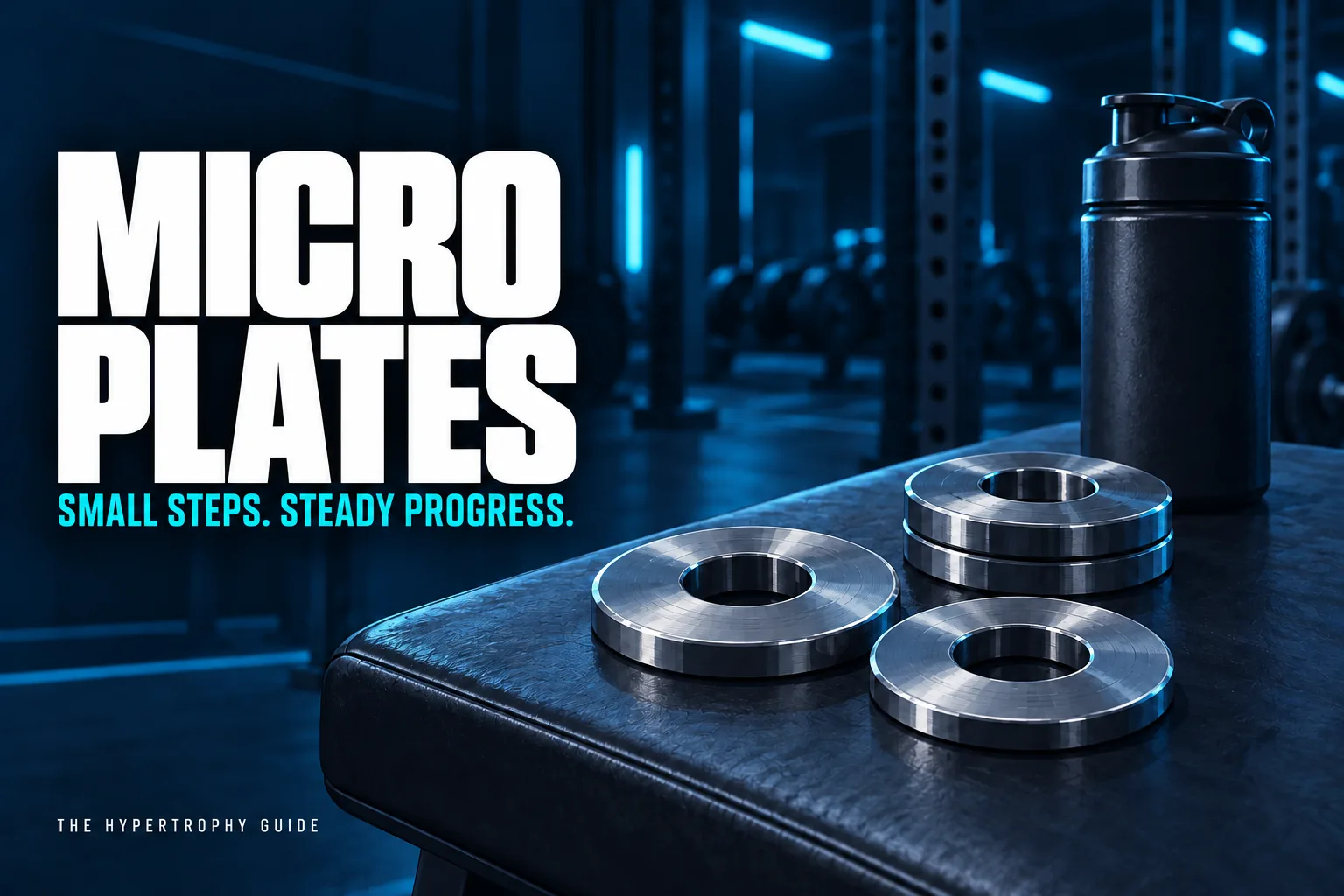
Microplates let you increase the weight in smaller steps when the next available plate is too large a jump. Also called fractional plates, they can be especially useful when you want to keep the same reps and technique on a bench press or overhead press. They are a progression tool, not a guarantee of extra muscle growth.
What Are Microplates?
Microplates are small weight plates used to make finer load adjustments than the gym’s usual minimum increment. The names microplates, fractional plates and change plates overlap, but a change plate is not necessarily small enough for your needs. Check the actual weight rather than relying on the label.
For example, two 2.5 lb plates add 5 lb to a barbell. If that increase repeatedly pushes you below your intended reps, two 0.5 lb plates give you a smaller 1 lb step. In a kilogram-based gym, two 0.5 kg plates provide a 1 kg step instead of the 2.5 kg added by two 1.25 kg plates.
The important number is the increase relative to your current load. Adding 5 lb to 100 lb is a 5% increase; adding it to 200 lb is 2.5%. In metric terms, adding 2.5 kg to 50 kg is 5%, while adding it to 100 kg is 2.5%. The same plates can represent very different challenges.
Microplate Sizes: Per Side vs Total Increase
For a symmetrically loaded barbell, total added weight equals twice the weight of one plate. These are example increments, not a shopping list you need to buy in full.
Pound-based plates (lb)
| Plate per side | Total added | Example barbell load |
|---|---|---|
| 0.25 lb | 0.5 lb | 135 to 135.5 lb |
| 0.5 lb | 1 lb | 135 to 136 lb |
| 1 lb | 2 lb | 135 to 137 lb |
| 1.25 lb | 2.5 lb | 135 to 137.5 lb |
Kilogram-based plates (kg)
| Plate per side | Total added | Example barbell load |
|---|---|---|
| 0.25 kg | 0.5 kg | 60 to 60.5 kg |
| 0.5 kg | 1 kg | 60 to 61 kg |
| 1 kg | 2 kg | 60 to 62 kg |
| 1.25 kg | 2.5 kg | 60 to 62.5 kg |
These tables show separate loading systems, not equivalent weights. One kilogram is approximately 2.205 lb: a 0.5 kg plate weighs about 1.1 lb, not 0.5 lb. Use the units on your gym equipment and keep your logbook consistent.
When Are Fractional Plates Worth Using?
When the next jump disrupts your pressing
The barbell bench press is a practical example: you can complete your target with a consistent touch point, but the next available increase costs several reps or changes the movement. Smaller plates give you an intermediate option. The same reasoning can apply to overhead pressing.
When your strength plan uses fixed reps
With a prescription such as 3 sets of 3, you may prefer to increase load while retaining those reps. Microplates let you make a smaller adjustment instead of forcing a jump that turns the last set into a grind.
When they solve an actual equipment gap
Microloading can also be useful on a lat pulldown or cable lateral raise if the stack’s next setting is too large. However, a barbell plate and a machine add-on weight are not automatically interchangeable. Use only a compatible attachment intended for that machine.
When larger jumps already work, keep it simple
If the next available weight lets you stay within your rep range with the same technique, smaller steps may add administration without solving a problem. You do not need to microload every exercise.
How to Use Microplates for Progression
Option 1: Keep the reps fixed
- Choose a load that lets you complete the prescribed sets and reps with the intended reserve.
- Keep setup, range of motion and rest periods consistent enough to compare sessions.
- When performance justifies it, add a matching small plate to each side.
- Repeat the load or step back if you lose the required reps or technique.
Illustrative example: after completing 135 lb for 3 sets of 3 with the intended technical control and reserve, try 136 lb by adding 0.5 lb per side. In a separate metric example, 60 kg becomes 61 kg with 0.5 kg per side. These increases are not equivalent; each shows how a small pair works in that loading system. Increase based on performance, not an automatic weekly schedule.
Option 2: Build reps, then add weight
For 3 sets of 8–12, keep the load while building toward 12 reps on every set at your intended effort. Then increase it and build again from lower in the range. Choose microplates if the usual jump pushes you below that range; use ordinary plates if they work.
An eight-week study comparing progression through repetitions with progression through load found broadly similar muscular adaptations, supporting both as practical options.1 It did not test whether fractional plates outperform standard plates. Do not turn evidence for progression into a claim that microplates uniquely build more muscle.
Use reps in reserve to keep effort comparable. More weight with a shorter range or much harder effort is not the same achievement as more weight under the previous conditions.
Which Microplates Should You Buy?
For a pound-based gym: if you want 1 lb total increases, choose two 0.5 lb plates. For 2 lb total increases, choose two 1 lb plates. You do not need to recreate Alex’s kilogram set exactly; choose the increments that solve your loading gap.
- Useful increment: buy the pair that bridges your actual loading gap. In a pound-based gym, consider a pound-based pair rather than mixing units unnecessarily.
- Hole size: match the plate opening to the bar sleeve. Plates for Olympic sleeves and smaller standard bars are not interchangeable. Check both manufacturers’ dimensions.
- Single, pair or set: confirm what the stated weight describes. A set’s total weight is not the weight of each plate.
- Accuracy and fit: check the stated weight tolerance, finish and fit. Tiny nominal increments are less useful if the plates vary substantially in actual weight.
- Secure loading: follow the bar and plate instructions, including appropriate collars. Do not assume a rubber coating replaces a collar.
- Gym permission: confirm that personal plates or machine add-ons are allowed before bringing them.
For context, manufacturers sell fractional plates in both kilogram and pound ranges; Rogue’s product specifications are examples of why you should check the individual plate weight and opening dimensions.2,3 These are specification references, not a claim that I have tested those products or a ranked product recommendation.
Machine and dumbbell compatibility
Use manufacturer-approved add-on weights or adapters within their stated limits. Do not balance loose dumbbells on a moving weight stack or hang plates from a selector pin that is not designed to carry them. An attachment must not obstruct the stack, cables, guards or selector mechanism.
For dumbbells, use only purpose-designed compatible add-ons that attach securely. With a pair of dumbbells, record the new weight of each dumbbell; the barbell’s two-sided calculation does not describe one dumbbell’s load.
On cable equipment, added stack mass may not equal the added resistance at the handle because pulley arrangements differ. Compare progress on the same machine and setup.
What Microplates Will Not Fix
Fractional plates can bridge an awkward loading gap. They cannot guarantee endless progression or fix inconsistent training, insufficient recovery or a changing technical standard. If performance is declining across several exercises, review the programme rather than automatically buying smaller plates.
You can also keep the same weight while improving control or completing more reps. A logbook does not need a new load every session to show useful progress.
Frequently Asked Questions
Are microplates worth it for beginners?
Sometimes. If normal increases already work, they are unnecessary. If the smallest available jump is too large for an exercise, a compatible small pair can be useful regardless of training experience.
Is adding just 1 lb worthwhile?
It can be when a larger jump costs your intended reps or technique. Two 0.5 lb plates add 1 lb total. Likewise, a 0.5 kg increase may be useful in a metric setup. Check whether you mean total added weight or weight per side, then judge it relative to the working load and your ability to keep the same reps and technique.
Do microplates build more muscle?
They make smaller load increases possible. The research cited here does not establish that microplates produce more hypertrophy than a well-managed programme using normal increments and rep progression.
Should I add microplates every workout?
Only when your performance supports an increase. Keep the weight unchanged when you have not met your progression criteria. Smaller plates do not remove the need for recovery.
Can I use barbell microplates on a cable machine?
Only through a compatible, manufacturer-approved system. Do not improvise with loose weights or an overloaded selector pin. Building reps first is an alternative when no safe add-on is available.
Bottom Line
Buy microplates to solve a loading problem, not to create a compulsory weekly increase. They are particularly useful when fixed reps and consistent technique matter, while rep-range progression may be simpler for much of your hypertrophy training.
Start with the smallest useful purchase, load both sides correctly and keep the technical standard unchanged. For the wider picture, explore the weightlifting equipment guide and exercise library.
References
- Plotkin D, et al. Progressive overload without progressing load? The effects of load or repetition progression on muscular adaptations. PeerJ. 2022;10:e14142.
- Rogue Fitness. KG Fractional Plates: manufacturer specifications. Product specifications, not evidence of superior training outcomes.
- Rogue Fitness. LB Fractional Plates: manufacturer specifications. Product specifications, not a hands-on review.