Cable Cuffs for Lateral Raises: Fit, Setup & Handle Comparison
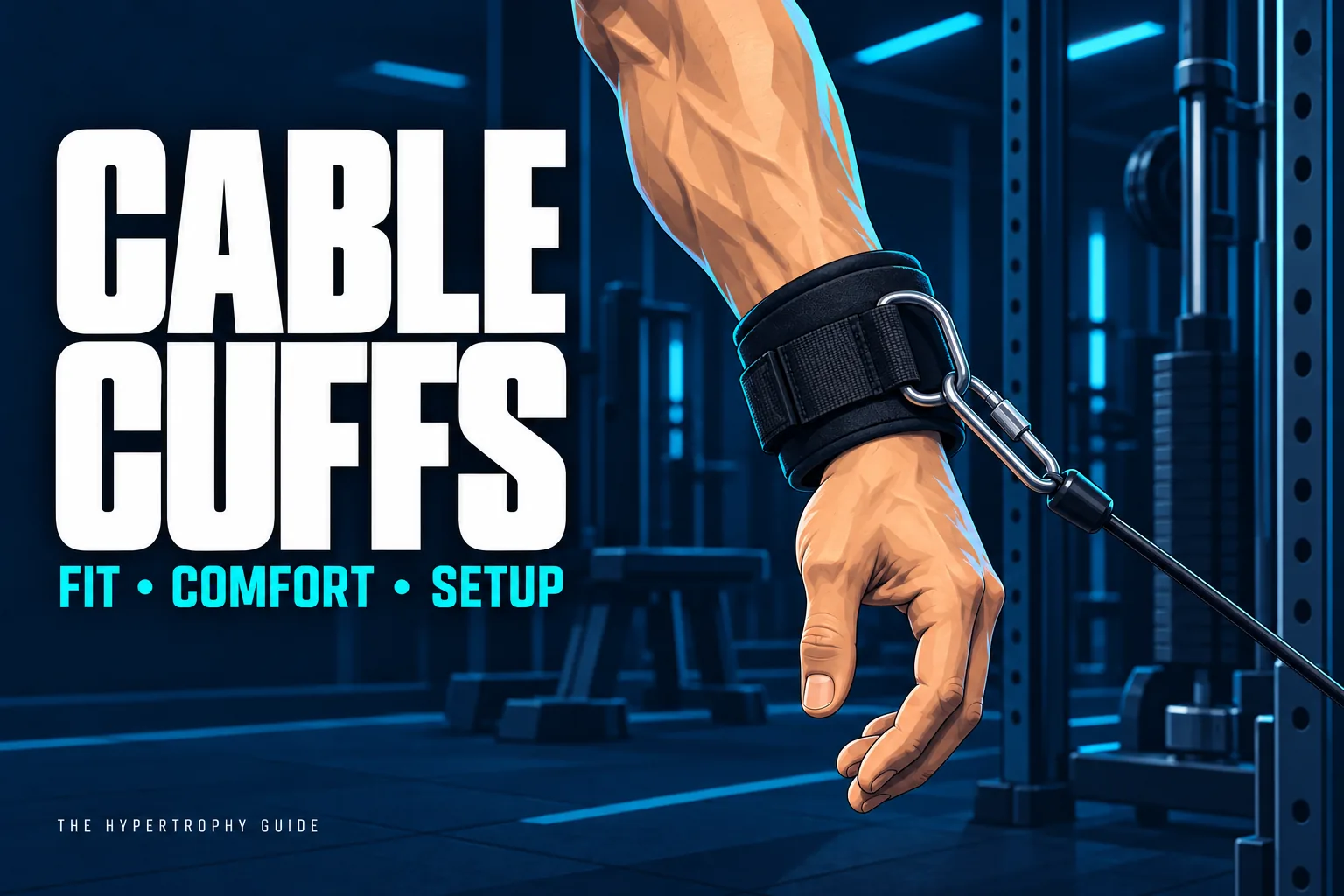
Cable cuffs let you connect a cable to your wrist or forearm without gripping a handle. For lateral raises, that can be a useful comfort and setup option. A cuff is worth considering when the handle feels awkward, but it is not a requirement for building your side delts.
What Are Cable Cuffs?
A cable cuff is an adjustable band with an attachment point, commonly a metal ring, that connects to a cable machine. Some are designed for wrists or forearms; others are ankle cuffs. Do not assume an ankle model will tighten sufficiently around your wrist.
Cuffs serve a different purpose from lifting straps. Straps help you hold a bar or handle. A cable cuff connects the cable directly to the limb. Wrist wraps, meanwhile, provide support around the wrist and are not cable attachments.
This guide focuses on choosing and using cuffs for lateral raises. For the full movement, arm path and programming, use the cable lateral raise guide.
Cable Cuffs vs Handles: Which Should You Use?
| Consideration | Cable cuff | Ordinary handle |
|---|---|---|
| Hand involvement | No need to hold a handle; pressure is transferred through the cuff. | Requires a grip, which may be comfortable and unproblematic. |
| Fit | Must match your wrist or forearm and stay secure. | No cuff sizing, though handle shape still affects comfort. |
| Setup time | Can take longer to fit and swap between arms. | Usually quick to pick up and use. |
| Potential drawback | Sliding, pinching or an unreliable closure. | An awkward grip or uncomfortable wrist position. |
| Reason to choose it | It makes your own movement more comfortable and repeatable. | It already works well and keeps training simple. |
A cuff changes where the cable applies its force. It does not remove all stress from the arm, and it does not automatically create a better resistance profile. Placement, cable direction and arm position still matter.
Where Should You Place a Cable Cuff?
Follow the cuff manufacturer’s intended placement. With a wrist-style cuff suitable for lateral raises, a practical starting point is around the distal forearm, just above the wrist joint, where it can sit securely without pressing sharply into the wrist bones.
Keep the hand relaxed and the wrist in a comfortable position. The cuff should not migrate down onto the hand during the repetition. If it only stays in place when tightened painfully, the fit or design is wrong for you.
A repeatable lateral-raise setup
- Check the attachment. Inspect the cuff, stitching, ring and closure. Connect the cable using the intended connector and ensure its gate is fully closed.
- Fit the cuff before loading it. Adjust it snugly, then test with a light load. Stop if it slips, opens or causes pinching or numbness.
- Choose a cable height. Hip height is Alex’s preferred starting point. Adjust the station and your distance so the cable can move freely.
- Support yourself if useful. Hold a stable part of the tower with your free hand, provided it is clear of moving components.
- Raise with control. Keep a small, fairly consistent elbow bend and use a comfortable arm path. Start around shoulder height as an upper reference rather than forcing extra range.
- Return under control. Avoid hitting the tower or letting the cuff twist as you lower the arm.
A loaded cable does not mean constant shoulder demand. The cable’s angle relative to your arm changes through the repetition. A cuff does not make every part of the movement equally difficult. Choose a setup you can repeat comfortably rather than chasing a claim of perfect tension.
How heavy should you go?
Start lighter than your usual handle load while you learn the new setup. Moving the attachment point or changing your elbow bend can change the leverage, so the same stack number is not necessarily the same challenge.
A practical starting point is 10–20 controlled reps for lateral raises. Progress when you can maintain your range, cuff position and control. If the next stack increment is too large, build reps first or use a compatible add-on as explained in the microplates guide.
What to Check Before Buying Cable Cuffs
- Intended use and fit range: measure where you will wear the cuff and compare with the manufacturer’s sizing. Check inches and centimetres carefully; overall strap length is not the same as usable circumference.
- Secure closure: the fastening must remain secure through the movement. Check that a hook-and-loop strap has the required overlap or that a buckle engages properly.
- Comfort under load: padding should spread pressure without creating bulky edges or rubbing against the hand.
- Hardware and stitching: look for clear specifications, intact seams and a ring and connector appropriate for the intended use. Follow stated load limits.
- Adjustment and swapping: consider how quickly you can fit it, change arms and share the station.
- Package contents: confirm whether you are buying one cuff or a pair, and whether suitable connectors are included.
As one manufacturer example, GymPin describes cuffs intended for ankle and wrist cable training.1 Product descriptions help establish intended use, but do not prove that a cuff will fit you or improve muscle growth. This guide is not a hands-on review of that product.
One cuff or two?
One cuff is enough for single-arm work. Two may make side changes easier or suit bilateral setups, but they are not essential. Start with what your actual exercise needs.
Common Cable-Cuff Problems
The cuff keeps sliding
Check placement and fit before increasing the load. If the smallest secure setting is still too loose, use a smaller cuff or return to a handle. Repeatedly tightening an unsuitable cuff is not a good solution.
The closure starts opening
Stop the set and unload the attachment. Check for wear, inadequate fastening or an unsuitable load. Do not continue hoping it will hold for the last few reps.
You can lift more, but the movement has changed
If you move the cuff closer to the elbow, bend the arm more or swing the torso, the leverage and execution change. Record the setup and compare like with like. A heavier stack alone does not show better side-delt training.
The setup takes longer than it helps
Frequently Asked Questions
Are cable cuffs better than handles for lateral raises?
They may feel better for you, particularly if the handle feels awkward. They are not automatically superior. Choose the option that gives you secure, comfortable and repeatable training.
Can I use ankle straps around my wrists?
Only if the product is suitable for wrist use and fits securely within its intended adjustment range. Some ankle cuffs are too large for wrists even at their tightest setting.
Do cable cuffs prevent wrist pain?
No guarantee can be made. They change how the load is applied and may feel more comfortable, but can also create pressure or irritation. Do not use them to push through persistent symptoms.
Should the cuff sit above the wrist or near the elbow?
This guide uses a wrist-style setup just above the wrist. Moving the attachment toward the elbow changes leverage and may require a different cuff design. Follow the product instructions and treat a new position as a different setup.
Do I need cable cuffs as a beginner?
No. A comfortable handle is enough to get started. Consider a cuff if it solves a specific problem and you can fit it securely.
Choose the Attachment That Helps You Train Consistently
A well-fitting cuff is useful when it makes the exercise easier to perform comfortably. It is optional when an ordinary handle already works. Prioritise fit, a dependable closure and a repeatable setup before worrying about materials or extra features.
Continue with the cable lateral raise technique guide, or compare other tools in the weightlifting equipment hub.
Source and Coaching Context
The coach notes reflect Alex’s personal training and client experience. They are not a controlled comparison of cuffs and handles. The manufacturer source below is used for product context, not as evidence of greater hypertrophy or injury prevention.
- GymPin. Cable Cuffs for Ankle & Wrist Training. Manufacturer explanation of cuff use.