How to Design a Hypertrophy Training Program
Most people don’t struggle with muscle growth because they lack effort — they struggle because their training isn’t structured correctly.
They train hard, push close to failure, and stay consistent for months. But progress is slow, unpredictable, or eventually stalls.
The problem is rarely intensity or motivation. It’s poor program design.
Without a clear structure for volume, intensity, frequency, and progression, even hard training becomes inefficient. Too much volume leads to fatigue without meaningful growth. Too little leads to stagnation. And without a system to manage these variables, progress becomes guesswork.
This article shows how to design a hypertrophy training program that actually works — by organizing the key variables that drive muscle growth into a clear, repeatable framework.
TL;DR
- A hypertrophy program is built by organizing volume, intensity, frequency, exercise selection, progression, and recovery
- Volume is a primary driver of hypertrophy, but must stay within recoverable limits, which in practice means learning how to identify your optimal training volume.
- Frequency is mainly a tool to distribute volume and maintain performance
- Hypertrophy can occur across a wide range of loads when sets are sufficiently challenging
- The goal is not to maximize a single variable, but to manage trade-offs between stimulus and fatigue
What Is Program Design for Hypertrophy?
Program design for hypertrophy is the process of organizing training variables so that muscle growth is stimulated consistently without creating more fatigue than you can recover from.
Instead of focusing on individual workouts, program design focuses on how training is structured over time. The goal is not just to train hard, but to apply the right amount of stress in the right way, and adjust it as your body adapts.
This includes decisions about how much volume you perform, how hard your sets are, how often you train each muscle, which exercises you choose, and how you progress these variables over time.
Without a structured approach, training becomes reactive instead of planned. You might push harder, add more exercises, or increase volume, but without understanding how these variables interact, progress becomes inconsistent.
That’s the difference between training and program design. Training can feel productive in the moment. Program design creates direction and makes progress repeatable.
The Key Variables That Drive a Hypertrophy Program
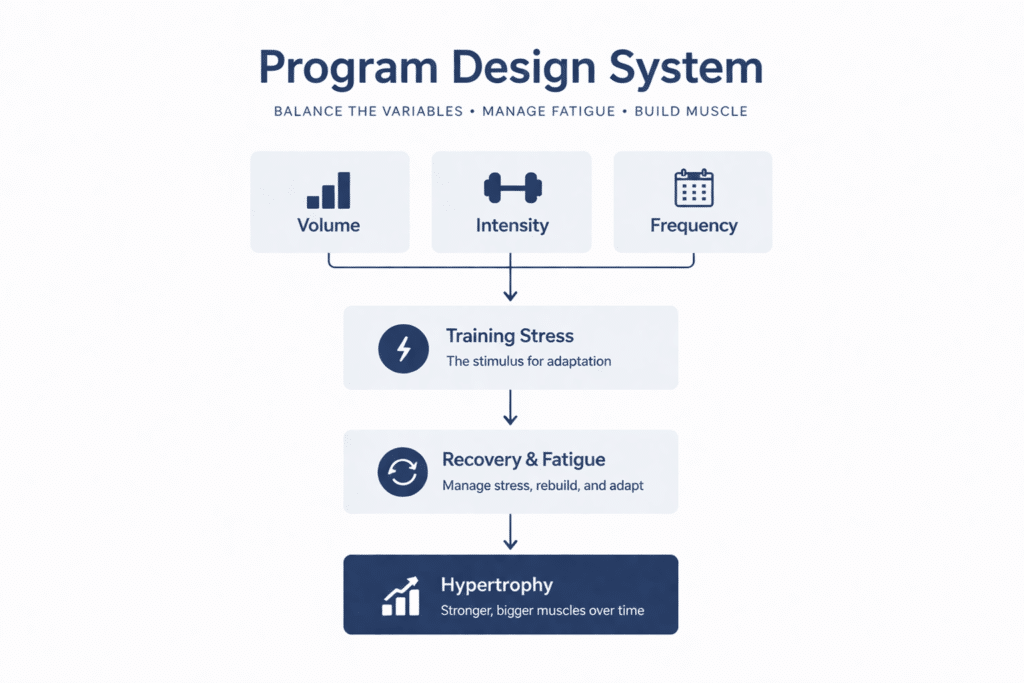
At its core, program design is about organizing a small number of variables that determine how much stimulus you apply, how that stimulus is distributed, and whether you can recover from it.
These variables do not work in isolation. Their interaction determines whether a program leads to consistent hypertrophy or stagnation.
Understanding the relationship between volume and intensity is essential.
Volume
Volume refers to the total amount of hard work performed, typically measured as sets per muscle group per week.
It is one of the most reliable drivers of hypertrophy. Increasing volume generally increases growth — but only up to the point where recovery can still be maintained.
Beyond that point, additional volume produces more fatigue than useful stimulus.
This is why volume should not be treated as a fixed target, but as a range that is adjusted based on performance and recovery. Concepts like minimum effective volume and maximum recoverable volume help define this range in practice.
This is where concepts like minimum effective volume become important.
Intensity
In hypertrophy training, intensity is best understood as a combination of load and effort.
Muscle growth can occur across a wide range of loads, provided that sets are sufficiently challenging. This makes hypertrophy more flexible than strength-specific training.
However, intensity still affects fatigue. Training very close to failure across many sets can limit how much total volume you can recover from.
Program design is therefore about balancing effort and volume — not maximizing either in isolation.
Frequency
Frequency refers to how often a muscle group is trained within a given timeframe.
Its primary role is to distribute volume in a way that maintains performance and reduces fatigue per session.
When weekly volume is equated, higher frequency does not consistently produce greater hypertrophy on its own. This is why comparing approaches like full body vs upper/lower becomes relevant in practice. More advanced structures such as push/pull/legs can also be used to distribute volume differently.
This is where your training split becomes important in practice.
Exercise Selection
Exercise selection determines how a muscle is trained and how much fatigue is generated relative to the stimulus.
A good program includes exercises that:
- allow consistent progression
- target the intended muscle effectively
- can be performed with stable technique
- do not generate excessive fatigue relative to their benefit
Rather than searching for the “best” exercises, the goal is to build a set of movements that work well together and can be progressed over time.
Progression
Progression is what allows a program to continue producing hypertrophy over time.
Without progression, the body adapts to a given level of stress and growth slows.
Progression can take several forms:
- increasing load
- performing more reps
- increasing volume
- improving execution
The key is that the overall stimulus gradually increases while remaining recoverable.
How Volume, Intensity, and Frequency Work Together
This is the core of program design.
Volume, intensity, and frequency are not independent variables. They interact.
Increasing volume often requires adjusting intensity or frequency to remain recoverable. High intensity can reduce the amount of volume you can sustain. Frequency helps distribute workload and maintain performance.
A useful way to think about it:
- Volume drives much of the hypertrophy stimulus
- Intensity determines how demanding that stimulus is
- Frequency organizes how that work is distributed
Two programs can have identical weekly volume but produce very different results depending on how these variables are combined.
Exercise Selection: Choosing Movements That Fit the Goal
Exercise selection is where theory meets practice.
A hypertrophy program does not require perfect exercises. It requires exercises that you can perform well, progress consistently, and recover from.
When selecting exercises, consider:
- Does this movement effectively train the target muscle?
- Can it be progressed over time?
- Is it limited by the target muscle or by something else?
- Does it create useful fatigue or unnecessary fatigue?
Consistency matters more than constant variation.
Progression: How a Program Produces Growth Over Time
Progression turns training into a long-term growth process.
For hypertrophy, progression is not always linear or obvious. It often occurs gradually through improved performance, increased workload tolerance, or better execution.
The key question is whether the program continues to provide a slightly greater effective stimulus over time.
Without progression, training becomes maintenance rather than growth.
Recovery and Fatigue: The Constraint Most Lifters Ignore
Program design is not just about creating stimulus. It is about managing fatigue.
Fatigue accumulates from volume, intensity, exercise selection, and overall workload. If fatigue exceeds your ability to recover, performance declines and progress stalls.
This is why hypertrophy is constrained by recovery, not just effort.
Managing fatigue includes:
- controlling total volume
- distributing workload across sessions
- selecting appropriate exercises
- allowing sufficient rest
This is also where concepts like MRV, local vs systemic fatigue, and central vs peripheral fatigue become important.
How to Design a Hypertrophy Training Program (Step-by-Step)
- Choose a training frequency you can sustain
- Select exercises for each muscle group
- Set a starting volume that is challenging but recoverable
- Define effort and rep ranges
- Plan progression over time
- Monitor fatigue and adjust
This framework provides structure while allowing flexibility based on individual response.
Even the best-designed training program depends on adequate nutrition. Use our free Macro Calculator to estimate your daily calorie, protein, carbohydrate, and fat targets so your diet supports your training and recovery goals.
Common Hypertrophy Program Design Mistakes
- Starting with too much volume
- Treating frequency as a primary growth driver
- Assuming only one rep range builds muscle
- Changing exercises too frequently
- Ignoring fatigue until progress stalls
Why It Matters: Good Programs Make Progress Predictable
The main advantage of good program design is predictability.
When volume, intensity, frequency, exercise selection, progression, and recovery are organized correctly, training becomes easier to interpret and adjust.
You understand what drives progress, when to push, and when to recover.
That is the difference between random training and structured hypertrophy programming.
References
Schoenfeld BJ (2010). The mechanisms of muscle hypertrophy and their application to resistance training.
https://pubmed.ncbi.nlm.nih.gov/20847704/
Schoenfeld BJ et al. (2019). Effects of resistance training frequency on muscle hypertrophy.
https://pubmed.ncbi.nlm.nih.gov/30558493/
Schoenfeld BJ et al. (2017). Resistance training load and hypertrophy.
https://pubmed.ncbi.nlm.nih.gov/28834797/
Schoenfeld BJ et al. (2016). Dose-response relationship between resistance training volume and muscle hypertrophy.
https://pubmed.ncbi.nlm.nih.gov/27433992/