Full Body vs Upper/Lower: Which Split Is Better?
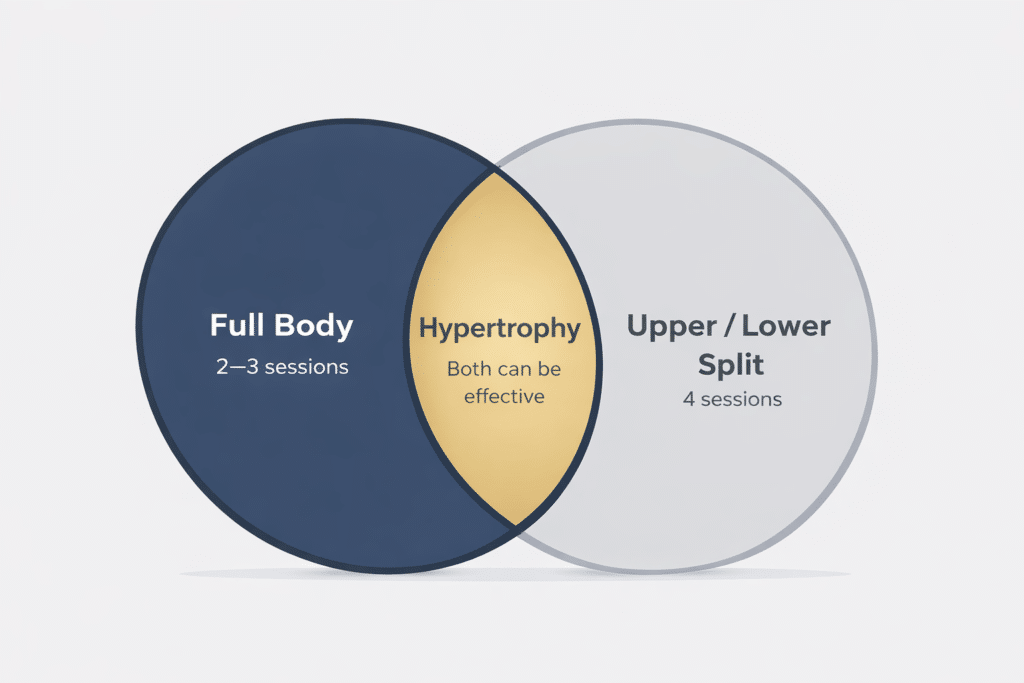
A training split does not build muscle by itself. It organizes exercises, weekly volume and recovery. The better choice is the structure that fits your available days and lets you repeat high-quality training.
Full Body vs Upper/Lower at a Glance
| Question | Full body | Upper/lower |
|---|---|---|
| Common weekly schedule | 2–3 sessions | 4 sessions |
| Muscle frequency | Usually 2–3 exposures | Usually 2 exposures |
| Work per muscle per session | Usually lower | Usually higher |
| Session focus | Many muscle groups each workout | Upper or lower body |
| Main practical strength | Efficient use of fewer training days | More exercise room and focus per region |
| Main practical limitation | Sessions may become long when weekly volume is high | A missed workout can disrupt the weekly balance more |
These are common implementations, not rules. A split can be modified in many ways. What matters is whether it distributes your required training volume into sessions you can perform and recover from.
What Does the Research Show?
A 2024 systematic review and meta-analysis examined full-body and split routines across 14 studies involving 392 participants. It found no meaningful difference in strength or hypertrophy when training volume was equated.
That supports a practical conclusion: preference, schedule and programme quality can drive the choice. It does not mean every full-body programme is identical to every upper/lower programme. Exercise selection, set effort, frequency and recovery can still differ substantially.
When Full-Body Training Is a Good Choice
In a full-body routine, most major muscle groups are trained in the same session. This does not mean performing several exercises for every muscle each time. A well-designed session may use one movement or a small dose for each region.
Choose full body when…
You can reliably train two or three days per week, prefer frequent practice or want each workout to cover the whole body.
Watch for…
Long sessions, too many exercises, accumulated systemic fatigue or later exercises suffering because everything is trained together.
Full-body training is often useful for beginners, but it is not a beginner-only split. Experienced lifters can also use it effectively when they control per-session volume and rotate exercise emphasis. If full body fits your schedule, learn how to build an effective full-body program with complete 2- and 3-day examples.
When Upper/Lower Is a Good Choice
An upper/lower split alternates workouts for the upper and lower body. A four-day version commonly trains each region twice per week, creating more space for exercises without needing to train every muscle in every session.
Choose upper/lower when…
You can consistently train four days, want more exercise variety per region or find full-body workouts too long.
Watch for…
Very demanding leg days, excessive per-session volume or scheduling problems when four visits are difficult to maintain.
Upper/lower does not automatically improve recovery. Concentrating too much work into one lower-body session can create more local fatigue than distributing those sets across full-body days.
Example Weekly Schedules
| Day | Three-day full body | Four-day upper/lower |
|---|---|---|
| Monday | Full Body A | Upper A |
| Tuesday | Rest | Lower A |
| Wednesday | Full Body B | Rest |
| Thursday | Rest | Upper B |
| Friday | Full Body C | Lower B |
| Weekend | Rest or flexible activity | Rest or flexible activity |
Both examples can train each muscle multiple times per week. Frequency is useful primarily because it distributes volume; it is not a guarantee of additional growth. See the complete guide to training frequency for hypertrophy.
How to Choose the Better Split for You
Base the split on the schedule you can repeat, not an ideal week.
Check whether each muscle receives enough productive work without overloaded sessions.
Keep the split while performance, recovery and motivation remain productive.
| Your main constraint | Likely starting choice | Why |
|---|---|---|
| Only two reliable training days | Full body | Both sessions can cover every major muscle. |
| Three reliable days | Full body | Simple frequency and volume distribution. |
| Four reliable days | Upper/lower | Natural balance of two upper and two lower sessions. |
| Full-body sessions have become too long | Upper/lower | Creates more room for exercise selection per region. |
| Severe soreness after concentrated leg days | Full body or lower-volume lower sessions | Can distribute lower-body work across the week. |
When Should You Change Splits?
Do not switch because one format is described as more advanced. Change when the current structure creates a practical problem: sessions no longer fit your schedule, performance falls late in workouts, required volume cannot be distributed well, or recovery between sessions becomes unreliable.
Before changing the entire routine, consider whether fewer exercises, different exercise order or a small volume adjustment solves the problem. Read the broader guide to choosing a training split for hypertrophy.
Frequently Asked Questions
Is full body or upper/lower better for hypertrophy?
Neither is inherently better. When weekly training volume is comparable, both can produce similar hypertrophy. Choose according to schedule, exercise needs and recovery.
Is full-body training enough to build muscle?
Yes. A full-body routine can provide sufficient weekly sets and challenging training for every major muscle group.
Is upper/lower good for beginners?
Yes, if four weekly sessions fit the person’s schedule. Beginners do not need a particular split; they need a manageable programme they can perform consistently.
Can you alternate full body and upper/lower?
Hybrid schedules can work, provided weekly volume, exercise overlap and recovery are planned coherently. The labels matter less than the resulting programme.
References
- Ramos-Campo DJ et al. Efficacy of Split Versus Full-Body Resistance Training on Strength and Muscle Growth: A Systematic Review With Meta-Analysis. J Strength Cond Res. 2024. PubMed.
- Pedersen H et al. A randomized trial on the efficacy of split-body versus full-body resistance training in non-resistance trained women. 2022. Full text.
- Schoenfeld BJ et al. Effects of resistance training frequency on measures of muscle hypertrophy: a systematic review and meta-analysis. Sports Med. 2019. PubMed.