Push Pull Legs Workout: A Practical Program for Muscle Growth
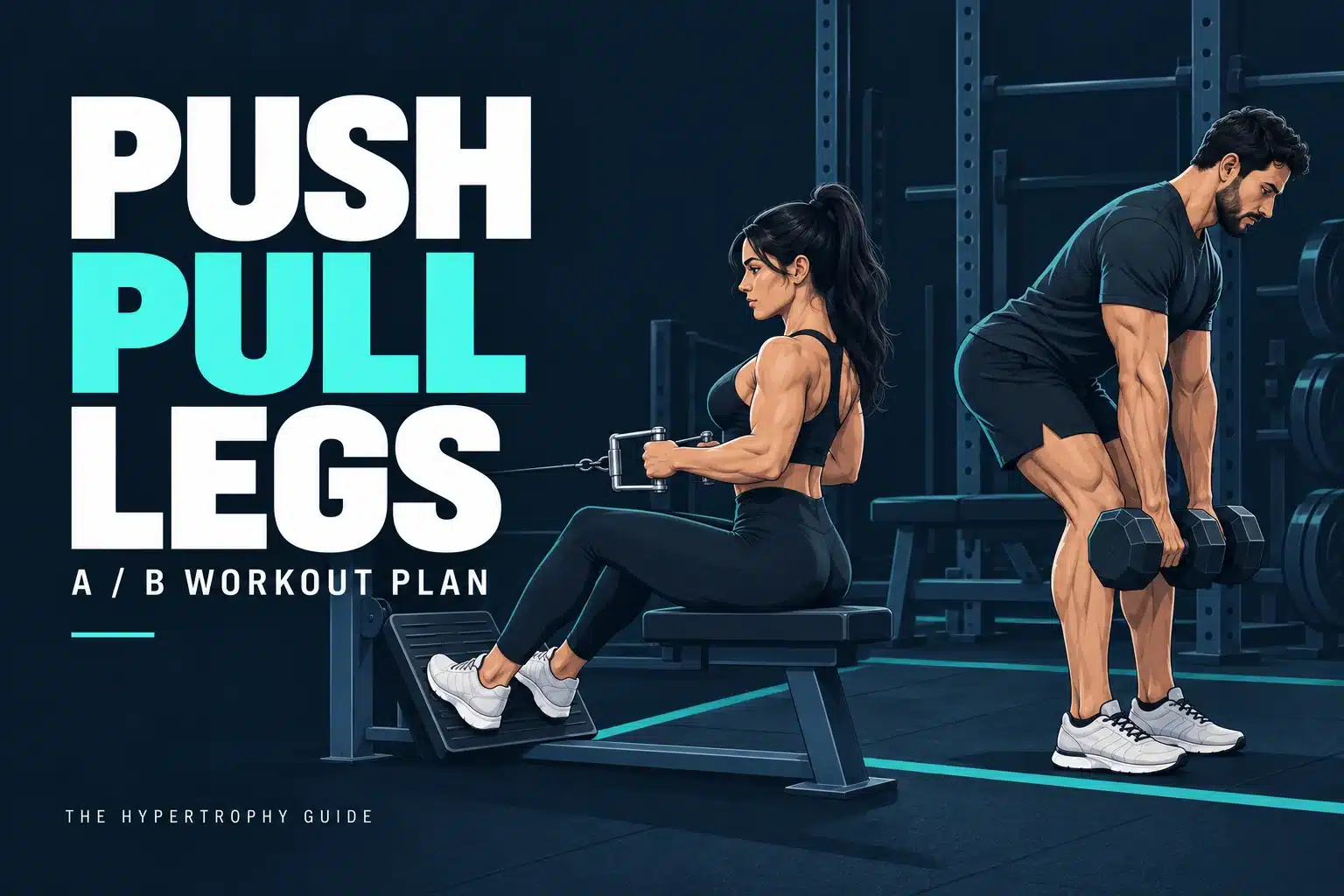
A useful push pull legs program gives you more than a list of exercises. You need a schedule you can keep, a manageable number of hard sets and a clear rule for progressing. Below, you will find six A/B workouts, a three-day option and a way to spread the sessions over more than seven days.
Is Push Pull Legs Good for Hypertrophy?
Yes. PPL can organise productive training, but the split itself does not make your muscles grow faster. A 2024 meta-analysis found similar strength and muscle growth from split and full-body routines when training volume was matched. That supports choosing a structure you can follow; it does not prove that every PPL program is equally effective.1
PPL is a sensible option when you like concentrating on a few muscle groups per session, have regular gym access and can recover from the amount of work you choose. You do not have to “graduate” from full-body to upper/lower and then to PPL. An experienced lifter can continue progressing with a simpler split.
If you are learning the main lifts, have only a few reliable training days or often miss sessions, distributing your work differently may be easier. The full-body vs upper/lower guide helps you compare those options.
That is a coaching preference about fitting training into a week, not a claim that three-day PPL cannot build muscle.
Choose Your PPL Schedule First
Sample weeks and rotations
The weekdays below are examples. Move them to fit your schedule while keeping the session sequence and planned rest days.
A push session includes presses and shoulder/triceps work. A pull session includes rows, vertical pulls and biceps work. Leg sessions cover knee-dominant work, a hip hinge or other hip-extension work, leg curls and calves. These categories overlap: pressing trains the triceps, and pulling trains the biceps.
| Schedule | Example | Main muscle-group exposure |
|---|---|---|
| 3 days per week | Mon Push · Wed Pull · Fri Legs | About once per week |
| 6 days per week | Mon Push A · Tue Pull A · Wed Legs A · Thu Push B · Fri Pull B · Sat Legs B · Sun Rest | About twice per week |
| 6 sessions over 8 days | Push A · Pull A · Legs A · Rest · Push B · Pull B · Legs B · Rest | Twice every 8 days; about 1.75 times per 7 days |
| 5-day hybrid | Mon Push · Tue Pull · Wed Legs · Thu Rest · Fri Upper · Sat Lower · Sun Rest | About twice per week with appropriate upper/lower sessions |
A rolling five-day PPL is different from a five-day hybrid. If you simply continue Push → Pull → Legs across five training days each week, each session averages 5 ÷ 3 = 1.67 appearances per week. It does not automatically train every muscle twice each week.
Frequency helps distribute work. A 2019 meta-analysis found no meaningful hypertrophy advantage from higher frequency when volume was equated. A newer dose–response analysis likewise found that the independent frequency effect on hypertrophy was compatible with negligible effects.23 That does not make scheduling irrelevant: spreading your sets can still help you fit them into sessions you can perform well.
For six days: use the A/B workouts below
Follow Push A, Pull A, Legs A, Push B, Pull B, Legs B, then rest. Six consecutive training days are a scheduling option, not a target to force. If that arrangement is difficult to sustain, use the eight-day rotation or choose fewer weekly sessions.
For three days: start with the A workouts
Use Push A on Monday, Pull A on Wednesday and Legs A on Friday, repeating those sessions each week. This is a lower-volume starting option, not a volume-matched version of the six-day plan. Do not combine A and B into one enormous session just to keep the same weekly set total.
Track whether you are progressing at that dose. If you need more work but your sessions are already losing quality, consider redistributing it across full-body sessions rather than extending each PPL day indefinitely.
For five days: the hybrid is a different arrangement
For all five workout tables and a seven- or eight-day schedule, use the upper/lower PPL hybrid guide. Its sample cycle starts with Upper and Lower. To compare other schedules, browse the workout program library.
Push, Pull, Legs, Rest, Upper, Lower, Rest gives you two upper-body and two lower-body exposures across the week. The upper session should contain a manageable selection of pressing and pulling; it should not combine the entire Push B and Pull B workouts. Use the program design guide to distribute the workload. The six tables below are the PPL plan, not a separate five-day hybrid prescription.
The Push Pull Legs Workout Program
This is a practical gym template for lifters who already know the exercises and can judge their effort. The exact combination has not been tested as a research intervention. Sets, rep ranges and exercise choices are starting prescriptions that you adjust to your training history.
The rest periods and exercise organisation follow common hypertrophy programming guidance, rather than a unique PPL formula.5 For the effort targets, research links closer proximity to failure with greater hypertrophy on average, but the exact optimal distance remains uncertain.4 You do not need to force failure on every exercise.
Push A
| Exercise | Sets | Reps | RIR |
|---|---|---|---|
| Bench press | 3 | 6–10 | 2 |
| Incline dumbbell press | 2 | 8–12 | 1–2 |
| Cable lateral raise | 3 | 12–20 | 1–2 |
| Cable triceps pushdown | 2 | 10–15 | 1–2 |
Start with the flat press while fresh, then use a smaller dose of incline work. Keep your setup and range of motion consistent as you add reps.
Pull A
| Exercise | Sets | Reps | RIR |
|---|---|---|---|
| Lat pulldown | 3 | 8–12 | 1–2 |
| Seated cable row | 3 | 8–12 | 1–2 |
| Reverse pec deck | 2 | 12–20 | 1–2 |
| Cable or dumbbell curl | 2 | 10–15 | 1–2 |
One vertical pull and one row give this session its main back work. There is no need to add two more row variations simply because it is “back day.”
Legs A
| Exercise | Sets | Reps | RIR |
|---|---|---|---|
| Leg press | 3 | 8–12 | 2 |
| Romanian deadlift | 2 | 8–10 | 2–3 |
| Seated leg curl | 2 | 10–15 | 1–2 |
| Leg extension | 2 | 10–15 | 1–2 |
| Standing calf raise | 3 | 10–15 | 1–2 |
The leg press, hinge and leg curl cover different roles. Keep the Romanian deadlift controlled; reaching lower is not progress if your movement changes to get there.
Push B
| Exercise | Sets | Reps | RIR |
|---|---|---|---|
| Incline dumbbell press | 3 | 8–12 | 1–2 |
| Machine chest press | 2 | 10–15 | 1–2 |
| Seated machine shoulder press | 2 | 8–12 | 2 |
| Cable lateral raise | 3 | 12–20 | 1–2 |
| Overhead cable triceps extension | 2 | 10–15 | 1–2 |
The incline press comes first this time. If the combined pressing is too demanding, remove the two shoulder-press sets before adding more exercises. Your front delts already work during the chest presses.
Pull B
| Exercise | Sets | Reps | RIR |
|---|---|---|---|
| Chest-supported row | 3 | 8–12 | 1–2 |
| Lat pulldown | 2 | 10–15 | 1–2 |
| Reverse pec deck | 2 | 12–20 | 1–2 |
| Cable or dumbbell curl | 3 | 10–15 | 1–2 |
A supported row makes it easier to perform the intended movement without turning the session into extra unsupported hinging. Use a pulldown grip you can control comfortably.
Legs B
| Exercise | Sets | Reps | RIR |
|---|---|---|---|
| Bulgarian split squat | 3 | 8–12 each leg | 2 |
| Seated or lying leg curl | 3 | 10–15 | 1–2 |
| Leg press | 2 | 10–15 | 2 |
| Seated calf raise | 3 | 12–20 | 1–2 |
For split squats, three sets means three sets per leg. Rest enough between sides and sets to maintain control. For each leg, this counts as three local sets, not six.
If direct abdominal training is a priority, you can add two sets of a comfortable abdominal exercise after each leg session. Start without extra accessories if you are still finding a recoverable workload. These optional sets are not included in the totals above.
How much weekly work does this provide?
When all six sessions fit into seven days, the following are useful counts of the main targeted work. They are not a complete measure of every muscle’s stimulus.
| Area | Sets | How to interpret the count |
|---|---|---|
| Chest | 10 | Flat, incline and machine chest presses |
| Back | 11 | Rows and pulldowns; individual back muscles share the work differently |
| Quads | 10 | Leg presses, split squats and extensions |
| Hamstrings | 7 | Romanian deadlifts and leg curls |
| Side / rear delts | 6 / 4 | Lateral raises / reverse pec deck; additional overlap from other exercises |
| Biceps / triceps | 5 / 4 | Isolation sets only; pulling and pressing add indirect work |
| Calves | 6 | Standing and seated calf raises |
The program also includes two shoulder-press sets. Glutes contribute to the leg presses, split squats and Romanian deadlifts; their stimulus depends partly on execution. We have not assigned a precise glute total or counted every compound set as a full set for every involved muscle.
More weekly sets can support more growth, but returns diminish, and direct and indirect work should be distinguished.3 These numbers are a starting point, not minimum requirements or individual optima. On the eight-day rotation, the same sets are spread over eight days, so the average per seven days is lower.
How to Progress the Program
Use double progression: first improve your reps within the range, then increase the load. Keep the exercise, setup, range of motion and effort target comparable so the log tells you something useful.
- Choose a starting load. Reach at least the bottom of the rep range on each working set while leaving the prescribed RIR.
- Build reps over repeated sessions. You might progress from 10/9/8 to 11/10/9. You do not need identical reps across all sets.
- Add weight when all sets reach the top. For 3 × 8–12, wait until you can do 12/12/12 with the intended technique and RIR, then use the smallest practical increase.
- Build again at the new load. Reps may drop within the range. If they fall below it or you lose control, use a smaller increase or return to the previous load.
Example: on a machine row, you progress from 50 kg for 10/9/8 to 12/12/12 over several sessions at about 2 RIR. You then try the next small weight increment. This is an illustration of the rule, not a promise that progress will happen every week.
Log A and B sessions separately when rep ranges, exercise order or set counts differ. A stronger incline press at the start of Push B does not automatically mean you should match it after bench pressing in Push A. See progressive overload for the broader principle.
If progress stalls across several comparable sessions, check rest periods, technique, effort and recovery before adding sets. A single disappointing session is not a reason to replace the whole program.
How to Adjust PPL Without Losing the Structure
If you miss a workout
Continue with the next session in the sequence when you return. If you miss Legs A, do Legs A next rather than skipping it to restart with Push on Monday. Let the calendar move; do not squeeze two full sessions together to repay a training debt.
If six days leave you worn down
Look for a repeated pattern: falling performance, unusually difficult sessions, persistent soreness that changes your movement, or a workload that no longer fits your sleep and life. Check recent changes in training, food and stress as well as the split.
Reduce a few sets or remove a low-priority exercise, keep more reps in reserve, or add a rest day. The eight-day rotation is one simple way to space the same sessions out. For more detail, read recovery and muscle growth.
This does not mean a fourth exercise is automatically “junk volume.” The question is what it contributes in your program and whether you can repeat the work with useful effort and execution.
If the gym is busy or an exercise does not suit you
Replace the exercise’s role, then establish a new working load. Machine weight stacks and different implements are not directly interchangeable.
| Original role | Possible replacement | Keep in mind |
|---|---|---|
| Flat chest press | Dumbbell or machine chest press | Choose a comfortable setup and keep the prescribed sets/effort initially |
| Incline press | Incline machine press | Keep a similar pressing angle rather than automatically replacing it with an overhead press |
| Vertical pull | Assisted pull-up or another pulldown | Adjust assistance or load to stay in the rep range |
| Horizontal row | Chest-supported machine or dumbbell row | Use a repeatable path and controlled torso position |
| Knee-dominant leg exercise | Hack squat, leg press or supported split squat | Reassess load and fatigue; the movements are not mechanically identical |
| Romanian deadlift | Dumbbell Romanian deadlift | Keep the hip-hinge role; a leg curl alone does not replace it |
| Leg curl | Another seated or lying curl machine | Retain direct knee-flexion work |
Choose substitutions for comfort, access and a clear training purpose, then keep them stable long enough to evaluate progress. The exercise guides cover setup and technique for the linked movements.
Frequently Asked Questions
Can a three-day push pull legs split build muscle?
Yes. It can provide challenging work for each muscle group once per week. Whether it is enough depends on your training dose and response. The three-day option here uses the A workouts and contains less weekly volume than all six sessions. If you want to distribute work more evenly across three days, full-body is another practical option.
Do I need to train six days a week for PPL to work?
No. Six days let you repeat Push, Pull and Legs twice within seven days. You can also use three days or run the six sessions over a longer cycle. Match the schedule and workload to what you can actually sustain.
Is five-day PPL the same as PPL plus upper/lower?
No. Rolling PPL across five training days averages about 1.67 of each session per week. A Push/Pull/Legs/Upper/Lower hybrid can provide two weekly exposures for the main muscle groups, provided the upper and lower sessions include appropriate work.
Is PPL better than upper/lower?
There is no established universal winner. PPL offers more focused sessions; upper/lower may fit fewer training days more easily. Choose based on your schedule, enjoyment and ability to perform and recover from the planned work.
Should every PPL set go to failure?
No. The template uses roughly 1–3 RIR depending on the exercise. Keep sets challenging, but do not turn the final reps into a different movement. Failure on a selected isolation set is optional, not a requirement to complete the program.
Do deadlifts belong on pull day or leg day?
Either arrangement can be programmed, but this plan places Romanian deadlifts on Legs A. That keeps the hip-hinge workload visible alongside the other lower-body work. Adding heavy deadlifts to Pull A without changing anything else would increase the workload and could affect the next leg session.
How long should I follow this program?
Keep it long enough to compare repeated sessions. A six- to eight-week review point is a practical choice, not an expiry date. Continue when it fits your life and you are progressing; adjust sooner if an exercise hurts or the workload is clearly not manageable.
References
The studies inform the programming principles. The workout tables, schedules, substitutions and progression example are practical applications, not a clinically tested package. Coach notes are editorial adaptations of Alex’s own training experience and preferences.
- Ramos-Campo DJ, et al. Efficacy of Split Versus Full-Body Resistance Training on Strength and Muscle Growth: A Systematic Review With Meta-Analysis. Journal of Strength and Conditioning Research. 2024;38:1330–1340.
- Schoenfeld BJ, Grgic J, Krieger J. How many times per week should a muscle be trained to maximize muscle hypertrophy? A systematic review and meta-analysis of studies examining the effects of resistance training frequency. Journal of Sports Sciences. 2019;37:1286–1295.
- Pelland JC, et al. The Resistance Training Dose Response: Meta-Regressions Exploring the Effects of Weekly Volume and Frequency on Muscle Hypertrophy and Strength Gains. Sports Medicine. 2026;56:481–505. Published online 4 December 2025.
- Robinson ZP, et al. Exploring the Dose–Response Relationship Between Estimated Resistance Training Proximity to Failure, Strength Gain, and Muscle Hypertrophy: A Series of Meta-Regressions. Sports Medicine. 2024;54:2209–2231.
- Schoenfeld BJ, et al. Resistance Training Recommendations to Maximize Muscle Hypertrophy in an Athletic Population: Position Stand of the IUSCA. International Journal of Strength and Conditioning. 2021;1(1).