How Long Should a Hypertrophy Phase Last?
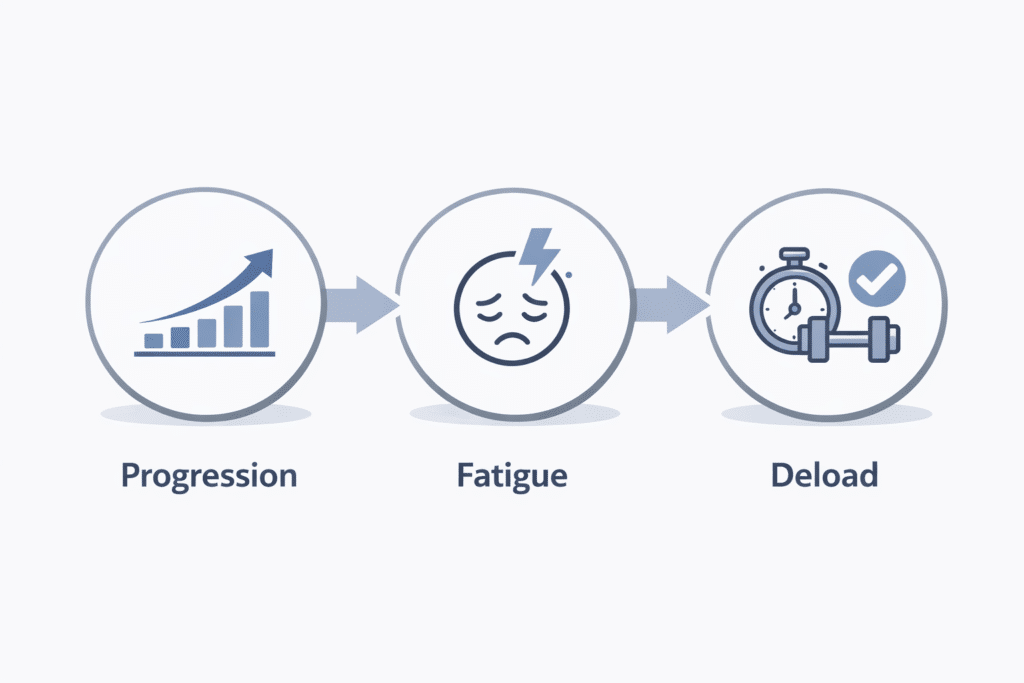
Hypertrophy phase length is often treated as a fixed number of weeks — but in practice, it depends on how fatigue, performance, and recovery evolve over time.
The goal of a hypertrophy phase is to accumulate productive training volume while staying within recoverable limits. This means the length of a phase is not determined by time alone, but by how long you can continue progressing before fatigue becomes limiting.
Understanding this allows you to structure training phases more effectively, rather than relying on arbitrary timelines.
TL;DR
- Most hypertrophy phases last 4–8 weeks
- Phase length depends on fatigue accumulation and recovery
- Progression should continue throughout the phase
- When performance declines, a deload or phase change is needed
- There is no fixed optimal duration for all lifters
Conceptual Foundation
A hypertrophy phase is a period of training focused on accumulating volume and driving muscle growth.
During this time, training stress gradually increases through higher volume, intensity, or effort. This progression creates the stimulus needed for adaptation, but it also leads to accumulating fatigue.
The key challenge is balancing these two factors. A phase should last long enough to generate meaningful adaptation, but not so long that fatigue reduces performance and limits further progress.
For this reason, hypertrophy phases are best understood as a balance between stimulus and recoverability, rather than a fixed timeline.
Evidence Review
Research does not support a single optimal phase length for hypertrophy. Instead, studies suggest that muscle growth depends on consistent training volume, sufficient intensity, and recovery over time.
In practice, this means that phase duration should be guided by performance trends rather than predetermined schedules.
As long as you are able to maintain or improve performance across exercises, the phase is likely still productive. When performance stagnates or declines, accumulated fatigue may be limiting further progress.
System-Level Implications
Short Phases (3–4 weeks)
- Lower fatigue accumulation
- May not fully exploit progression potential
- Useful during periods of higher stress or limited recovery
Moderate Phases (4–8 weeks)
- Balance between progression and fatigue
- Most common approach for hypertrophy
- Allows sufficient time for adaptation
Long Phases (8+ weeks)
- Higher total volume accumulation
- Greater risk of fatigue limiting performance
- Requires strong recovery capacity
The optimal phase length depends on how quickly fatigue accumulates relative to your ability to recover.
Practical Implementation
In most cases, a hypertrophy phase should continue as long as:
- Performance is stable or improving
- You can complete planned volume with good execution
- Fatigue is manageable between sessions
A phase should likely end when:
- Performance declines across multiple sessions
- Fatigue begins to reduce training quality
- Motivation or recovery becomes limiting
At this point, introducing a deload or transitioning to a new phase can restore performance and allow continued progress.
Why it matters:
Using a fixed timeline for hypertrophy phases can lead to ending productive training too early or continuing past the point where fatigue limits results.
By adjusting phase length based on performance and recovery, you can maintain higher training quality and accumulate more effective volume over time.
This leads to more consistent long-term muscle growth.
FAQ
How long should a hypertrophy phase last?
Most hypertrophy phases last between 4–8 weeks, but the optimal length depends on how well you recover and whether performance continues to improve.
When should you end a hypertrophy phase?
A hypertrophy phase should typically end when performance declines across multiple sessions or fatigue begins to reduce training quality.
Do you need to deload after every hypertrophy phase?
Not always, but a deload is often useful when accumulated fatigue limits performance and recovery.
References
- Schoenfeld BJ et al. (2019) — Meta-analysis on resistance training volume and muscle hypertrophy, supporting the role of progressive overload and accumulated training stress
- Schoenfeld BJ et al. (2016) — Review on training variables for hypertrophy, highlighting the importance of volume, intensity, and recovery over time