Citrulline Malate for Muscle Growth: Does It Really Work?
Citrulline malate for muscle growth has become one of the most popular topics in sports nutrition. Many pre-workout supplements claim it increases your pump, improves performance, and helps build muscle—but what does the research actually show?
Those claims sound highly relevant for muscle growth. If a supplement helps you perform more high-quality repetitions, maintain performance across sets, or recover more effectively between sessions, it could theoretically support hypertrophy over time.
However, a stronger pump does not automatically mean more muscle growth, and the research on citrulline malate is more mixed than supplement labels often suggest.
In this article, we will examine what citrulline malate is, how it may affect resistance training, whether it directly helps build muscle, and whether it is worth adding to your supplement routine.
Key Takeaways
- Citrulline may increase nitric oxide availability, which can improve blood flow and contribute to a stronger training pump.
- Citrulline malate may produce a small improvement in repetitions performed during demanding, high-volume resistance training, but results vary considerably between studies.
- It does not appear to reliably improve maximal strength in resistance-trained adults.
- There is not enough evidence to conclude that citrulline directly increases muscle hypertrophy.
- A practical dose is usually 6–8 grams of citrulline malate or approximately 3–6 grams of pure L-citrulline, taken around 45–60 minutes before training.
- Product quality matters because the actual citrulline content of citrulline malate depends on the citrulline-to-malate ratio.
What Is Citrulline Malate?
Citrulline malate is a combination of the amino acid L-citrulline and malic acid, also known as malate.
L-citrulline is a non-essential amino acid. This means your body can produce it naturally, although it can also be obtained through food and supplements. Watermelon is one of the best-known dietary sources.
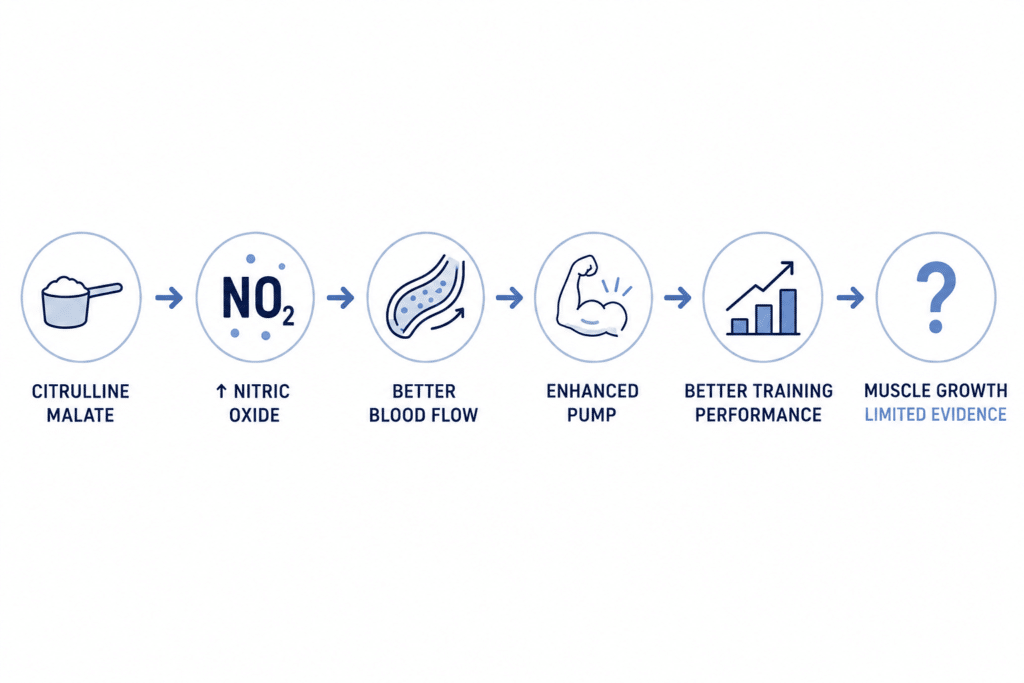
After ingestion, citrulline is converted into arginine in the kidneys. Arginine can then be used to produce nitric oxide, a signalling molecule involved in blood-vessel dilation and blood flow.
This pathway is one reason citrulline is often preferred over supplemental arginine. Oral citrulline generally raises circulating arginine more effectively because it avoids much of the intestinal and hepatic metabolism that limits arginine availability.
Malate is involved in cellular energy metabolism. It has therefore been proposed that combining citrulline with malate could provide additional performance benefits. However, it remains uncertain whether malate meaningfully improves the effects of citrulline in resistance-trained individuals.
L-Citrulline vs Citrulline Malate
The terms L-citrulline and citrulline malate are often used as though they were interchangeable, but they are not identical.
- L-citrulline contains only citrulline.
- Citrulline malate combines citrulline with malic acid.
The distinction matters because a gram of citrulline malate does not provide a full gram of citrulline.
For example, a genuine 2:1 citrulline-to-malate product would theoretically provide roughly two parts citrulline for every one part malate. An 8-gram serving would therefore contain approximately 5.3 grams of citrulline.
However, supplement labels do not always state the ratio clearly, and some commercial products may contain less citrulline than consumers expect.
A recent randomized crossover trial compared pure L-citrulline with citrulline malate while matching the actual citrulline dose. The results did not establish a clear additional performance benefit from malate, suggesting that citrulline itself may be the more important component.
How Could Citrulline Affect Resistance Training?
Citrulline could potentially support training through several mechanisms:
- Increasing circulating arginine
- Supporting nitric oxide production
- Increasing blood flow to active muscle
- Potentially improving nutrient and oxygen delivery
- Possibly assisting the removal of exercise-related metabolites
- Potentially delaying fatigue during repeated high-effort sets
These mechanisms are physiologically plausible. But a plausible mechanism is not enough by itself. The relevant question is whether these effects produce a meaningful and repeatable improvement in real hypertrophy training.
Does Citrulline Malate Improve the Muscle Pump?
Citrulline is strongly associated with the training pump because nitric oxide can promote vasodilation and increase blood flow.
Some users notice fuller muscles, increased vascularity, or a stronger sensation of swelling during training after taking citrulline. This is plausible, particularly when citrulline is combined with a carbohydrate-containing meal, adequate hydration, sufficient sodium, and higher-repetition training.
However, the pump is influenced by many variables, including:
- Exercise selection
- Repetition range
- Rest periods
- Carbohydrate availability
- Hydration and sodium intake
- Training volume
- Individual responsiveness
A better pump may make a workout feel more productive and could provide useful feedback that the intended muscle is working. But it should not be treated as direct evidence that more hypertrophy has occurred.
I noticed this effect myself when I used pre-workout more regularly. I often experienced a much stronger pump—especially during arm training—and that made the session more enjoyable. On some days, I willingly performed an extra set simply because I wanted to keep the pump going. Today, without pre-workout, I am sometimes more tempted to skip the arm work at the end of an upper-body session.
I cannot attribute that difference specifically to citrulline. The pre-workout contained multiple ingredients, and hydration, sodium, carbohydrates, caffeine, the training itself, and expectation may all have contributed. But the experience taught me that a supplement can affect training indirectly: not because the pump automatically builds muscle, but because enjoying the session may change how much effort or work you are willing to perform.
I have also recommended pre-workout to clients—particularly men who enjoy the combination of pump and focus. The caution is that the ritual can become a psychological requirement. If you begin to believe you cannot train properly without pre-workout, part of the benefit may come from expectation rather than the ingredients alone. Stimulant-containing products add a separate concern because regular caffeine use can lead to tolerance and physical dependence.
Important: A muscle pump reflects an acute increase in blood flow and fluid within the muscle. Muscle hypertrophy is a long-term structural adaptation. The two are not the same outcome.
Does Citrulline Malate Improve Repetitions and Muscular Endurance?
This is where citrulline malate has its strongest evidence.
A systematic review and meta-analysis of double-blind, placebo-controlled trials found that consuming 6–8 grams of citrulline malate approximately 40–60 minutes before resistance training produced a small increase in total repetitions performed.
Across the included studies, participants completed approximately three additional repetitions in total, corresponding to an average improvement of roughly 6%.
That does not necessarily mean three extra repetitions on every set. The advantage, when present, often appears later in a demanding training protocol as fatigue begins to accumulate.
This may be more relevant during sessions involving:
- Multiple hard sets
- Moderate-to-high repetitions
- Short or moderate rest periods
- Sets taken close to muscular failure
- High total training volume
Several individual studies have reported improved repetition performance during bench pressing, leg pressing, hack squatting, and other repeated-set protocols.
However, the evidence is inconsistent. Other controlled trials have found no meaningful improvement in repetitions, power output, muscle swelling, perceived exertion, or soreness.
The most accurate conclusion is therefore not that citrulline always improves muscular endurance. It is that it may produce a small improvement under some conditions, especially during fatiguing, high-volume resistance training. This is the most plausible indirect case for citrulline malate for muscle growth, but the effect is still small and inconsistent.
Does Citrulline Malate Improve Strength?
Citrulline malate does not appear to reliably improve maximal strength.
A meta-analysis examining strength outcomes in resistance-trained adults found no significant overall benefit for either upper-body or lower-body strength.
This makes sense when considering the proposed mechanism. Improved blood flow or fatigue resistance may be more useful during repeated submaximal work than during a single maximal-effort repetition.
In practical terms, citrulline is unlikely to produce an obvious acute increase in your one-repetition maximum.
If your primary goal is maximal strength, factors such as an effective training program, technical proficiency, sufficient rest, carbohydrate intake, caffeine, and creatine are likely to be more influential.
Does Citrulline Malate Build Muscle?
There is currently insufficient evidence to conclude that citrulline malate for muscle growth directly increases muscle hypertrophy in healthy resistance-trained adults.
Most citrulline research measures acute outcomes such as:
- Total repetitions
- Blood flow
- Nitric oxide metabolites
- Power output
- Perceived exertion
- Muscle soreness
These outcomes can provide useful information, but they are not the same as measuring changes in muscle size over several months.
A supplement could indirectly contribute to hypertrophy if it consistently helps a lifter perform more productive training volume. But this requires several assumptions:
- The supplement must reliably improve performance.
- The additional work must provide a meaningful hypertrophic stimulus.
- The lifter must recover from the additional work.
- The effect must persist across many weeks or months.
At present, that full chain has not been demonstrated convincingly for citrulline malate.
One longer-term trial reported changes in lean mass when resistance training was combined with citrulline-containing supplementation. However, the study included different supplement combinations and does not provide strong evidence that ordinary citrulline malate independently increases hypertrophy.
Therefore, citrulline should be viewed as a possible training-performance supplement, not as a direct muscle-building supplement.
Can a Better Pump Lead to More Muscle Growth?
The relationship between the pump and muscle growth is frequently oversimplified.
Cell swelling has been proposed as one potential anabolic signal, and exercises that create a strong pump can certainly be effective for hypertrophy. However, it is difficult to isolate the independent contribution of the pump from the effects of muscular tension, proximity to failure, exercise volume, and metabolite accumulation.
A strong pump may accompany effective hypertrophy training, but it is neither necessary nor sufficient for muscle growth.
You can build substantial muscle with exercises that do not produce an extreme pump, and you can create an enormous pump with light, low-tension work that provides a relatively weak hypertrophic stimulus.
The practical priority remains:
- Training the target muscle through an appropriate range of motion
- Using stable exercises that allow high force production
- Performing sufficient hard sets
- Training reasonably close to failure
- Applying progressive overload over time
Citrulline may enhance the sensation of the pump, but it does not replace these fundamentals.
Does Citrulline Reduce Muscle Soreness?
Some studies have reported lower muscle soreness after citrulline malate supplementation, while others have found no meaningful effect.
The inconsistent findings make it difficult to recommend citrulline primarily as a recovery supplement.
Even when soreness is reduced, this does not necessarily indicate faster muscle repair or improved adaptation. Delayed-onset muscle soreness is an imperfect measure of recovery and should not be treated as a direct indicator of muscle damage or readiness to train.
For recovery and muscle growth, the main priorities remain:
- Adequate sleep
- Sufficient calories
- Adequate protein
- Appropriate training volume
- Reasonable fatigue management
- Time between demanding sessions
How Much Citrulline Malate Should You Take?
The most commonly studied acute dose is:
- 6–8 grams of citrulline malate
- Taken approximately 40–60 minutes before training
For pure L-citrulline, commonly used doses are approximately:
- 3–6 grams before training
Some newer research has used higher amounts, but more is not automatically better. Higher doses can increase cost and the risk of gastrointestinal discomfort without guaranteeing a larger performance benefit.
Because citrulline malate products vary in ratio and purity, check whether the label identifies:
- The total amount of citrulline malate
- The citrulline-to-malate ratio
- The actual amount of L-citrulline per serving
A product providing 8 grams of an unclear proprietary blend may not deliver the same citrulline dose as 8 grams of a verified 2:1 formula.
When Should You Take Citrulline?
Most acute performance studies provide citrulline approximately 40–60 minutes before exercise.
A practical recommendation is therefore:
Take it around 45–60 minutes before your first working set.
It can be consumed with or without food. However, a large meal immediately before training may slow digestion and make it more difficult to judge the supplement’s effects.
If you experience stomach discomfort, try:
- Starting with a lower dose
- Mixing it with more water
- Taking it slightly earlier
- Avoiding a large pre-workout meal
- Using pure L-citrulline instead of a large dose of citrulline malate
Do You Need to Take Citrulline Every Day?
Citrulline is commonly used acutely before training rather than through a traditional loading phase.
You do not need to take it every day to potentially benefit from its pre-workout effects.
Some studies have investigated daily supplementation over several weeks, but the long-term performance and hypertrophy advantages remain uncertain.
For most lifters, using it before selected training sessions is a more practical approach than taking it every day.
For example, you may choose to use citrulline before:
- High-volume leg sessions
- Upper-body hypertrophy sessions
- Workouts with several sets close to failure
- Sessions where maintaining repetition performance is important
Does Citrulline Work Better With Caffeine?
Citrulline and caffeine affect performance through different mechanisms.
- Caffeine primarily influences the central nervous system, alertness, perceived effort, and performance.
- Citrulline is more closely associated with blood flow and potential fatigue resistance.
In theory, they can be combined. However, controlled research does not clearly show that adding citrulline to caffeine consistently improves resistance-training performance beyond caffeine alone.
Caffeine currently has a stronger and more consistent evidence base for acute strength and exercise performance.
If you already use caffeine, add citrulline only if you want to test whether it provides an additional benefit for your own training. Do not assume that a larger ingredient list automatically produces a better pre-workout.
Citrulline Malate vs Creatine
Citrulline malate and creatine serve different purposes.
| Supplement | Primary Role | Evidence for Strength | Evidence for Hypertrophy | Typical Use |
|---|---|---|---|---|
| Creatine | Supports rapid energy production and training performance | Strong | Strong when combined with resistance training | Daily supplementation |
| Citrulline malate | May support blood flow and repeated-set performance | Weak or inconsistent | Insufficient direct evidence | Usually taken before training |
If you are choosing only one supplement for muscle growth and strength, creatine is the much stronger choice.
Citrulline is better viewed as an optional addition after the fundamentals and higher-priority supplements are already covered.
Who Might Benefit Most From Citrulline?
Citrulline may be most useful for lifters who:
- Perform relatively high training volumes
- Use moderate-to-high repetition ranges
- Train close to muscular failure
- Want to maintain repetitions across several hard sets
- Enjoy a stronger pump during training
- Do not tolerate large amounts of caffeine
- Want a non-stimulant pre-workout ingredient
It may be less useful for lifters who:
- Primarily perform low-repetition strength work
- Complete only a few working sets per session
- Already struggle to recover from their current volume
- Expect a dramatic or immediate increase in strength
- Have not yet optimized training, sleep, calories, or protein
Is Citrulline Malate Safe?
Citrulline is generally well tolerated at commonly studied doses.
The most likely side effect is gastrointestinal discomfort, particularly at higher doses. This may include:
- Nausea
- Stomach cramping
- Bloating
- Loose stools
Because citrulline can influence blood flow and blood pressure, people using blood-pressure medication, nitrate medication, or medication for erectile dysfunction should consult a qualified healthcare professional before using it.
Pregnant or breastfeeding individuals and people with relevant cardiovascular, kidney, or metabolic conditions should also seek professional guidance before supplementation.
Is Citrulline Malate Worth It?
Citrulline malate is a reasonable but non-essential supplement.
It may provide a small performance benefit during demanding, high-volume resistance training, particularly by helping some lifters complete slightly more work before fatigue.
However:
- The effect is not consistent across all studies.
- The average improvement appears small.
- It does not reliably increase maximal strength.
- It has not been shown convincingly to directly increase hypertrophy.
- Commercial products vary in citrulline content and quality.
If your budget is limited, prioritize:
- A well-designed resistance-training program
- Adequate calories and protein
- Sleep and recovery
- Creatine monohydrate
- Caffeine, when appropriate and well tolerated
Once those factors are covered, citrulline can be tested as an optional pre-workout ingredient. Overall, the evidence for citrulline malate for muscle growth is indirect rather than conclusive.
The Bottom Line
Citrulline malate can increase blood flow and may slightly improve repetition performance during high-volume resistance training.
However, it does not reliably improve maximal strength, and there is currently insufficient evidence that it directly increases muscle growth.
A stronger pump may improve the training experience, but it should not be confused with a stronger hypertrophic stimulus.
For most lifters, citrulline malate is best viewed as an optional, lower-priority supplement—not a foundational requirement for building muscle.
Frequently Asked Questions
Does citrulline malate directly build muscle?
There is not enough evidence to conclude that citrulline malate directly increases muscle hypertrophy. It may indirectly support training by slightly improving repetition performance in some workouts.
Does citrulline give you a better pump?
It can increase nitric oxide availability and blood flow, which may contribute to a stronger pump. The magnitude of the effect varies between individuals.
How much citrulline malate should I take?
Most resistance-training studies use 6–8 grams approximately 40–60 minutes before exercise. Check the product’s citrulline-to-malate ratio because the total product weight is not the same as the amount of actual citrulline.
Is L-citrulline better than citrulline malate?
Pure L-citrulline provides a more transparent citrulline dose. It remains unclear whether malate adds a meaningful performance benefit when citrulline intake is matched.
Should I take citrulline on rest days?
Probably not, unless you are following a specific daily protocol. Most lifters use it only before training because the main proposed benefit is acute exercise performance.
Is citrulline better than creatine?
No. Creatine has much stronger evidence for increasing strength, training performance, lean mass, and muscle growth over time. Citrulline is an optional pre-workout supplement.
Can I combine citrulline with caffeine and creatine?
Yes, these supplements are commonly combined because they act through different mechanisms. However, combining more ingredients does not guarantee a larger performance improvement.
References
-
Trexler ET, Persky AM, Ryan ED, Schwartz TA, Stoner L, Smith-Ryan AE.
Acute effects of citrulline supplementation on high-intensity strength and power performance: a systematic review and meta-analysis.
Sports Medicine. -
Vårvik FT, Bjørnsen T, Gonzalez AM.
Acute effect of citrulline malate on repetition performance during strength training: a systematic review and meta-analysis.
International Journal of Sport Nutrition and Exercise Metabolism.
PubMed -
Rhim HC, Kim SJ, Park J, Jang KM.
Effects of citrulline malate supplementation on muscle strength in resistance-trained adults: a systematic review and meta-analysis of randomized controlled trials.
Journal of Functional Morphology and Kinesiology.
PubMed -
Pérez-Guisado J, Jakeman PM.
Citrulline malate enhances athletic anaerobic performance and relieves muscle soreness.
Journal of Strength and Conditioning Research.
PubMed -
Wax B, Kavazis AN, Weldon K, Sperlak J.
Effects of supplemental citrulline malate ingestion during repeated bouts of lower-body exercise in advanced weightlifters.
Journal of Strength and Conditioning Research.
PubMed -
Glenn JM, Gray M, Jensen A, et al.
Acute citrulline malate supplementation improves upper- and lower-body submaximal weightlifting exercise performance in resistance-trained females.
European Journal of Nutrition.
PubMed -
Gonzalez AM, Spitz RW, Ghigiarelli JJ, Sell KM, Mangine GT.
Acute effect of citrulline malate supplementation on upper-body resistance exercise performance in recreationally resistance-trained men.
Journal of Strength and Conditioning Research.
PubMed -
Fickling J, Allwood DM, Chappell A, Simper T.
Citrulline malate supplementation does not improve German Volume Training performance or reduce muscle soreness in moderately trained males and females.
Journal of the International Society of Sports Nutrition.
PubMed -
Chappell AJ, Allwood DM, Simper TN.
Citrulline malate fails to improve German Volume Training performance in healthy young men and women.
Journal of Dietary Supplements.
PubMed -
Martín-Olmedo JJ, et al.
Malate or not? Acute effects of L-citrulline versus citrulline malate on neuromuscular performance in young, trained adults.
International Journal of Sport Nutrition and Exercise Metabolism.
PubMed -
Bayat D, Azizi M, Behpour N, Tinsley GM.
Changes in resistance training performance, rating of perceived exertion, and blood biomarkers after six weeks of supplementation with L-citrulline versus L-citrulline DL-malate in resistance-trained men.
Journal of the International Society of Sports Nutrition.
PubMed