Minimum Effective Volume (MEV): How Many Sets Do You Need?
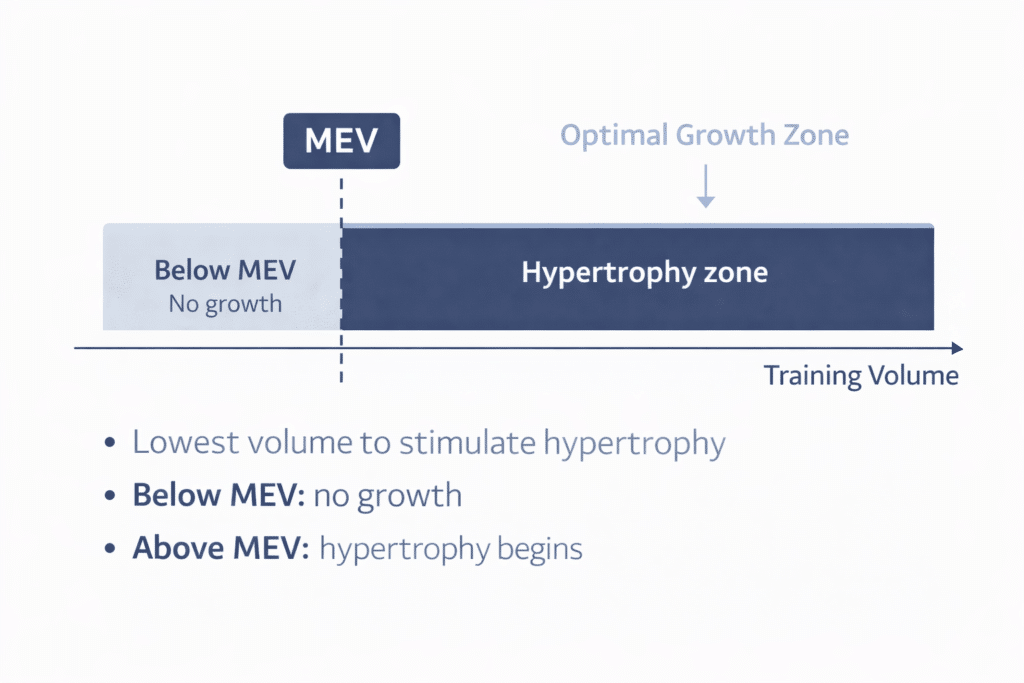
Minimum effective volume (MEV) for hypertrophy refers to the minimum number of sets needed to stimulate muscle growth.
Understanding MEV helps lifters identify the point where training becomes productive — before additional volume starts providing diminishing returns, which is why learning how to determine your optimal training volume is essential.
TL;DR
- Minimum Effective Volume (MEV) is the lowest training volume that produces muscle growth.
- Below MEV → maintenance or no meaningful adaptation.
- At or slightly above MEV → hypertrophy begins.
- More volume is not automatically better.
- MEV shifts depending on training experience, recovery, and calorie intake.
What Is Minimum Effective Volume?
Minimum effective volume for hypertrophy describes the smallest number of hard sets per muscle group per week that leads to measurable increases in muscle size.
If you train below your MEV, you are likely maintaining muscle rather than building it. If you train at or slightly above it, hypertrophy begins.
MEV is not a universal number. It depends on:
- Training age
- Muscle group
- Training intensity and proximity to failure
- Sleep and stress
- Energy availability
These factors also influence how much muscle you can realistically gain over time.
For a beginner, MEV may be relatively low. For an advanced lifter, it is often meaningfully higher.
For a deeper breakdown of how volume interacts with load and effort, see our article on Volume vs Intensity for Hypertrophy.
The Conceptual Foundation
Hypertrophy is primarily driven by mechanical tension, sufficient volume, and proximity to failure.
Training volume is typically measured as hard sets per muscle group per week. Meta-analyses show a clear dose-response relationship between weekly set volume and muscle growth, at least up to a point.
However, growth does not occur linearly from zero. There is a lower threshold where stimulus becomes sufficient to trigger adaptation. That threshold is what we refer to as minimum effective volume.
Below it, stimulus is insufficient.
Above it, muscle growth begins.
Importantly, volume only matters if sets are sufficiently challenging. Rest periods between sets also influence how much effective volume you can accumulate across a session. Sets performed far from failure likely do not count meaningfully toward MEV.
Example MEV Ranges (Starting Points)
- Chest: ~8–12 sets/week
- Back: ~10–14 sets/week
- Quads: ~8–12 sets/week
- Shoulders: ~6–10 sets/week
These are general starting points and will vary based on training status, recovery capacity, and exercise selection.
In practice, this is often implemented through your training split for hypertrophy.
While MEV represents the minimum stimulus required for growth, excessive training volume can eventually become counterproductive. At higher volumes, fatigue is not always limited to the working muscles, but can accumulate as broader systemic fatigue that affects overall performance.
To understand why only sufficiently challenging sets contribute to minimum effective volume for hypertrophy, see our breakdown of effective reps for hypertrophy.
This range only makes sense when volume is properly structured within a hypertrophy training program.
What Does Research Suggest?
Research does not explicitly define MEV, but we can infer it from volume-response studies.
Evidence suggests:
- Around 4–6 hard weekly sets per muscle may stimulate growth in beginners
- Around 8–10 sets are often required for trained individuals
- Advanced lifters may require 10–15+ weekly sets
A meta-analysis by Schoenfeld et al. (2017) showed that performing more than 10 weekly sets per muscle produced greater hypertrophy compared to fewer sets.
This does not mean 10 sets is the minimum effective volume. It simply shows that growth increases as volume increases within a recoverable range.
MEV is the lowest point at which progress begins — not the point of maximal growth.
MEV vs Optimal Volume vs MRV
It is important to distinguish between different volume landmarks:
- Minimum Effective Volume (MEV): the lowest growth threshold
- Optimal volume: the best stimulus-to-fatigue ratio
- Maximum Recoverable Volume (MRV): the highest volume you can recover from
Training at MEV is efficient but typically produces slower gains.
Training closer to optimal volume produces faster progress while remaining sustainable.
At the other end of the spectrum is maximum recoverable volume (MRV) — the highest amount of training volume you can perform while still recovering and making progress. Training near MRV produces high fatigue and requires structured deload periods.
Confusing these landmarks is one of the most common programming errors.
How Many Sets Per Week Is Minimum Effective Volume?
For most lifters, MEV typically falls around 6–10 hard sets per muscle group per week, although the exact number varies based on training experience, recovery capacity, and exercise selection.
How to Estimate Your MEV
There is no calculator for MEV. It must be detected through performance trends.
A practical framework:
- Start with a conservative weekly volume, such as 6–8 sets per muscle.
- Train sets within 0–3 reps in reserve (RIR).
- Track load or rep progression weekly.
- At these lower volumes, performance is rarely limited by central fatigue mechanisms, as overall fatigue levels remain relatively low.
- If performance improves consistently, you are at or above MEV.
- If progress stalls for multiple weeks, volume may be below MEV.
Signs you may be below MEV:
- No strength progression
- No visible hypertrophy over time
- Minimal training stimulus
Signs you are likely above MEV:
- Gradual performance increases
- Manageable fatigue
- Predictable recovery between sessions
System-Level Implications
Minimum effective volume for hypertrophy is not static.
It shifts depending on:
- Calorie intake
- Sleep quality
- Psychological stress
- Exercise selection
- Training frequency
During a calorie deficit, MEV may increase slightly because recovery capacity is reduced.
During a well-fed, low-stress surplus phase, MEV may decrease slightly relative to total adaptive potential.
This dynamic nature is why structured mesocycles outperform fixed programs.
Because recovery capacity determines how much volume you can benefit from, fatigue management becomes central to long-term hypertrophy.
Why It Matters:
Many lifters either train far below MEV and see no progress, or push volume too high and accumulate unnecessary fatigue.
Understanding minimum effective volume allows you to:
- Train efficiently
- Avoid junk volume
- Structure progression logically
- Scale volume across mesocycles
Long-term hypertrophy is not about doing more. It is about doing enough.
However, “enough” depends on both weekly volume and the quality of each set. For more, see our guide on training intensity for hypertrophy.
Minimum effective volume is only one part of a larger system that determines muscle growth over time.
This concept is part of a broader framework explained in our hypertrophy training guide.
Practical Implementation
General starting ranges:
- Beginner: 6–8 weekly sets per muscle
- Intermediate: 8–12 weekly sets
- Advanced: 10–15+ weekly sets
Increase volume only if:
- Performance stalls
- Recovery remains strong
- Sleep and nutrition are adequate
Volume should be adjusted gradually, not dramatically.
FAQ
How many sets per week is minimum effective volume for hypertrophy?
Minimum effective volume typically begins around 4–6 hard sets per muscle per week for beginners and may be higher for trained individuals depending on recovery capacity and training intensity.
Is minimum effective volume enough for optimal muscle growth?
Training at minimum effective volume can stimulate growth, but higher volumes within a recoverable range generally produce faster hypertrophy over time.
Does minimum effective volume increase as you gain experience?
Yes. As training experience increases and adaptation occurs, the volume required to stimulate measurable muscle growth may gradually rise.
Can you build muscle training at MEV?
Yes. Training at minimum effective volume can build muscle, but progress is typically slower than training closer to your optimal volume. MEV represents the lowest volume threshold that reliably stimulates hypertrophy.
References
Schoenfeld BJ, Ogborn D, Krieger JW.
Dose-response relationship between weekly resistance training volume and increases in muscle mass.
J Sports Sci. 2017.
https://pubmed.ncbi.nlm.nih.gov/27433992/
Schoenfeld BJ, Grgic J, Ogborn D, Krieger JW.
Strength and hypertrophy adaptations between low- vs high-load resistance training.
J Strength Cond Res. 2017.
https://pubmed.ncbi.nlm.nih.gov/25853914/
Baz-Valle E et al.
A Systematic Review of the Effects of Different Resistance Training Volumes on Muscle Hypertrophy.
Sports Med. 2022.
https://pubmed.ncbi.nlm.nih.gov/35291645/