Range of Motion for Muscle Growth
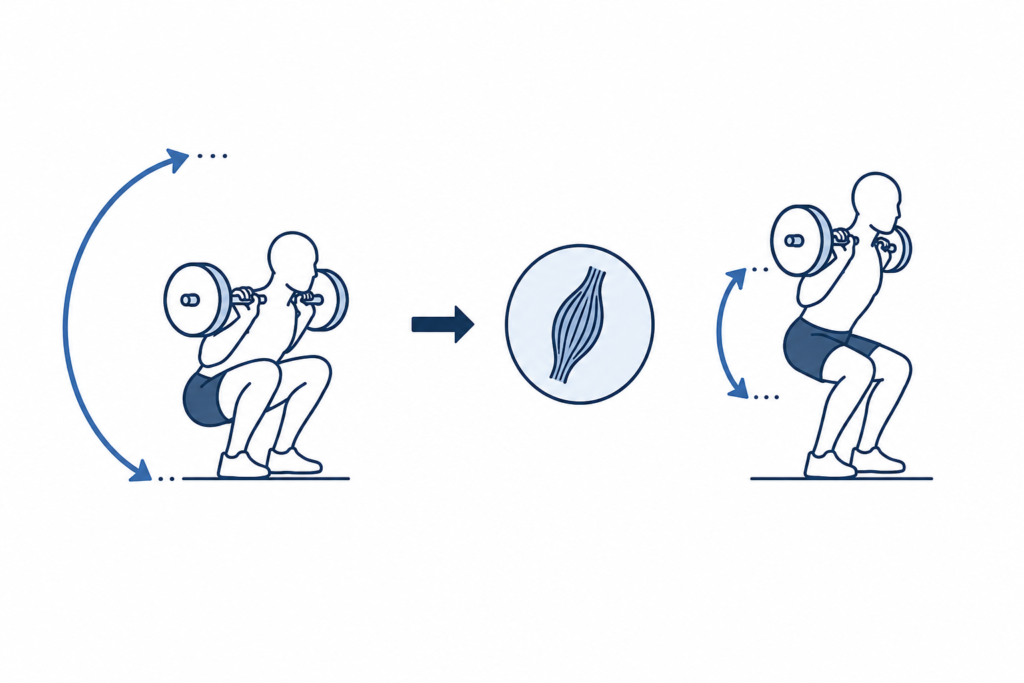
Range of motion for muscle growth is one of the most debated topics in hypertrophy training. Some lifters argue that every repetition should be performed through the largest possible range of motion, while others believe partial repetitions are equally effective.
As with many topics in hypertrophy, the answer is more nuanced.
In general, training through a larger range of motion tends to produce greater muscle growth. However, this does not mean that every exercise should always be performed through the absolute maximum range possible.
The goal is not to maximize range of motion for its own sake. The goal is to maximize productive tension on the target muscle.
TL;DR
- A larger range of motion generally leads to greater muscle growth.
- Training muscles at longer muscle lengths appears particularly beneficial for hypertrophy.
- Partial repetitions can still build muscle when performed with sufficient effort.
- The best range of motion depends on the exercise, the target muscle, and individual anatomy.
- Most hypertrophy exercises should be performed through the largest pain-free and stable range of motion possible.
What Is Range of Motion?
Range of motion (ROM) refers to the distance and joint excursion covered during an exercise repetition.
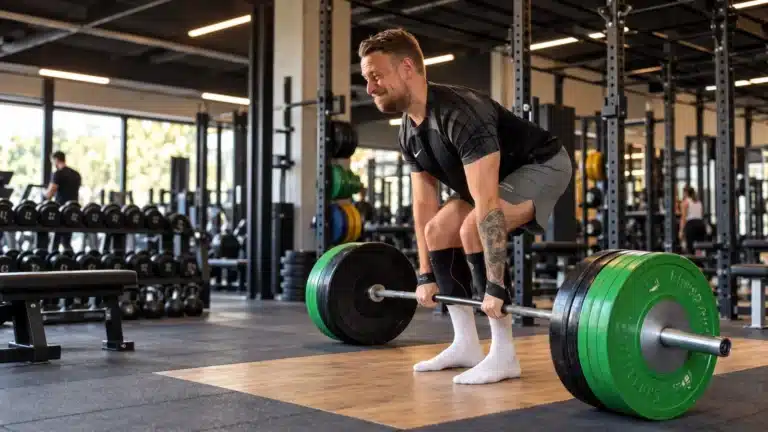
For example, a full squat typically involves descending until the hips are at least below knee level before standing back up. A partial squat only covers part of that movement.
Range of motion exists on a continuum rather than as a strict full-versus-partial distinction.
Examples include:
- Full squat vs half squat
- Deep dumbbell press vs shortened press
- Full ROM biceps curl vs top-half curl
- Deep leg press vs shortened leg press
Exercise selection should therefore consider not only the movement itself but also how much of the muscle’s functional range is being trained. For a broader framework, see How to Choose Exercises for Muscle Growth.
Why Range of Motion Matters for Hypertrophy
Muscle growth is primarily driven by mechanical tension. A larger range of motion often exposes the muscle to tension across a greater portion of its functional length.
This appears especially important when the muscle is trained in a lengthened position.
Emerging evidence suggests that exercises emphasizing long muscle lengths may produce superior hypertrophy compared to exercises performed only in shortened positions.
However, more range is not automatically better if stability deteriorates or if the target muscle is no longer the limiting factor.
Does a Full Range of Motion Build More Muscle?
Overall, the research suggests that full range of motion training generally produces greater hypertrophy than partial range of motion training.
Meta-analyses comparing full and partial ROM have consistently found advantages for full ROM in many muscle groups, particularly for lower-body exercises.
This does not mean partial repetitions are useless. Partial repetitions can still produce significant muscle growth when sets are performed close to failure and sufficient tension is applied.
The key distinction is that full ROM often provides a larger hypertrophic stimulus per repetition.
Importantly, “full” should not be interpreted as maximizing joint excursion at all costs. Instead, lifters should aim for the largest stable and pain-free range that effectively loads the target muscle.
What Does the Research Show?
Current evidence generally favors full ROM training for hypertrophy.
Several studies have shown superior muscle growth when exercises are performed through a full range of motion compared to partial ROM alone. This effect appears particularly pronounced when the muscle is challenged at longer lengths.
That said, recent research has also shown that partial repetitions performed in the lengthened portion of an exercise may be highly effective. This has contributed to growing interest in techniques such as lengthened partials for muscle growth.
Because the literature is still evolving, it is probably premature to conclude that all partial training is inferior.
For now, the evidence supports full ROM as the default approach for most hypertrophy training.
When More Range of Motion Is Beneficial
Increasing ROM is usually beneficial when:
- The target muscle remains the limiting factor.
- The exercise remains stable and repeatable.
- No pain or joint irritation occurs.
- The increased ROM allows greater loading at long muscle lengths.
Examples include:
- Deep squats for quadriceps and glutes.
- Deficit Romanian deadlifts for the posterior chain.
- Deep dumbbell presses for the chest.
- Overhead cable triceps extensions emphasizing stretch.
Exercise choice also matters. Certain machine and free-weight exercises may allow different ranges of motion while still effectively loading the target muscle. See Free Weights vs Machines for Muscle Growth for more.
When Partial Range of Motion Can Make Sense
Partial repetitions are not inherently inferior.
They may be useful when:
- Joint discomfort limits full ROM.
- The goal is to overload a specific portion of the strength curve.
- Additional volume is desired without excessive fatigue.
- Lengthened partials are intentionally programmed.
For example, performing lengthened partial lateral raises after full-ROM repetitions may increase total stimulus while maintaining tension on the side delts.
Similarly, advanced lifters sometimes use partial repetitions to extend a set beyond conventional failure.
As with all hypertrophy techniques, these methods should complement rather than replace high-quality full-ROM training.
System-Level Implications
The relationship between range of motion and hypertrophy highlights an important principle:
The most difficult exercise variation is not always the most effective.
A larger ROM only improves hypertrophy if it increases productive tension on the target muscle.
If increasing ROM introduces excessive instability, coordination demands, or fatigue, the net hypertrophic stimulus may actually decrease.
This is why exercise categories such as compound and isolation exercises should be evaluated based on stimulus quality rather than ideology.
Likewise, effort still matters. Regardless of ROM, sets generally need to be performed sufficiently close to failure to maximize hypertrophy. For more, see Reps in Reserve (RIR) for Hypertrophy and Effective Reps for Hypertrophy.
Practical Implementation
For most lifters, the following guidelines work well:
- Use full ROM as the default approach.
- Prioritize stable, repeatable technique.
- Train through the largest pain-free range possible.
- Consider partial repetitions as an advanced supplementary tool.
- Evaluate whether increased ROM actually improves target-muscle stimulus.
Examples:
- Perform deep leg presses if quad tension remains high.
- Use a full stretch during chest presses when shoulder comfort allows.
- Use partial lateral raises only as an accessory technique rather than the primary exercise.
Volume still matters. If ROM changes substantially alter exercise difficulty, total weekly volume may need adjustment. See How Many Sets Per Muscle Group Per Week? and Volume vs Intensity for Hypertrophy.
Why It Matters:
Many lifters unknowingly reduce hypertrophy potential by consistently shortening exercises, bouncing repetitions, or avoiding challenging stretched positions.
On the other hand, some lifters pursue extreme ROM variations that compromise stability or create unnecessary joint stress.
The evidence currently supports a simple strategy:
Perform most hypertrophy exercises through the largest stable, pain-free range of motion possible while maintaining high-quality tension on the target muscle.
Use partial repetitions strategically, not by default.
FAQ
Is full range of motion better for muscle growth?
In most cases, yes. Research generally shows superior hypertrophy with full ROM compared to partial ROM, especially when muscles are trained at longer lengths.
Can partial reps build muscle?
Yes. Partial repetitions can build muscle when performed with sufficient effort and tension. However, full ROM should usually remain the foundation of hypertrophy training.
Should every exercise use full range of motion?
No. Exercises should use the largest stable and pain-free range that effectively trains the target muscle. Individual anatomy and exercise selection matter.
Are lengthened partials effective for hypertrophy?
Current research suggests that lengthened partials may be highly effective, but full-ROM training remains the evidence-based default recommendation.
Does more range of motion always mean more muscle growth?
No. Increasing ROM is only beneficial if it increases productive tension on the target muscle without introducing excessive instability or discomfort.
References
- Nunes JP, et al. Does a Full Range of Motion Optimize Muscle Hypertrophy? A Systematic Review and Meta-Analysis. J Strength Cond Res. 2021.
- Kassiano W, et al. Does Varying Resistance Exercise Range of Motion Influence Muscle Hypertrophy? A Systematic Review. Eur J Sport Sci. 2021.
- Pinto RS, et al. Effect of Range of Motion on Muscle Strength and Thickness. J Strength Cond Res. 2012.
- Wolf R, et al. Effects of Resistance Training Performed to Repetition Failure or Non-Failure on Muscular Strength and Hypertrophy. Sports Med. 2021.
- Schoenfeld BJ, et al. Resistance Training Recommendations to Maximize Muscle Hypertrophy in an Athletic Population. Strength Cond J. 2021.