Machine Chest Press for Muscle Growth: Setup, Form & Reps
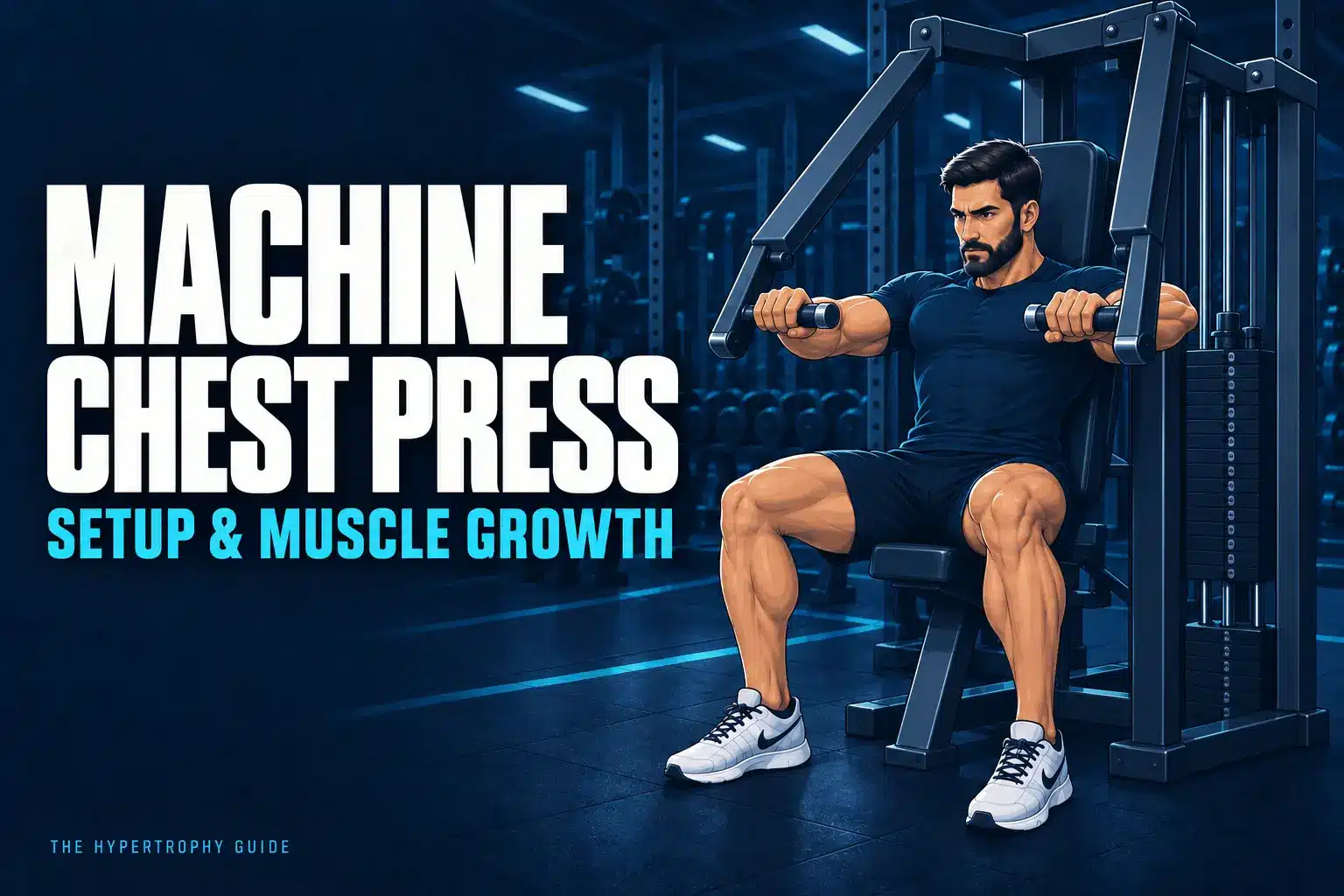
The machine chest press is a stable, scalable chest exercise that works especially well after a more technical compound press or when training time is limited. The best machine is the one whose handle path fits your shoulders and allows a controlled stretch.
How to Set Up a Chest-Press Machine
Set the seat so the handles line up around the middle of the chest rather than the neck or abdomen. Plant the feet, keep the pelvis and upper back supported and choose a grip that lets the forearms line up with the force of the machine.
I have used both neutral and overhand grips. The best option depends heavily on the brand and handle design, so use the position that feels most natural. A neutral grip is often worth trying when the shoulder is sensitive. I normally keep the elbows around 30-45 degrees from the torso.
How to Perform the Machine Chest Press
- Plant the feet and keep the hips and upper back against the pads.
- Stack the wrists over the forearms and keep the elbows below or slightly outside the shoulders.
- Press smoothly without shrugging or letting one side race ahead.
- Extend under control without slamming into the end of the machine.
- Return to the same comfortable depth without bouncing the stack.
Should the elbows stay tucked?
No fixed angle is mandatory. Keeping the elbows around 30-60 degrees from the torso is a practical range for many lifters. Forcing them against the body can reduce chest contribution, while flaring them straight out may feel uncomfortable.
How Deep Should You Go?
Use the deepest position in which the chest receives a useful stretch and the shoulders remain comfortable and organised. The shoulder blades can stay supported against the pad with a small natural arch. Stop before the shoulder rolls forward simply to create more handle travel.
I like a large controlled range, but some machines have an awkward start position or path. If the machine forces discomfort or makes it impossible to keep the shoulder organised, I would rather use dumbbells than fight the design.
Converging, Independent and Plate-Loaded Machines
I often place the machine after an incline press or overhead press. The first movement demands more technique and stability; the machine then lets the chest and triceps keep working hard. I also use machines during phases when the priority is getting in and out of the gym quickly, with pin-loaded versions preferred for convenience.
Machine Chest Press vs Bench Press
| Factor | Machine press | Barbell bench press |
|---|---|---|
| Stability | High; path largely fixed | Requires more whole-body setup |
| Failure safety | Usually easier to stop safely | Needs a spotter or safeties |
| Individual path | Depends on machine geometry | Lifter controls the bar path |
| Strength skill | Machine-specific | Useful standardised barbell skill |
Sets, Reps and Progression
| Use | Sets x reps | Effort | Rest |
|---|---|---|---|
| Main stable press | 3-4 x 6-10 | 1-3 RIR | 2-3 min |
| Secondary hypertrophy work | 2-4 x 8-15 | 0-3 RIR | 90-180 sec |
| Higher-rep finisher | 2-3 x 12-20 | 0-2 RIR | 60-120 sec |
I am more comfortable taking a machine press to failure than a barbell bench press because the set is safer to end. That does not mean every set needs failure. Zero to three RIR works well, with the final set being the most sensible place to push all the way.
Progress by adding reps without reducing depth or control, then move the pin or add the smallest plates. If wrist position becomes uncomfortable at heavy loads, review the handle choice first; wrist wraps are optional rather than a default requirement.
Common Mistakes
Frequently Asked Questions
Is the machine chest press good for building muscle?
Yes. It trains the same broad pressing muscles and provides stability that can make hard sets easier to execute.
Is it worse than bench press?
No. It is less useful for developing the barbell skill but can be equally practical for chest hypertrophy when it fits your body.
Can I train to failure?
Usually more safely than on a barbell bench, but failure still adds fatigue. Use it selectively, often on the final set.
Bottom Line
Adjust the machine to your structure, keep the elbows in a comfortable 30-60-degree path and use the deepest stable range available. A chest press machine is especially valuable after a technical free-weight press or whenever efficiency and safe hard sets are priorities.
References
- Pallares JG, et al. Effects of range of motion on resistance training adaptations. Scand J Med Sci Sports. 2020.
- Schoenfeld BJ, et al. Loading recommendations for muscle strength, hypertrophy, and local endurance. Sports. 2021.
- Refalo MC, et al. Influence of resistance training proximity-to-failure on skeletal muscle hypertrophy. Sports Med. 2023.