Can AI Plan a Realistic 45-Minute Workout? A Coach’s Review
An AI-generated 45-minute workout needs more than a short exercise list. It needs time for warm-up sets, recovery and the person occupying your next machine. Here is a five-exercise plan with a visible time budget and a prompt you can adapt.
The plan allocates 35 minutes to training and 10 minutes to a buffer. These are estimates, not measured results. I remember completing a previous session with this exercise combination in 43 minutes, including warm-up; I used a lateral-raise machine instead of dumbbells. This is retrospective personal experience, not a newly timed test of the AI-generated plan. This design does not establish that AI outperforms a human coach.
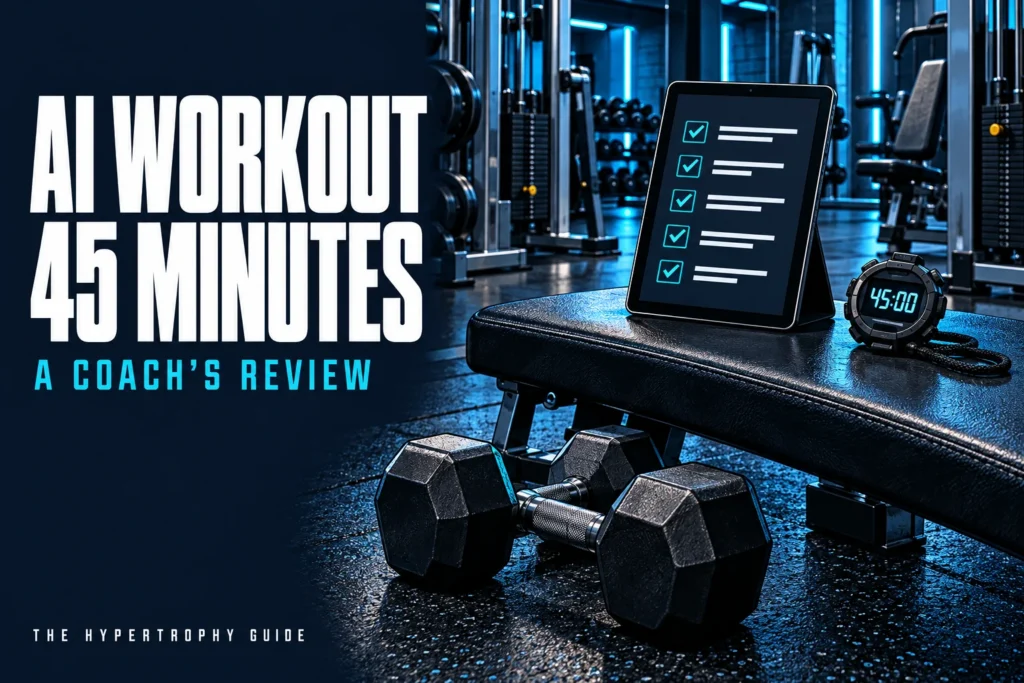
A 45-minute AI workout with five exercises
This example is for an experienced lifter using familiar machines and dumbbells. Use straight sets: finish both working sets before changing stations. Start with four minutes of easy cycling or walking and comfortable movement as needed.
| Exercise | Sets × reps | Effort | Rest | Estimated block |
|---|---|---|---|---|
| Pin-loaded leg press | 2 × 8–12 | 2–3 RIR | About 2 min; longer if needed | 4–12 min |
| Machine chest press | 2 × 6–10 | 2–3, then 1–2 RIR | 2 min | 12–19 min |
| Chest-supported machine row | 2 × 8–12 | 2–3, then 1–2 RIR | 2 min | 19–26 min |
| Seated leg curl | 2 × 10–15 | 1–2 RIR | 90 sec | 26–31 min |
| Dumbbell lateral raise | 2 × 12–20 | 1–2, then 0–1 RIR | 60–90 sec | 31–35 min |
RIR means repetitions in reserve: the additional reps you estimate you could perform with the same technique and range. Take longer rests when needed; the buffer allows for that.
The blocks include ramp-up sets. For leg press, use roughly eight easy reps, then three to five moderate reps. For press, use six to eight light reps and, if needed, another three to four moderate reps. For row and curl, start with one light set of approximately six to eight reps. Add preparation when needed, including a light lateral-raise set. Keep these sets non-fatiguing.
Alternatives include low-incline dumbbell press for 8–12 reps, seated cable row, and lying leg curl. Allow for their setup time. Record load, reps and RIR; increase load by the smallest practical increment when both sets reach the top of their range at the intended effort.
For the lateral-raise slot, a familiar machine is another option, as in my previous session. If you prefer cables, see our cable lateral raise guide; allow for cable setup and training each side when judging the time budget.
What I changed after reviewing the plan
I have used this exercise combination when busy or less motivated to train, with machine lateral raises in place of the dumbbell version listed here. I remember timing a previous session at 43 minutes including warm-up—two minutes inside the 45-minute target. This supports the plan’s practicality in my familiar gym conditions. It does not validate every estimated block or guarantee the same time in another gym.
- Leave room in the first set. I prefer 2–3 RIR on the first press and row set, often closer to three while calibrating the load, then 1–2 RIR on the second. On leg press, I prefer keeping 2–3 reps available; when getting used to the exercise again, around four may be a more suitable starting choice.
- Budget for the hardest transition: starting again. Leg press has often taken me the most time because of the mental effort of preparing for the next hard set. Two minutes is a starting point, not a deadline. I also allow one or two ramp-up sets on leg press and pressing.
- Make equipment choices practical. I favor pin-loaded machines when time is short because changing weight is simple. A seated cable row can replace the supported row. I personally enjoy incline pressing too, but changing to dumbbells requires time to collect them and set up a bench.
- Keep the small exercise small. I like 12–20 reps on lateral raises, usually resting about a minute. The closer-to-failure final set shown here reflects my preference on a familiar exercise; stop when the next rep would lose the intended technique. Replacing this slot with both biceps and triceps adds work and setup, so it is not automatically a time-equivalent swap.
I prefer seated leg curls for their feel and stretch, especially at 10–15 reps. That preference is not a claim that lying curls are unsafe. Although two working sets make me feel motivated to work harder, that psychological response does not establish that two harder sets always replace three sets.
Does the time budget survive a real gym?
The arithmetic is 4 + 8 + 7 + 7 + 5 + 4 = 35 minutes, plus a ten-minute buffer. Blocks include ordinary setup, logging and transitions. Most working sets are budgeted around 30–50 seconds, sometimes longer at higher reps. Repetitions should remain controlled rather than rushed.
Start the clock before warming up; stop after the final working repetition. Waiting and loading count. Changing and showering do not.
- Busy station: move to another available exercise from the plan or a familiar replacement. Log the change.
- Low-energy day: adjust load to preserve the planned RIR. A shorter session can use fewer sets rather than forcing failure.
- Running late: check at minute 35. If only lateral raises remain at minute 40, one good set is an option. Record the actual time or reduced workload; do not rush preparation.
Five exercises cover a knee-dominant movement, knee flexion, pressing, pulling and side-delt work. Arms work indirectly; calves and abs have no dedicated sets. There is no sixth exercise hidden in the timing. This is a useful limited session, not maximal coverage of every muscle.
A 2025 trial found improvements with one set of nine exercises twice weekly. It supports taking short sessions seriously, but did not compare higher volume or test this routine.[1] A smaller eight-week trial found similar quadriceps growth with failure and near-failure training; it does not establish a universal optimal RIR.[2]
Should you use supersets or alternating sets?
I usually prefer completing one exercise before moving on. When short on time, I have used alternating sets for biceps and triceps, with a pause between exercises; I find that more manageable for my breathing than immediately moving into a second exercise. I have not tested the press-and-row pairing below.
Straight sets need one station and few rules. Superset research suggests shorter sessions and broadly similar outcomes, often with higher perceived effort; protocols and evidence for individual outcomes vary.[3]
If adjacent press and row machines are freely available, warm up both and try: press → 45–60 seconds → row → 45–60 seconds → press → 45–60 seconds → row. Transitions are inside those gaps. Extend them when needed, and avoid occupying two stations while others wait.
With 40-second sets and 45-second gaps, this takes 4:55 and gives 2:10 recovery between sets of the same exercise. Straight sets with two-minute rests take 6:40, excluding the change between exercises. The modeled saving is about 1:45; setup can erase it.
Myo-reps and rest-pause are optional tools for another experiment. Two conventional sets already fit here. Jeff Nippard’s public minimalist-program description offers useful inspiration about fewer sets and practical substitutions; this independently designed session does not reproduce his paid program.
Copy this AI workout prompt
Replace every bracketed field. Select and copy the text into your preferred AI tool; on mobile, press and hold to select it. A good prompt supplies constraints, but the output still needs checking.
AI workout FAQ
Is this better than a human coach’s program?
That has not been tested here. AI can organize constraints and alternatives quickly. It cannot observe your technique, read your motivation reliably or know today’s gym layout unless you provide that information. Qualified coaching remains useful when those judgments matter.
Can I use it every week?
As a temporary routine, two non-consecutive sessions provide four direct weekly sets per listed exercise. Assess recovery and progression; this is not a promise of maximal growth. Adjust your existing workload rather than adding this session on top.
Use this as a busy-day fallback within your training. For a structured progression plan with exercise videos, explore the free eight-week full-body program. You do not need a different AI-generated routine every day.
References
- Hermann T, et al. Without Fail: Muscular Adaptations in Single-Set Resistance Training Performed to Failure or with Repetitions-in-Reserve. 2025. Eight weeks, 42 trained participants; no higher-volume comparison.
- Refalo MC, et al. Similar muscle hypertrophy following eight weeks of resistance training to momentary muscular failure or with repetitions-in-reserve in resistance-trained individuals. 2024. Eighteen participants; leg press and extension.
- Zhang X, et al. Superset Versus Traditional Resistance Training Prescriptions. 2025. Systematic review of 19 studies involving 313 participants.