Machine Chest Press for Muscle Growth: Setup, Form & Reps
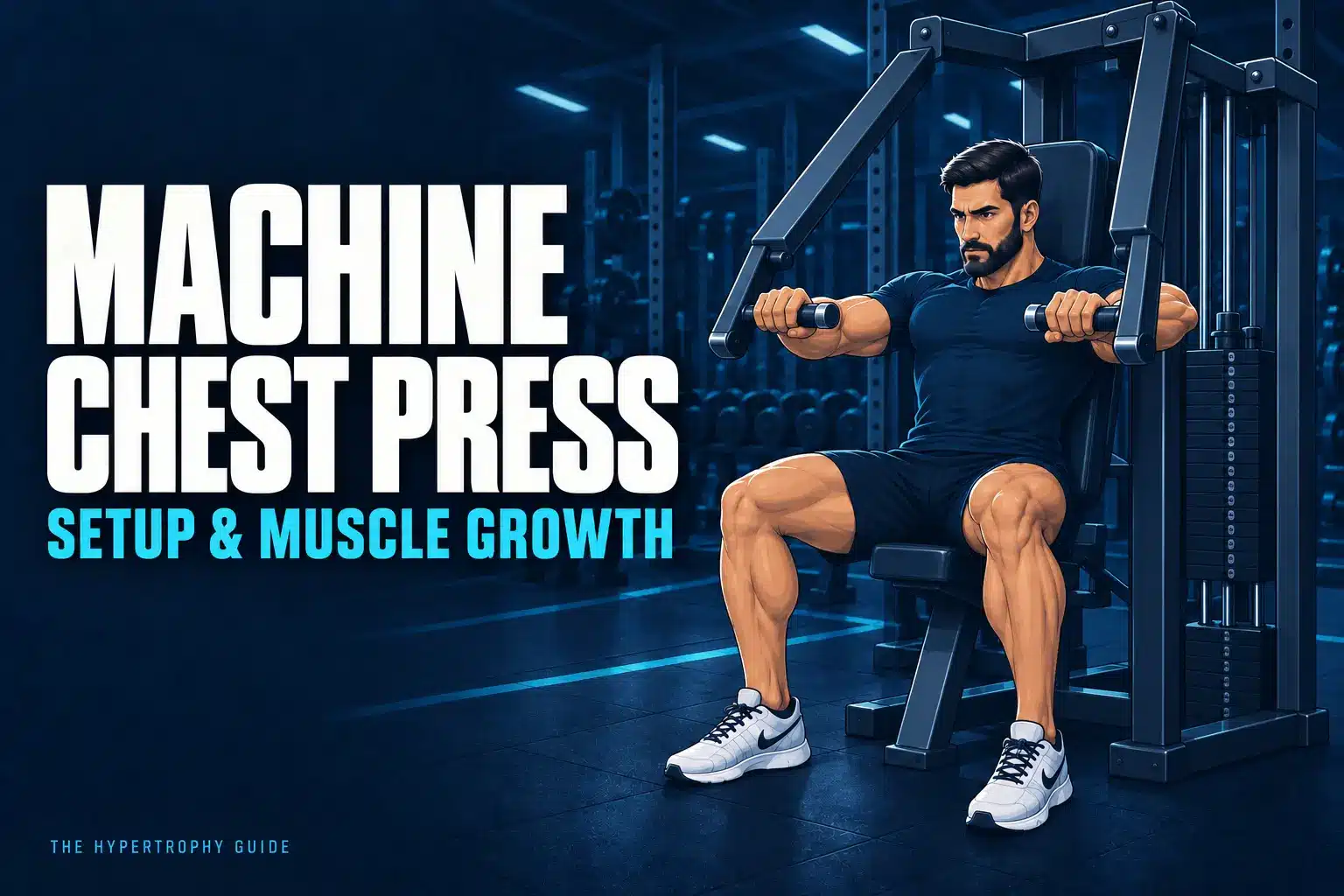
The machine chest press is not a beginner substitute for “real” pressing. Its stability can make it easier to train the chest hard, standardise technique and approach failure without being trapped under a bar.
How to Set Up a Chest-Press Machine
Machine design varies, so seat numbers cannot be copied between gyms. Use the relationship between your shoulder, elbow and handles rather than an arbitrary setting.
How to Perform the Machine Chest Press
- Set the load conservatively. Test the machine before committing to a hard first set.
- Plant your feet. Keep the pelvis and upper back in contact with the pads.
- Align the handles. Start around chest height with wrists stacked and elbows below or slightly outside the shoulders.
- Press smoothly. Drive the handles forward without shrugging or allowing one side to lead.
- Finish under control. Extend the elbows without forcefully slamming into lockout.
- Lower to the same depth. Let the chest and shoulder reach a comfortable stretch, then reverse without bouncing the stack.
Should the elbows stay tucked?
No fixed angle is mandatory. Keep the upper arms somewhere between tightly pinned and fully flared, then adjust according to handle path and comfort. The forearms should generally align with the direction of the handles rather than twisting against it.
How deep should you go?
Use the deepest range you can control while maintaining contact with the pad and a comfortable shoulder position. Evidence across resistance training generally supports meaningful ranges of motion, but anatomy and machine design determine the useful endpoint.1
Converging, Independent and Plate-Loaded Machines
| Design | Potential advantage | What to check |
|---|---|---|
| Converging handles | Hands travel slightly inward during the press | Whether the convergence matches your arm length |
| Independent arms | Each side works without one handle masking asymmetry | Whether both arms begin at the same depth |
| Fixed linked handles | Very stable and simple to load | Whether the fixed path is comfortable |
| Plate loaded | Large loading range and familiar increments | Whether resistance changes sharply through the rep |
| Selectorised stack | Fast setup and convenient small changes | Whether the stack increment is manageable |
None of these labels guarantees a better hypertrophy exercise. The useful machine is the one that fits, loads a meaningful range and allows the chest to approach failure without joint discomfort.
Machine Chest Press vs Bench Press
| Factor | Machine chest press | Barbell bench press |
|---|---|---|
| Stability | High; path constrained | High, but bar still requires control |
| Safety near failure | Usually easy to stop or rerack | Requires safeties or a spotter |
| Skill transfer | Specific to the machine | Directly improves barbell bench skill |
| Movement freedom | Depends on machine geometry | Grip fixed, bar path self-selected |
| Progression | Limited by stack or plate increments | Microplates allow small changes |
For chest hypertrophy, both can work. Choose the barbell bench press when bench strength and loading skill matter. Choose the machine when you want more stability, simpler fatigue management or safer high-effort sets. Using one in each weekly session is also a sensible combination.
Sets, Reps and Progression
| Use | Sets × reps | Effort | Rest |
|---|---|---|---|
| Main press | 3–4 × 6–12 | 1–3 RIR | 2–3 min |
| Secondary press | 2–4 × 8–15 | 1–2 RIR | 90–180 sec |
| Higher-rep work | 2–3 × 12–20 | 1–2 RIR | 60–120 sec |
Machines are well suited to moderate and higher repetitions, but there is no rule against heavier work when the machine remains smooth and comfortable. A broad range of loads can build muscle when sets are sufficiently challenging.2
Use double progression within a range such as 8–12. When all work sets reach 12 with the same seat, depth and RIR, move the pin or add the smallest plates. If the next increment is too large, use a magnetic add-on weight or extend the repetition range temporarily.
The machine can come first when it is your main chest exercise or later after a free-weight press. Pair it with the cable fly when you want direct adduction work without more pressing. See the complete chest-training guide for full programmes.
Common Mistakes
Frequently Asked Questions
Is the machine chest press good for building muscle?
Yes. Its stability can make it easier to direct effort toward the chest and approach failure with consistent technique.
Is it worse than bench press?
No for hypertrophy. It is less specific to barbell strength, but that is a performance difference rather than proof of an inferior chest stimulus.
Where should the handles line up?
Mid-chest is a reliable starting point. Adjust slightly when another height improves wrist, elbow and shoulder alignment.
Can I train to failure on the machine?
You can do so more safely than under a free bar, but failure is still optional. Most sets can stop around 1–2 RIR.
Bottom Line
The machine chest press is a legitimate primary or secondary chest exercise. Set the seat from your body rather than its number, use the deepest comfortable range, keep the torso supported and progress without allowing the machine stack to dictate sloppy repetitions.
References
- Pallarés JG, et al. Effects of range of motion on resistance training adaptations. Scand J Med Sci Sports. 2020.
- Schoenfeld BJ, et al. Loading recommendations for muscle strength, hypertrophy, and local endurance. Sports. 2021.
- Refalo MC, et al. Influence of resistance training proximity-to-failure on skeletal muscle hypertrophy. Sports Med. 2023.