Training Split for Hypertrophy: How to Structure Your Week
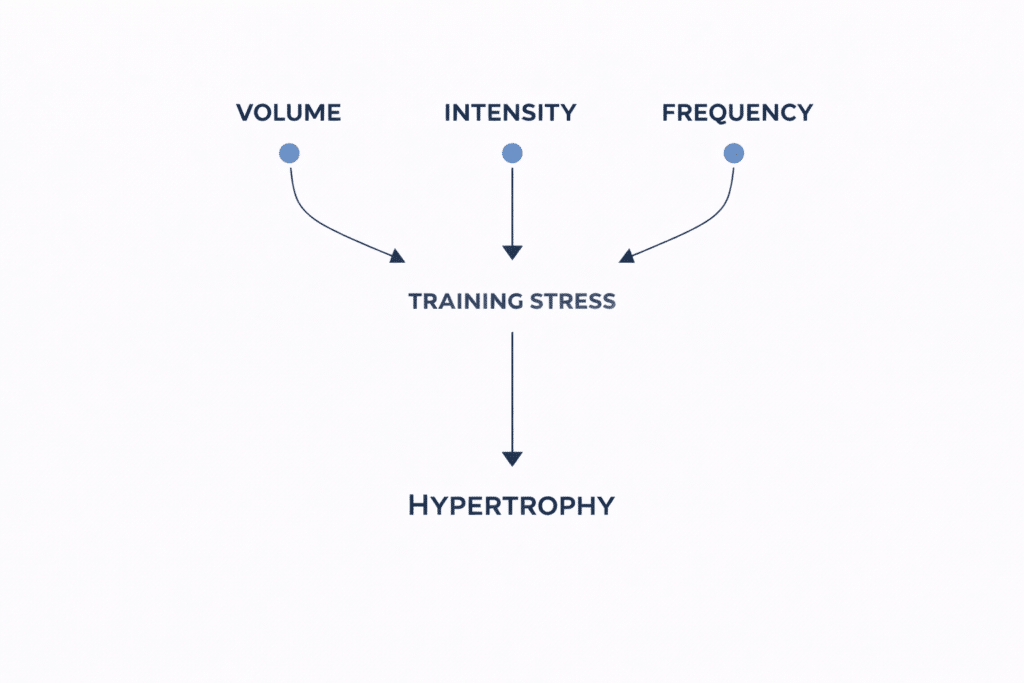
Most people don’t struggle with effort in the gym — they struggle with how their training week is structured.
They train hard, stay consistent, and push close to failure. But progress is inconsistent. Some sessions feel strong, others flat. Certain muscles recover well, while others feel constantly fatigued.
The problem is not effort. It’s structure.
A poorly designed training split makes it difficult to distribute volume, manage fatigue, and maintain performance across the week. A well-designed split does the opposite — it organizes your training so that each session contributes to progress instead of interfering with it.
This article explains how to structure your training split for hypertrophy in a way that supports consistent muscle growth.
TL;DR
- A training split determines how your weekly training is structured
- There is no single best split — only what fits your volume and recovery
- The goal is to distribute volume while maintaining performance
- Most problems come from poor fatigue management, not the split itself
- A good split supports progression, not just effort
What Is a Training Split?
A training split is how your weekly training is organized.
It determines:
- how often each muscle is trained
- how volume is distributed across sessions
- how much recovery time each muscle gets
A training split is only one part of structuring an effective program. Variables like volume, frequency, and progression must be aligned within a broader system. For a complete framework, see how to design a hypertrophy training program.
This is why training splits should be understood as part of program design, not as isolated templates.
What Is the Best Training Split for Hypertrophy?
There is no single best training split for hypertrophy.
The best split is the one that allows you to:
- perform enough weekly volume
- maintain performance across sessions
- recover consistently
This is where most lifters go wrong. They search for the “best split” instead of asking whether their current structure supports volume distribution and recovery.
A split does not create hypertrophy on its own. It either supports or limits the effectiveness of your program.
The Role of Training Splits in Hypertrophy
Training splits do not directly cause muscle growth. They influence how effectively you can apply the variables that do.
A well-structured split allows you to:
- distribute volume across multiple sessions
- maintain higher performance per set
- reduce excessive fatigue within a single workout
A poorly structured split often leads to:
- too much volume in one session
- declining performance across sets
- incomplete recovery between sessions
The difference is not the split itself, but how it manages workload across the week.
The Most Common Training Splits
Full Body
Full body splits train most muscle groups in each session, typically 3–4 times per week.
This allows for:
- high training frequency
- lower volume per session
- frequent practice of movements
Full body training works well when volume is moderate and recovery is managed properly. If this structure fits your schedule, use our complete full-body workout guide to build a practical 2- or 3-day program.
Upper / Lower
Upper/lower splits divide training into upper-body and lower-body sessions, typically performed 4 times per week.
This structure allows:
- balanced frequency
- manageable session length
- good recovery between sessions
For many lifters, this is one of the most practical and sustainable setups.
For a more detailed comparison, see full body vs upper/lower for muscle growth.
Push Pull Legs
Push pull legs splits separate training by movement patterns, often performed 5–6 times per week.
This allows:
- higher training frequency
- more specialization
- flexible volume distribution
However, it also requires:
- good recovery capacity
- consistent scheduling
For a deeper breakdown, see push/pull/legs for hypertrophy.
Body Part Split (Bro Split)
Body part splits train one muscle group per session, typically once per week.
They allow:
- high volume per session
- focus on individual muscles
But they often:
- reduce frequency
- make volume distribution less efficient
They can work, but are harder to optimize compared to higher-frequency approaches.
How to Choose the Right Training Split
The right question is not:
“What is the best training split?”
The better questions are:
- How many days can I train per week?
- How much volume do I need?
- How well do I recover?
Your training split should be built around these constraints.
A split is effective when it allows you to:
- distribute volume without excessive fatigue
- maintain performance across sessions
- recover between workouts
Key Factors That Determine Your Training Split
Frequency
Frequency determines how often each muscle is trained across the week.
Higher frequency can:
- improve performance per session
- allow better volume distribution
But only when recovery is sufficient.
Volume Distribution
Volume must be spread across the week in a way that maintains output quality.
This becomes easier to manage once you understand your minimum effective volume.
Too much volume in a single session often leads to:
- declining performance
- lower quality sets
- increased fatigue
Distributing volume across multiple sessions improves efficiency.
This is closely related to how much volume you perform per muscle group.
Recovery Capacity
Recovery determines how much training you can sustain.
Fatigue accumulates from:
- volume
- intensity
- exercise selection
This interaction between workload variables is explained in more detail in volume vs intensity for hypertrophy.
Your split must account for this.
If recovery is insufficient, performance drops and progress slows.
Fatigue management plays a central role in how well a split works.
Time and Consistency
The best split is one you can follow consistently.
A theoretically optimal plan that cannot be sustained will always underperform a simpler structure that you can execute reliably.
How Training Splits Affect Fatigue and Performance
Training splits directly influence how fatigue accumulates across the week.
If too much volume is placed in a single session:
- performance declines
- later sets become less effective
If frequency is too high without recovery:
- fatigue accumulates across sessions
- performance becomes inconsistent
A good split balances:
- session quality
- recovery
- total workload
This is what allows progression to occur over time.
Practical Framework: How to Structure Your Week
Step 1: Choose how many days you can train
Step 2: Assign muscle groups across those days
Step 3: Distribute volume across sessions
Step 4: Ensure recovery between sessions
Step 5: Adjust based on performance
This framework keeps your training structured while allowing flexibility.
Common Training Split Mistakes
Choosing a split based on preference instead of structure
Placing too much volume in a single session
Training too frequently without sufficient recovery
Changing splits too often
Focusing on the split instead of progression
Why it matters:
A training split determines how your training is organized, but more importantly, it determines whether your program is sustainable.
When your split supports volume distribution, recovery, and performance, training becomes more consistent. When it does not, progress becomes unpredictable.
The goal is not to find the perfect split, but to build a structure that allows you to train effectively over time.
FAQ
What is the best training split for hypertrophy?
There is no single best training split for hypertrophy. The best split is the one that allows you to distribute volume effectively, maintain performance, and recover between sessions.
Is push pull legs the best split for muscle growth?
Push pull legs can be very effective, especially for higher training frequency. However, it is not inherently better than other splits — its effectiveness depends on how well volume and recovery are managed.
Is upper lower better than push pull legs?
Neither is universally better. Upper/lower is often easier to recover from, while push pull legs allows more frequency and specialization. The best choice depends on your training schedule and recovery capacity.
How many days per week should you train for hypertrophy?
Most people build muscle effectively training 3–5 days per week. The goal is not to train more often, but to structure training so volume is distributed and recoverable.
Can you build muscle with a full body split?
Yes. Full body training can be very effective for hypertrophy, especially when volume is distributed properly and sessions are structured to maintain performance.
References
Schoenfeld BJ (2010). The mechanisms of muscle hypertrophy and their application to resistance training.
https://pubmed.ncbi.nlm.nih.gov/20847704/
Schoenfeld BJ et al. (2016). Dose-response relationship between weekly resistance training volume and muscle hypertrophy.
https://pubmed.ncbi.nlm.nih.gov/27433992/
Schoenfeld BJ et al. (2019). Effects of resistance training frequency on muscle hypertrophy.
https://pubmed.ncbi.nlm.nih.gov/30558493/
Grgic J et al. (2018). Effects of resistance training frequency on measures of muscle hypertrophy: A systematic review and meta-analysis.
https://pubmed.ncbi.nlm.nih.gov/29791532/