Seated Cable Row for Muscle Growth: Form, Grip & Programming
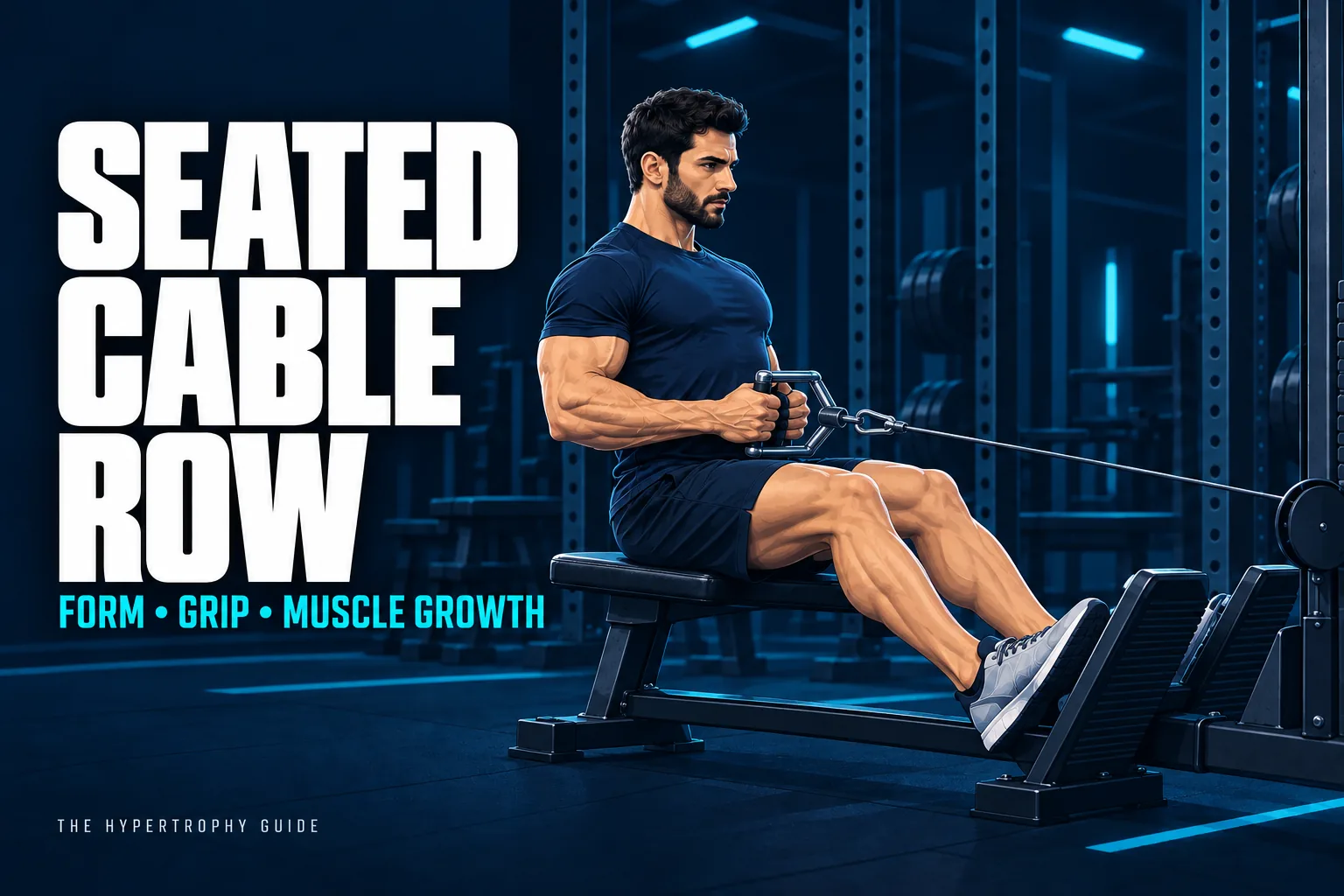
The seated cable row trains the back through a horizontal pull that is easy to adjust for different bodies and experience levels. Start with a comfortable grip, let the shoulder blades move, and use a load you can pull and return without uncontrolled swinging.
What Muscles Does the Seated Cable Row Work?
The lats help move the upper arms backward. The middle trapezius and rhomboids contribute to shoulder-blade retraction, while the rear deltoids assist at the shoulder. The elbow flexors and grip muscles also work; feeling some effort in the arms is normal.
Research comparing rows and pulldowns has measured activity in the lats, biceps and middle-back muscles. These short-term EMG measurements do not establish which grip will produce the most muscle growth over months.1
A row can complement a lat pulldown in a back routine. The movements overlap, but pull from different directions. See the exercise library for the broader selection.
How to Do a Seated Cable Row
- Set your position. Sit facing the cable, brace your feet securely and keep a slight bend in the knees. Choose a distance that allows a comfortable reach without the stack resting between every repetition.
- Find a controlled start. Reach the arms forward and allow the shoulder blades to move around the rib cage. Keep enough trunk tension to control the load.
- Pull through the elbows. Bring the handle toward the lower ribs or upper abdomen. Let the shoulder blades move back as the upper arms travel behind you.
- Finish without forcing the range. Stop at a repeatable position before you need to shrug, throw the torso backward or roll the shoulders forward to move the handle farther.
- Return deliberately. Let the arms extend and shoulder blades move forward. Control the weight rather than letting it yank you into the next repetition.
A useful rhythm is a purposeful pull followed by a controlled return. You do not need to make the lowering phase artificially slow.
Should your torso stay completely still?
A small, deliberate movement from the hips can be part of a repeatable row. It is different from using a progressively larger backward swing to finish each repetition. For a simple starting version, use a mostly stable torso and learn the shoulder and arm movement first.
A cue for learning shoulder-blade movement
Briefly imagining a coin between the shoulder blades can help you understand retraction. Then allow the shoulder blades to separate on the return. Treat this as a learning cue, not an instruction to squeeze as hard as possible or hold the shoulders down throughout the whole exercise.
Once the movement feels familiar, the arms and shoulder blades should work together rather than becoming two exaggerated, disconnected actions.
Which Grip and Elbow Position Should You Use?
Grip choice changes comfort and the path available to the upper arms. Start with a handle that lets your wrists remain comfortable and your elbows move naturally.
| Option | How to use it |
|---|---|
| Close neutral grip | Keep the elbows relatively close to the torso and pull toward the lower ribs or upper abdomen. A straightforward starting option. |
| Angled handles | Try an elbow path around 45 degrees from the torso if comfortable. Let the handle and your build guide the position. |
| Wider overhand grip | A wider elbow path emphasizes a different shoulder movement. Do not force a chest touch if it requires shrugging or excessive backward lean. |
These are ways to explore the movement, not switches that isolate the lats or upper back. Keep the setup consistent long enough to judge comfort, control and progression.
Cable Row, Chest-Supported Row or Single-Arm Row?
| Variation | Practical reason to choose it |
|---|---|
| Dedicated seated cable row | Quick setup, easy load changes and freedom to adjust your reach. |
| Bench at a cable tower | A useful alternative when there is no dedicated station. Position the pulley for a comfortable row and make sure the bench and foot position stay secure. |
| Chest-supported row | The pad provides support when you prefer to concentrate on pulling. Adjust it so it does not make the position uncomfortable or restrict breathing. |
| Single-arm cable row | Allows each arm its own path. Useful if that suits you, but slower to complete for both sides. |
Sets, Reps and Progression
Use the following as a coaching framework. Count the rows alongside the other back work in your program instead of adding sets without considering the total.
| Use | Working sets | Reps |
|---|---|---|
| Learning the movement | 2–3 | 10–12 |
| General muscle-building work | 2–3 | 8–12 |
| Heavier work with established technique | 2–3 | 6–8 |
Rest roughly two minutes initially, then adjust if breathing or fatigue prevents another controlled set. Keep a little technical reserve while learning. For established lifters, challenging sets around 1–3 reps in reserve are a practical default.
When should you add weight?
Choose a rep range. When you can reach its top across your planned sets with the same reach, finish position and control, and still have the intended reserve, try the next manageable load. If that forces a large swing or much shorter repetitions, build more capacity at the previous load.
Broader resistance-training research suggests muscle growth generally benefits from training closer to failure, while the exact best distance remains uncertain. It does not establish a seated-row-specific requirement to fail every set.2
Rows fit naturally into a full-body routine or an upper/lower split. Place them earlier when rowing performance is a priority.
Straps, Grip Fatigue and Common Mistakes
Lifting straps are worth considering when the hands consistently give out while the back could continue. They assist the grip; they do not remove the biceps from a row.
Feeling the biceps does not prove the back is inactive. Judge the movement and what ends the set, rather than demanding a perfect sensation on every repetition.
- Increasing the swing: lower the load when torso momentum replaces a controlled pull.
- Rushing the return: keep control as the arms extend.
- Shrinking the range: compare repetitions against the same start and finish positions.
- Pinning the shoulder blades: allow them to move forward during the reach.
- Forcing the handle to touch: stop at your controlled endpoint rather than distorting the shoulders to complete a touch.
Frequently Asked Questions
Should I lean forward during a cable row?
A small, controlled lean from the hips can be part of the movement. Keep it deliberate and repeatable. You do not need to chase a deep forward fold to perform an effective row.
Is neutral grip the best grip?
It is a useful starting option, not a proven universal winner. Choose a comfortable handle and elbow path that you can progress consistently.
Should the handle touch my stomach?
It may, but the exact endpoint depends on the attachment and your proportions. A repeatable pull toward the lower ribs or upper abdomen is more useful than forcing contact.
Can I replace cable rows with a chest-supported row?
Yes, when that version fits your equipment and preferences. Record it as a different exercise; the load numbers are not directly interchangeable.
References
- Lehman GJ, et al. Variations in muscle activation levels during traditional latissimus dorsi weight training exercises: an experimental study. Dynamic Medicine. 2004. Read study.
- Robinson ZP, et al. Exploring the dose-response relationship between estimated resistance training proximity to failure, strength gain, and muscle hypertrophy: a series of meta-regressions. Sports Medicine. 2024. Read analysis.